
This list ranks roller coasters by theoretical hourly capacity — the number of riders a coaster can move through the line per hour when it’s running at full efficiency. It’s the throughput number operations teams use to size queues and estimate wait times, and it comes down to how many people fit in a train, how many trains are running at once, and how fast the ride can dispatch and reset between cycles.
The top spot belongs to Gemini at Cedar Point, a racing coaster that runs two trains per side and moves 3,300 riders per hour — the highest capacity of any coaster operating today. The next-highest entry, The Racer at Kings Island, tops out at 2,640 riders per hour. From there, the list settles into a tight band: everything from #2 down to #25 sits between roughly 1,700 and 2,640 riders per hour, which is the range where most classic steel and wooden coasters actually operate.
Gemini’s Racing Layout Leads the Field
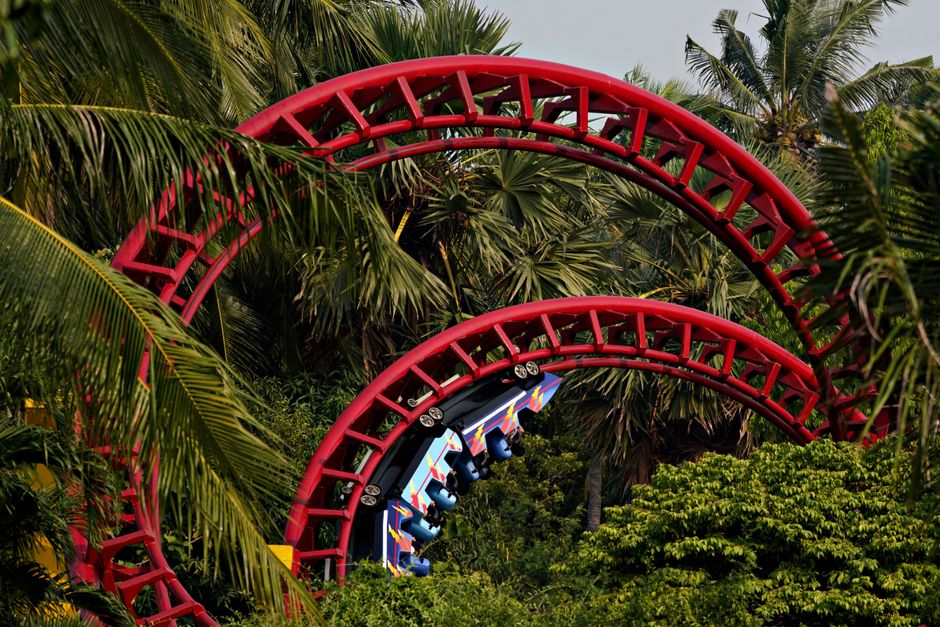
At 3,300 riders per hour, Gemini at Cedar Point earns the #1 spot the old-fashioned way: it’s a racing coaster with two parallel tracks, each running two trains, so the station is effectively dispatching four trains’ worth of riders at once. That dual-track format is capacity engineering at its simplest, and it has kept the 1978 classic at the top of the throughput charts for decades.
The rest of the top five is a much more familiar story. The Racer at Kings Island, Cedar Creek Mine Ride, Dahlonega Mine Train, and Big Thunder Mountain at Disneyland Paris all land within a few hundred riders per hour of each other, clustered between roughly 2,160 and 2,640. That’s the kind of capacity you get from coasters running multiple trains on a well-tuned dispatch cycle — strong, but still short of Gemini’s dual-track output.
| # | Name | riders/hr | opened |
|---|---|---|---|
| 1 | Gemini | 3300 | 1978 |
| 2 | The Racer | 2640 | 1972 |
| 3 | Cedar Creek Mine Ride | 2400 | 1969 |
| 4 | Dahlonega Mine Train | 2200 | 1967 |
| 5 | Big Thunder Mountain | 2160 | 1992 |
| 6 | Viper | 2100 | 1982 |
| 7 | Expedition Everest | 2050 | 2006 |
| 8 | Runaway Mine Train | 2010 | 1966 |
| 9 | Flight of Fear | 2000 | 1996 |
| 10 | Lisebergbanan | 2000 | 1987 |
| 11 | Star Wars Hyperspace Mountain | 1980 | 2017 |
| 12 | Space Fantasy – The Ride | 1920 | 2010 |
| 13 | The Incredible Hulk Coaster | 1920 | 1999 |
| 14 | De Vliegende Hollander | 1900 | 2007 |
| 15 | Oblivion: The Black Hole | 1890 | 2015 |
| 16 | Alpengeist | 1820 | 1997 |
| 17 | American Eagle | 1800 | 1981 |
| 18 | Jaguar! | 1800 | 1995 |
| 19 | Max & Moritz | 1800 | 2020 |
| 20 | Nitro | 1800 | 2001 |
| 21 | Road Runner Express | 1800 | 1997 |
| 22 | Gold Rusher | 1750 | 1971 |
| 23 | Joris en de Draak | 1750 | 2010 |
| 24 | Blue Fire Megacoaster | 1720 | 2009 |
| 25 | Katun | 1700 | 2000 |
How Riders-Per-Hour Capacity Actually Works
Hourly capacity comes down to three things: how many seats are in a train, how many trains are running the circuit at once, and how quickly the ride can load, dispatch, and get the next train back into the station. Coasters running three or four trains with fast, efficient load platforms post big capacity numbers even without a huge vehicle — that’s why several mine train-style coasters on this list, like Dahlonega Mine Train and Runaway Mine Train, punch above their size.
For riders, a high capacity number translates directly into a shorter wait. A coaster moving 2,000-plus riders an hour eats through a queue far faster than one running a single train with a slow reset, even if the two rides last the same length of time. It’s one of the few stats where the number on paper maps almost exactly onto the experience of standing in line.
What Stands Out Further Down the List
Once you get past the top handful, the list is dominated by long-running, well-established coasters rather than the newest builds — Viper at Six Flags Darien Lake, Alpengeist, and Nitro have all been moving big crowds for years, and their capacity numbers show why they’ve stayed in rotation. Mine train coasters make a particularly strong showing, with Cedar Creek Mine Ride, Dahlonega Mine Train, Runaway Mine Train, and Gold Rusher at Six Flags Magic Mountain all cracking the top 25 — a reminder that a simple, fast-cycling ride format can out-throughput flashier attractions. Flight of Fear — the twin launch coasters at Kings Island and Kings Dominion — hits an even 2,000 riders per hour, while family rides like Jaguar! at Knott’s Berry Farm and Road Runner Express at Six Flags Fiesta Texas keep pace at 1,800. One note on Star Wars Hyperspace Mountain: the commonly quoted 2,400 riders per hour is a theoretical figure — its realistic sourced capacity is closer to 1,980.
Explore more: browse more roller coasters.
Build a working coaster on the kitchen table and learn why the first drop has to be the tallest. A good gift for young coaster fans.
Over 3,700 pieces, a real vertical loop and a working chain lift. Display it on a shelf in the coaster room.
Rub-on sunscreen that fits in a pocket — reapply in the queue without greasy hands on the lap bar.
Highest-Capacity Roller Coasters FAQs
What roller coaster has the highest hourly capacity?
Gemini at Cedar Point, with a capacity of 3,300 riders per hour — its racing layout runs two trains per side, giving it the highest throughput of any coaster operating today.
How is roller coaster capacity measured?
As riders per hour, based on how many seats are in each train, how many trains run the circuit at once, and how quickly the ride can dispatch and reset between cycles.
Does higher capacity mean a shorter wait in line?
Generally yes — coasters with higher riders-per-hour capacity move queues faster, so all else being equal you’ll wait less than you would for a lower-capacity ride facing similar demand.
Get More from Highest-Capacity Roller Coasters
Log the coasters, stadiums, and venues you’ve experienced, rate Highest-Capacity Roller Coasters, and see what your friends thought. Get the ThrillZing app.
Photo by Tony Rojas on Pexels.