
This list ranks currently operating roller coasters by their peak g-force — the maximum force riders feel pressed into their seat or harness at any single point on the ride, measured in multiples of Earth’s gravity (g). It’s a different metric than speed or height: a coaster doesn’t need to be tall or fast to rank here, it just needs a tight, abrupt change of direction somewhere in its layout.
On paper, the g-force king is still Shock Wave at Six Flags Over Texas, whose 5.9g remains a clear step above everything else ever measured on this list. But Shock Wave has been standing but not operating since early 2026, so the operating crown passes to the Vekoma Boomerang family: ten coasters tied at exactly 5.2g, followed by another eight tied at exactly 5g. That clustering isn’t a coincidence — as the sections below explain, it’s mostly the fingerprint of one ride model repeated at parks around the world.
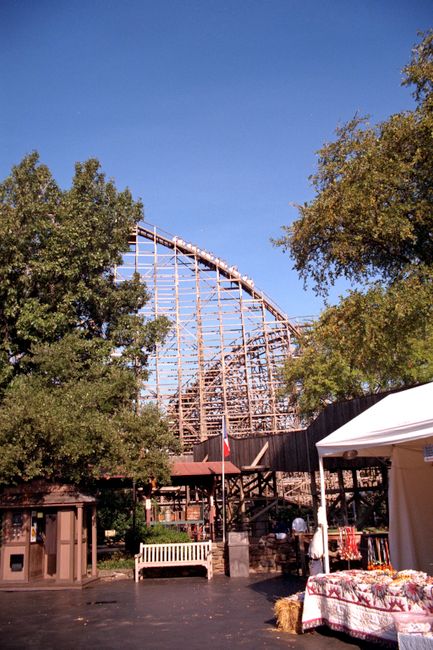
Shock Wave: The King on Paper
Shock Wave, at Six Flags Over Texas, still holds the record on paper at 5.9g — noticeably ahead of the 5.2g cluster that tops this list. But the ride has been standing but not operating since early 2026, which is why it no longer appears in the rankings above: this list only counts coasters you can actually ride. Its signature is a pair of back-to-back vertical loops, a layout that dates to 1978, well before computer-optimized track design became the industry norm.
That vintage matters for g-force. Older steel loopers were built with circular loops of a fairly constant radius, rather than the teardrop-shaped clothoid loops modern designers use to spread the force out gradually. A tighter, more constant-radius loop concentrates the direction change into a shorter span of track, which is exactly what produces a sharper g spike. It’s part of what gave Shock Wave its reputation as one of the more jarring, old-school rides in the business — a reputation on pause while the ride sits idle.
| # | Name | g | opened |
|---|---|---|---|
| 1 | Boomerang: Coast to Coaster | 5.2 | 1998 |
| 2 | Cobra | 5.2 | 2001 |
| 3 | Euro-Star | 5.2 | 2019 |
| 4 | Jolly Rancher Remix | 5.2 | 1991 |
| 5 | Olympia Looping | 5.2 | 1989 |
| 6 | Sea Serpent | 5.2 | 1984 |
| 7 | Space Shuttle | 5.2 | 1995 |
| 8 | Speed of Sound | 5.2 | 2000 |
| 9 | The Flying Cobras | 5.2 | 2009 |
| 10 | Zoomerang | 5.2 | 1997 |
| 11 | Diving Machine G5 | 5 | 2000 |
| 12 | Flying Aces | 5 | 2016 |
| 13 | Rock ‘n’ Roller Coaster Starring The Muppets | 5 | 1999 |
| 14 | Skyrush | 5 | 2012 |
| 15 | Storm Runner | 5 | 2004 |
| 16 | Taiga | 5 | 2019 |
| 17 | The Oath of Kärnan | 5 | 2015 |
| 18 | Typhoon | 5 | 2004 |
| 19 | Colossus the Fire Dragon | 4.9 | 1983 |
| 20 | The Great American Revolution | 4.9 | 1976 |
How G-Force Actually Works on a Coaster
A g-force reading describes acceleration, not speed — it’s a measure of how hard and how quickly your direction of travel is changing. Positive g’s press you down into your seat through loops and the bottoms of dips; negative g’s are the floaty, out-of-your-seat feeling on the way over a hill; lateral g’s push you sideways through unbanked or flat turns. The numbers on this list are all peak positive g, the hardest single squeeze a rider feels anywhere on the ride.
What keeps a 5-6g coaster ride safe rather than punishing is duration. In the US, designers work within ASTM F2291, which caps sustained positive vertical g well below what’s allowed for a split-second peak. A coaster’s top g figure typically lasts under a second — closer to a hard jolt than the sustained multi-second loads a fighter pilot trains for — which is why riders don’t need a G-suit to handle it, even at the top of this list.
Why So Many Coasters Tie at 5.2g
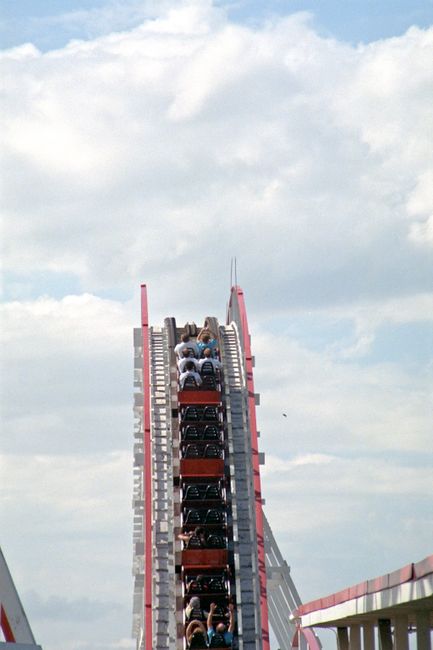
Ten of the coasters here — Boomerang: Coast to Coaster, Cobra (the shuttle looper at Walibi Belgium), Euro-Star, Jolly Rancher Remix (Hersheypark’s freshly renamed Sidewinder), Olympia Looping, Sea Serpent, Space Shuttle, Speed of Sound, The Flying Cobras, and Zoomerang — share the top spot at 5.2g, and most of them are essentially the same ride wearing different names: installations of Vekoma’s Boomerang, a compact shuttle coaster that launches trains backward and forward through a cobra roll and a vertical loop. Vekoma built dozens of them at parks worldwide starting in the 1980s, and because the layout and trains are near-identical from park to park, so is the g-force. If you’ve ridden one Boomerang, you’ve felt roughly what the whole tier delivers. The 5g tier below it is a more varied group — launch coasters like Storm Runner, hypercoasters like Skyrush, Euro-Fighters like Typhoon at Bobbejaanland, and dark-ride-style launches like Rock ‘n’ Roller Coaster Starring The Muppets — different technology converging on the same number, likely because 5g sits close to where safety standards and rider comfort both draw a natural line.
Explore more: browse more roller coaster rankings.
Highest G-Force Coasters FAQs
What roller coaster has the highest g-force?
On paper, Shock Wave at Six Flags Over Texas holds the record at 5.9g through its back-to-back vertical loops — but it has been standing but not operating since early 2026. Among coasters currently running, the crown belongs to the Vekoma Boomerang family, ten installations worldwide each pulling 5.2g.
Is 5g on a roller coaster dangerous?
Not for most healthy riders. Coaster g-forces in this range last under a second, unlike the sustained multi-second loads that make high-g flight dangerous, and US ride design follows ASTM F2291, which limits how much sustained positive g a coaster can put on riders.
Why do so many coasters have the exact same g-force rating?
Most of the coasters tied at 5.2g are the same ride: Vekoma’s Boomerang model, sold to parks worldwide under different names like Cobra, Jolly Rancher Remix, and Zoomerang. Same layout and trains, same g-force.
Get More from Highest G-Force Coasters
Log the coasters, stadiums, and venues you’ve experienced, rate Highest G-Force Coasters, and see what your friends thought. Get the ThrillZing app.
Photo by ROBERT MORROW on Pexels.
Related: Roller Coaster G-Force: How Many Gs, Max & Human Limits