
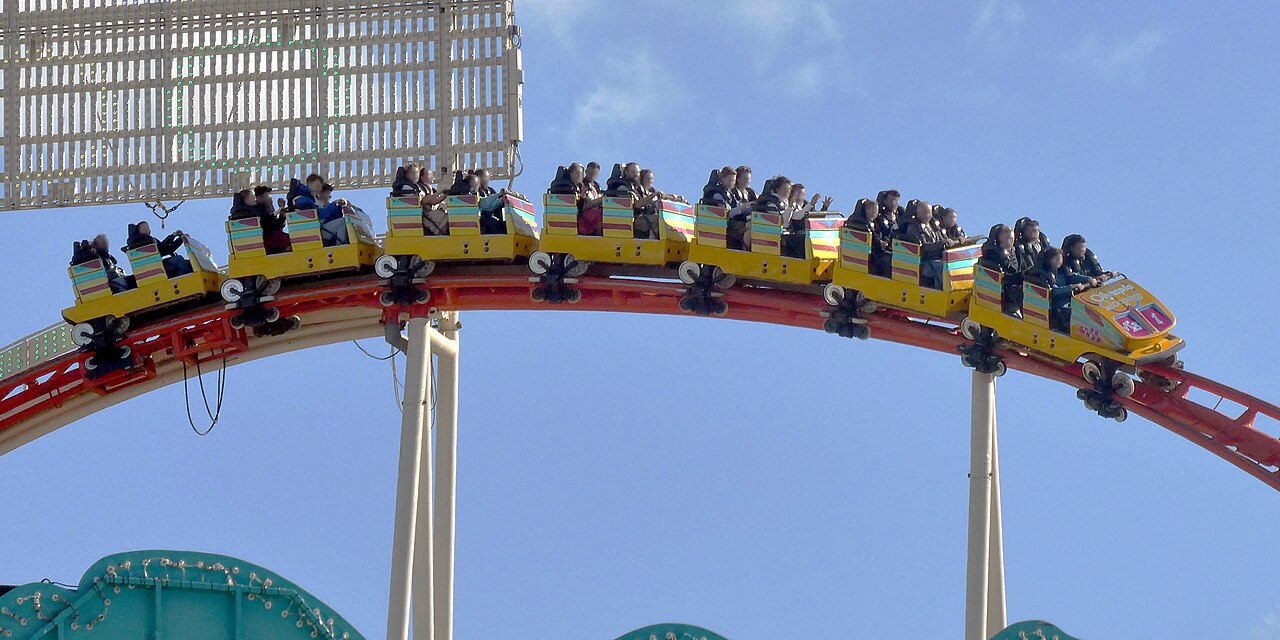
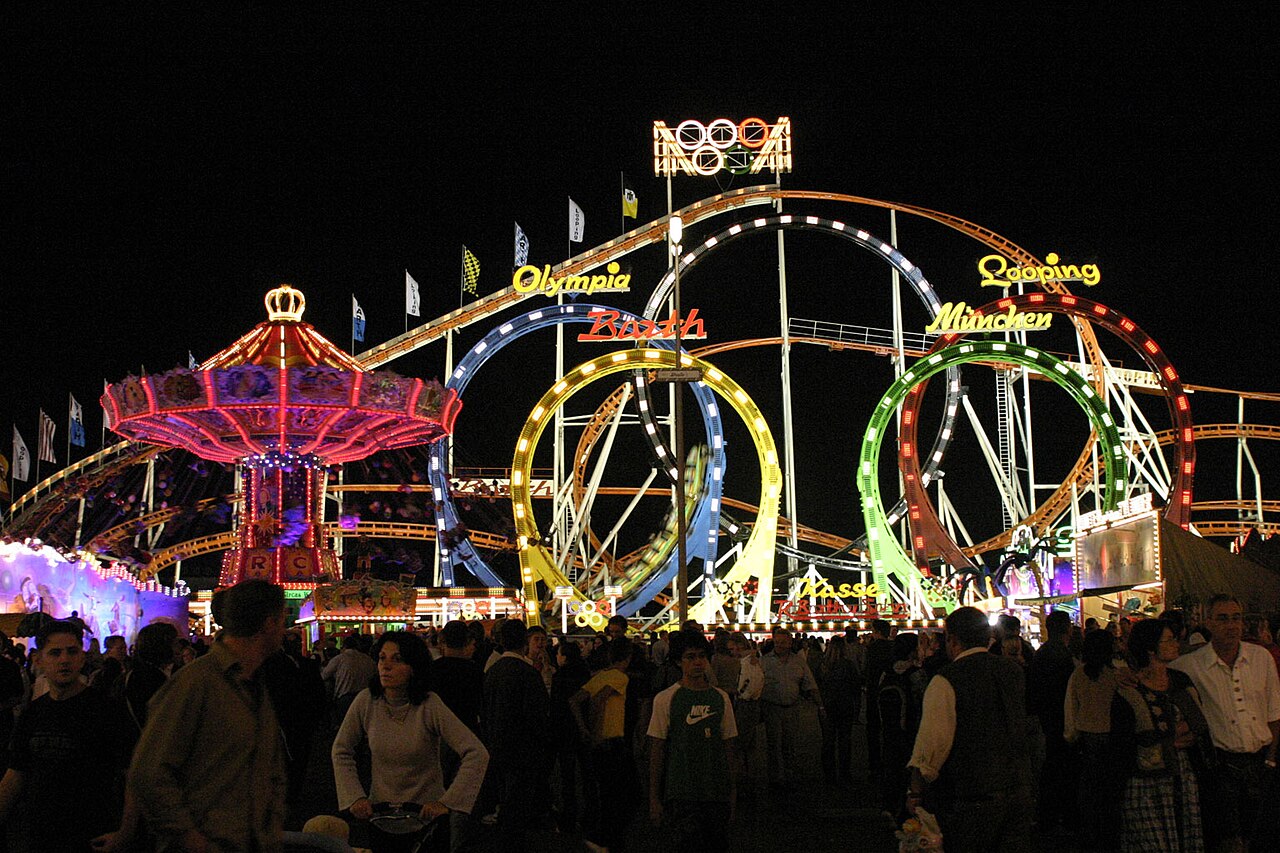
Most roller coasters live in one place for their entire lives. Olympia Looping does not. The world’s largest portable roller coaster travels the German fair circuit every year — most famously to Munich’s Oktoberfest, where it made its debut in 1989 and has been the skyline of the Theresienwiese ever since. Designed by the legendary Anton Schwarzkopf with engineering by Werner Stengel, it remains the only traveling coaster on Earth with five inversions.
Key Stats
| Height | 34 m (112 ft) |
| Drop | 30 m (98 ft) |
| Speed | 84 km/h (52 mph) |
| Length | 1,250 m (4,101 ft) |
| Inversions | 5 vertical loops |
| Max g-force | 5.2 g |
| Ride time | 1:45 |
| Designers | Anton Schwarzkopf & Werner Stengel (built by BHS) |
| Debut | September 17, 1989 (Oktoberfest, Munich) |
| Owner | R. Barth und Sohn Schaustellerbetriebe KG |
The Oktoberfest Icon
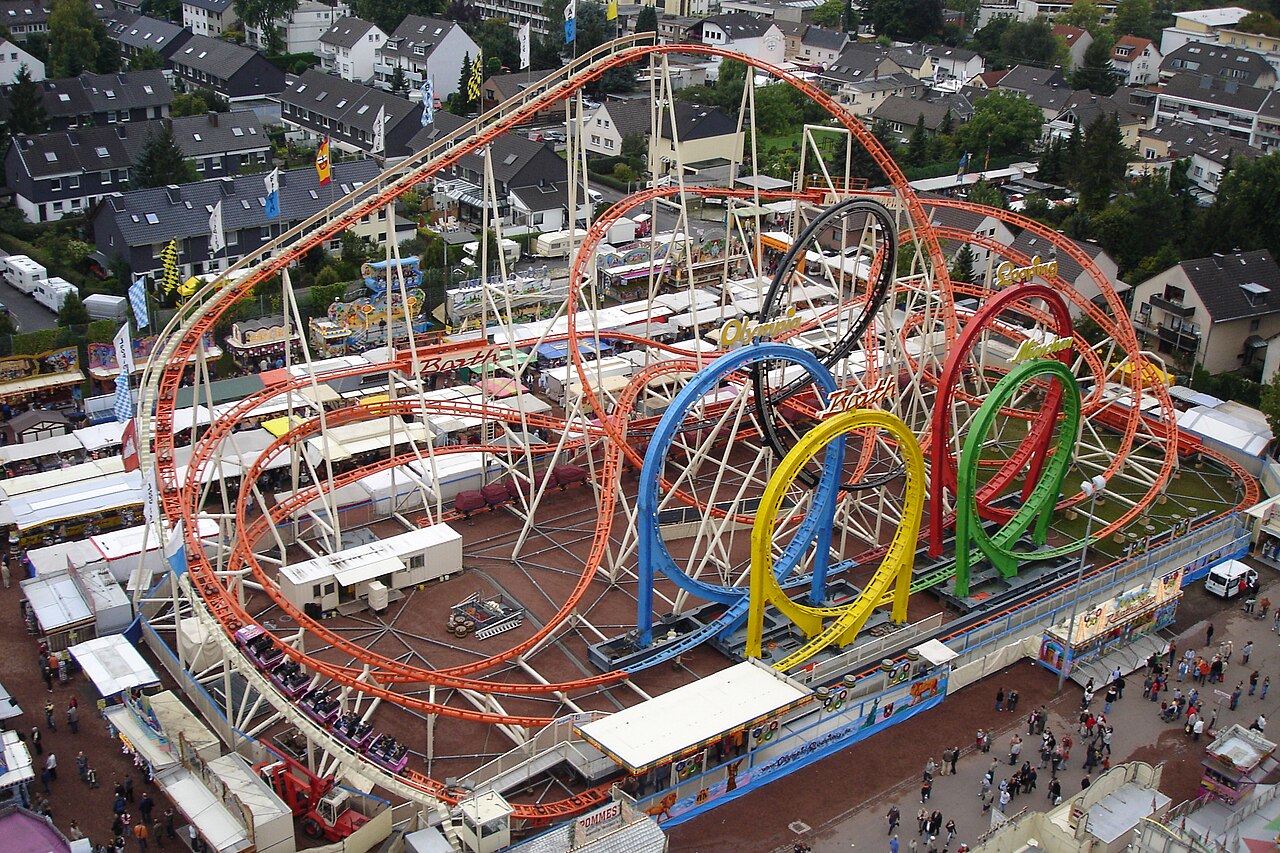
Olympia Looping is owned and operated by the Barth family’s traveling amusement business and was conceived as the follow-up to Schwarzkopf’s earlier traveling loopers, Doppel Looping and Dreier Looping — during design it was simply called Fünfer Looping (“five loops”). Its finished name comes from the obvious visual gag: the five vertical loops are painted and arranged to echo the Olympic rings.
The entire structure weighs about 900 metric tonnes and needs a footprint 85 meters wide by 36 meters deep, yet it is assembled and torn down season after season. Since 2016 it has also appeared at London’s Hyde Park Winter Wonderland under the name Munich Looping, a rebrand chosen to sidestep Olympic references after the 2012 London Games and to fit the event’s Bavarian theme.
Ride Experience
The train turns 180 degrees while climbing the 34-meter lift hill, then dives into the first drop and immediately hits the first loop. A sharp 180-degree turn leads into two back-to-back vertical loops, followed by a climb into the mid-course brake run — itself a small lift hill. From there the train drops through two half-helix elements into the final pair of back-to-back loops, hits a block brake, and winds through full helixes past the on-ride camera to the final brakes. Trains usually run with five cars, but at high-capacity events like Oktoberfest and Winter Wonderland the Barths add two more for seven-car trains.
Records and Forces
Olympia Looping’s loops are shaped closer to circular than the flattened clothoid loops on most modern coasters, and the payoff is intensity: riders pull up to 5.2 g, a figure that puts this fairground machine in the same conversation as the highest g-force roller coasters in the world. It also ranked as high as 14th in Mitch Hawker’s worldwide steel coaster poll (1999). It holds two standing records: largest portable roller coaster on Earth, and the only portable coaster with five inversions.
FAQ
Where can you ride Olympia Looping?
It travels the German funfair circuit, most reliably appearing at Munich’s Oktoberfest each fall. It has also been a fixture at Hyde Park Winter Wonderland in London (as Munich Looping) since 2016, and has visited Vienna’s Prater.
How intense is Olympia Looping?
Very. Its near-circular loops generate up to 5.2 g — stronger than almost any modern looping coaster. See how that compares on our highest g-force coasters ranking.
Who built Olympia Looping?
It was designed by Anton Schwarzkopf with layout engineering by Werner Stengel and fabrication by BHS, debuting at Oktoberfest on September 17, 1989.
Photo: Stefan Scheer via Wikimedia Commons (CC BY-SA 3.0)