
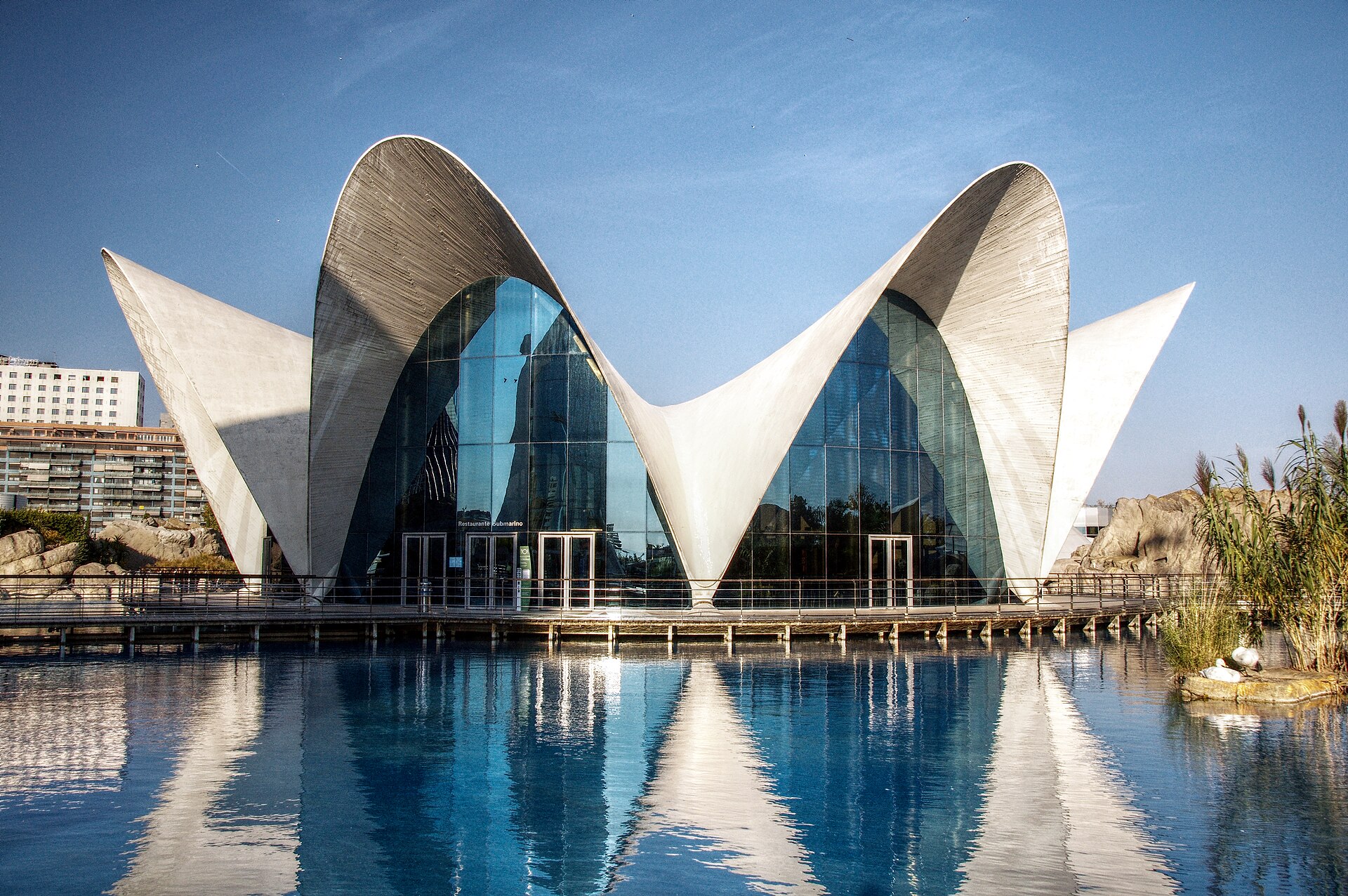
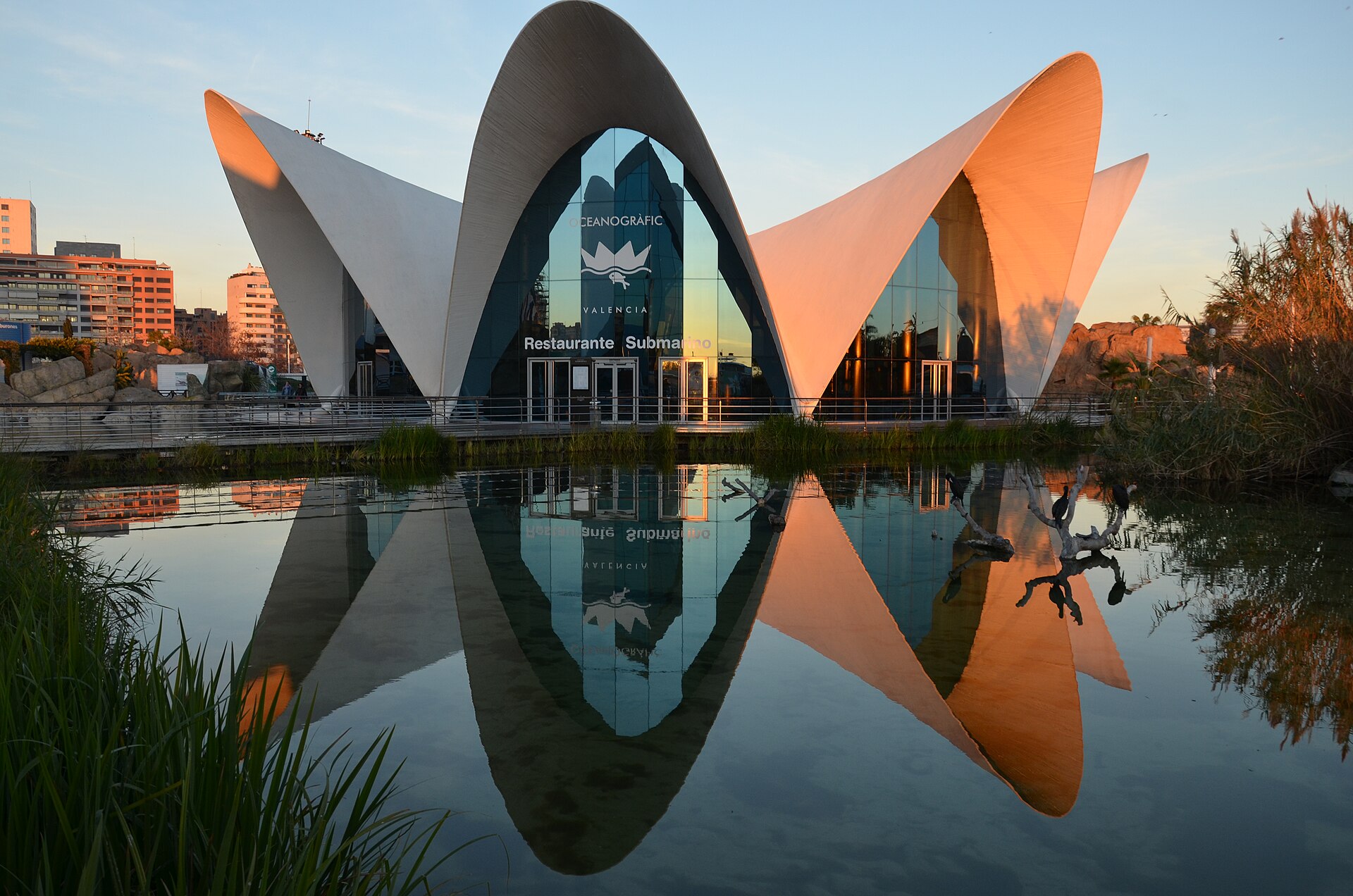
L’Oceanogràfic is a vast oceanarium in Valencia, Spain, forming part of the City of Arts and Sciences complex in the dried-up bed of the Turia River. Opened on February 14, 2003, it was designed by architect Félix Candela, with structural engineering by Alberto Domingo and Carlos Lázaro, and is instantly recognizable for its cluster of nine two-tiered underwater towers linked by tunnels and a striking hyperbolic paraboloid roof over the entrance building.
Billed as the largest aquarium complex of its kind in Europe, L’Oceanogràfic is home to more than 27,000 animals representing around 750 species across habitats modeled on the Mediterranean, the Arctic, temperate and tropical seas, and the Red Sea. Its facilities include a large dolphinarium, an underwater restaurant set inside one of the main tanks, and exhibits dedicated to sharks, penguins, sea lions, and beluga whales, drawing more than a million visitors a year to Valencia.
Stats at a Glance
- Location: Valencia, Spain
- Opened: February 14, 2003
- Size: About 110,000 square meters (27 acres)
- Water Capacity: 42 million liters (largest tank: 7 million liters)
- Species/Animal Count: More than 27,000 animals, around 750 species
- Annual Visitors: Over 1 million
- Famous for: Europe’s largest oceanarium complex and its Félix Candela-designed roof
A Landmark of Modern Architecture
L’Oceanogràfic anchors the eastern end of the City of Arts and Sciences, a futuristic cultural complex designed largely by Santiago Calatrava. While Calatrava shaped the wider complex, the oceanarium itself was the final project of renowned architect Félix Candela, known for his pioneering work with thin concrete shells. The entrance pavilion’s sweeping hyperbolic paraboloid roof, evoking a water lily or open shell, has made the building an architectural attraction in its own right, distinct from the marine exhibits inside.
Exploring the Marine Habitats
Visitors move through a series of themed zones connected by underwater tunnels, each recreating a distinct marine ecosystem, from Mediterranean coastal waters to Arctic ice and tropical reefs. Highlights include a dolphinarium used for both public shows and educational presentations, extensive shark tanks, and colonies of penguins and sea lions. The complex has also participated in marine conservation and research efforts, including rescue programs for stranded sea turtles and other animals along the Spanish coast.
Explore more: Explore more top zoos and aquariums.
A stick means no greasy hands. Reapply quickly between the penguins and the giraffes.
Let them photograph their own favorite animals — and keep your phone in your pocket.
Hauls kids, coolers and souvenirs across a big zoo or park, folds flat for the trunk.
L’Oceanogràfic FAQs
Where is L’Oceanogràfic located?
It is located in Valencia, Spain, within the City of Arts and Sciences complex, built in the former bed of the Turia River.
When did L’Oceanogràfic open?
It opened to the public on February 14, 2003.
How many animals live at L’Oceanogràfic?
The oceanarium is home to more than 27,000 animals representing around 750 species, housed across 42 million liters of water.
Get More from L’Oceanogràfic
Log the coasters, stadiums, and venues you’ve experienced, rate L’Oceanogràfic, and see what your friends thought. Get the ThrillZing app.
Photo: Holger Uwe Schmitt / CC BY-SA 4.0, via Wikimedia Commons.