
U.S. Bank Stadium opened on July 22, 2016 in downtown Minneapolis, Minnesota, as the new home of the Minnesota Vikings of the National Football League. Built at a cost of $1.061 billion, the stadium replaced the Hubert H. Humphrey Metrodome and was designed by HKS, Inc. Its sharp, angular silhouette—inspired by Nordic vernacular architecture—immediately established it as one of the most visually distinctive venues in American sports.
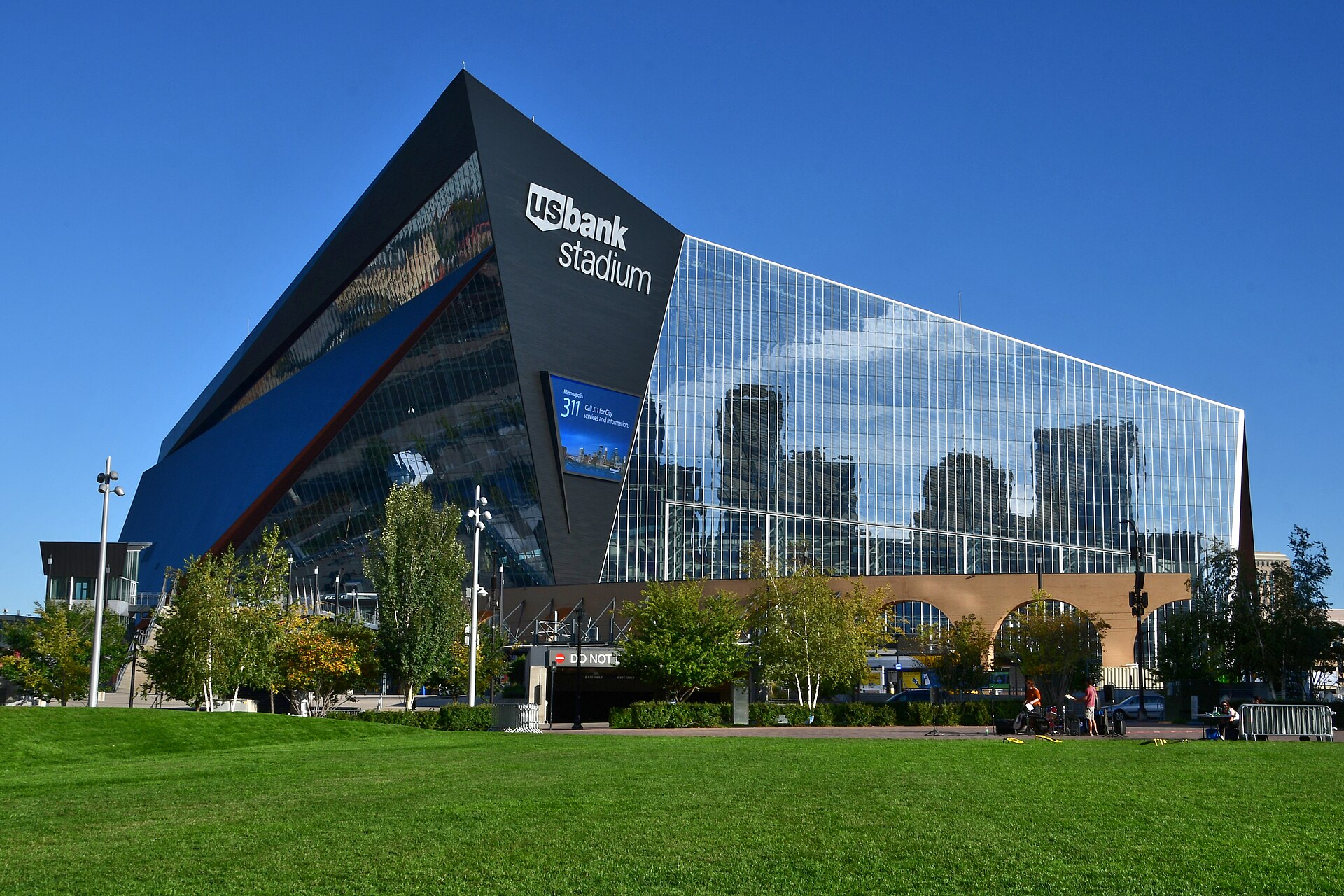
Seating 66,202 fans with expansion capability to approximately 73,000, U.S. Bank Stadium set a new benchmark for indoor NFL venues. The stadium won the best completed sport building at the 2017 World Architecture Festival, and in its first decade hosted some of the biggest events in American sports, from Super Bowl LII in 2018 to the 2019 NCAA Men’s Basketball Final Four, cementing its status as a premier multi-use arena.
Stats at a Glance
- Team(s): Minnesota Vikings (NFL)
- Location: 401 Chicago Avenue, Minneapolis, Minnesota
- Opened: July 22, 2016
- Capacity: 66,202 (expandable to ~73,000)
- Construction Cost: $1.061 billion
- Architect: HKS, Inc.
- Roof: Translucent ETFE (first in a U.S. stadium), 240,000 sq ft
- Notable Honor: Best Completed Sport Building, 2017 World Architecture Festival
A Groundbreaking Design
U.S. Bank Stadium’s most celebrated innovation is its roof, constructed from translucent ETFE (ethylene tetrafluoroethylene) plastic spanning 240,000 square feet—the first of its kind in any American stadium. The material floods the interior with natural daylight while shielding fans from Minneapolis winters, eliminating the cave-like atmosphere of its predecessor, the Metrodome.
Equally dramatic is the Legacy Gate, a facade of five enormous pivoting glass doors ranging from 75 to 95 feet tall. These doors open to connect the stadium concourse with the adjacent plaza on event days, dissolving the boundary between the city and the game. The overall form, with its steeply pitched roofline, draws consciously from Scandinavian architectural tradition—fitting for a city with deep Nordic heritage.
World-Class Events
On February 4, 2018, U.S. Bank Stadium hosted Super Bowl LII, drawing 67,612 fans as the Philadelphia Eagles defeated the New England Patriots 41–33. The game reached roughly 103 million television viewers worldwide and became the first Super Bowl designated a ‘Zero Waste’ event, with 91% of waste recycled or composted.
In April 2019, the stadium welcomed the NCAA Division I Men’s Basketball Final Four, setting a venue attendance record of 72,711 for the championship game in which the Virginia Cavaliers claimed their first national title. The stadium also hosted X Games Minneapolis from 2017 to 2019, further demonstrating its versatility as one of the most active large-scale event venues in the United States.
Explore more: Explore more stadiums on ThrillZing.
For late-season football, outdoor hockey and October park nights. Shake, pocket, and stay warm for hours.
12 x 10.5 x 6 in. — built to the common stadium clear-bag size. Check your venue's rules.
USB-charged warmers for cold night games — no disposable packets.


U.S. Bank Stadium FAQs
What NFL team plays at U.S. Bank Stadium?
U.S. Bank Stadium is the home of the Minnesota Vikings of the National Football League. The Vikings have played there since the stadium opened in July 2016, after spending two seasons at Huntington Bank Stadium while their new home was under construction.
Has U.S. Bank Stadium hosted a Super Bowl?
Yes. U.S. Bank Stadium hosted Super Bowl LII on February 4, 2018, where the Philadelphia Eagles defeated the New England Patriots 41–33. It was also notable as the first ‘Zero Waste’ Super Bowl, with 91% of event waste recycled or composted.
What makes U.S. Bank Stadium’s roof unique?
The stadium features the first ETFE (ethylene tetrafluoroethylene) translucent plastic roof ever installed in a U.S. sports stadium. Spanning 240,000 square feet, it allows natural light to fill the interior while providing full protection from the elements—a major departure from the opaque, climate-controlled dome it replaced.
Get More from U.S. Bank Stadium
Log the coasters, stadiums, and venues you’ve experienced, rate U.S. Bank Stadium, and see what your friends thought. Get the ThrillZing app.
Photo: August Schwerdfeger / CC BY 4.0, via Wikimedia Commons.