
The Minneapolis Auditorium opened its doors on June 4, 1927, as one of the Twin Cities’ grandest gathering spaces, a brick-and-steel hall built across roughly two city blocks of downtown Minneapolis. With seating for about 10,000 spread across its floor, balcony, and stage, the venue was designed to handle everything from conventions and trade shows to sporting events and touring concerts, making it a civic centerpiece for more than sixty years.
Its basketball legacy is what cemented the Auditorium’s place in sports history. The Minneapolis Lakers, led by George Mikan, called the arena home from 1947 to 1959, winning multiple championships before the franchise eventually relocated to Los Angeles. The building later added a massive Convention Hall wing in 1965 to compete with newer facilities, but changing times caught up with it, and the Auditorium closed and was torn down in 1989.
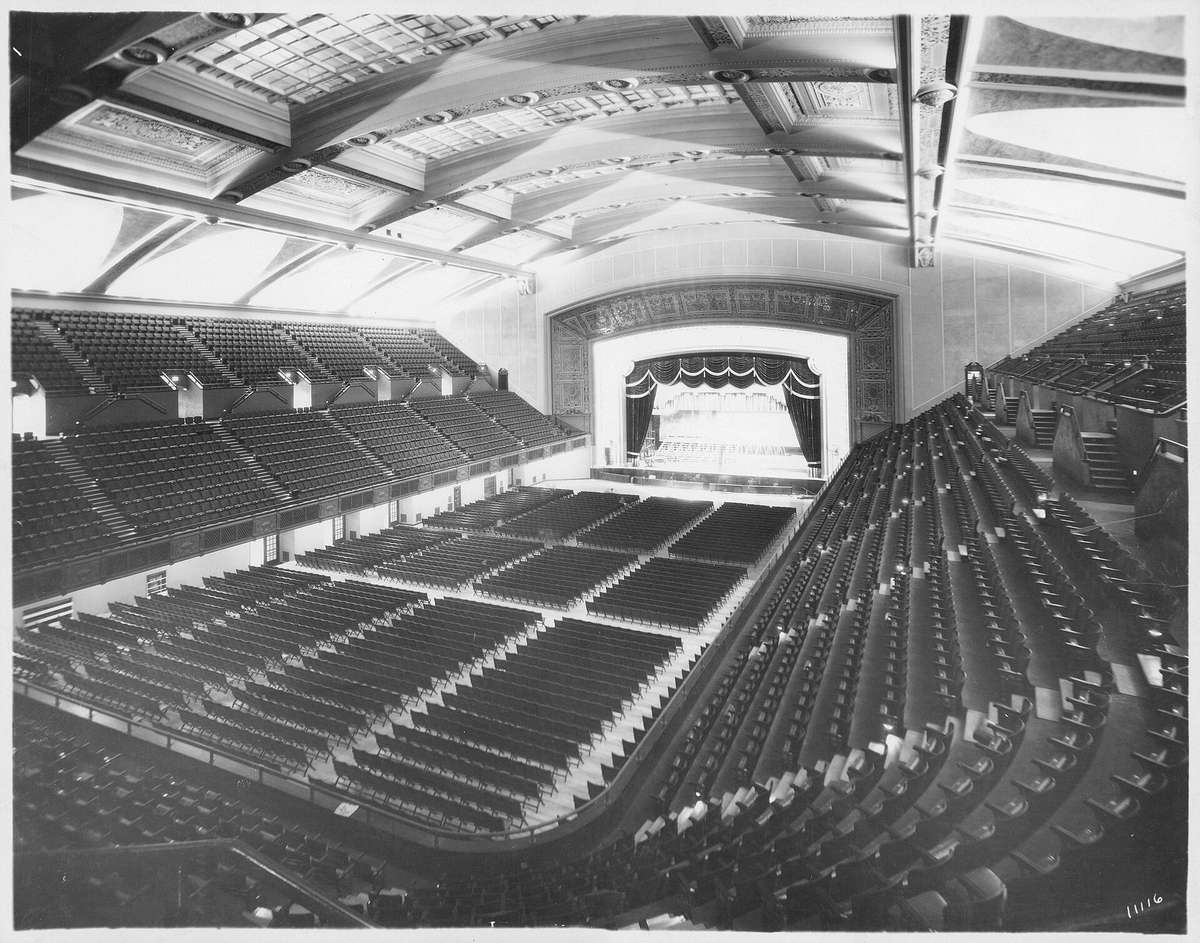
- Los Angeles Lakers played here 1947–1959. See every Lakers arena →
Stats at a Glance
- Location: Minneapolis, Minnesota
- Opened: June 4, 1927
- Demolished: 1989
- Capacity: About 10,000 (plus 12,000 more in the 1965 Convention Hall addition)
- Primary Tenant: Minneapolis Lakers (NBL/BAA/NBA), 1947-1959
- Notable Fact: Replaced by the Minneapolis Convention Center on the same site
Home of the Lakers Dynasty
Long before the Lakers meant Los Angeles, the Minneapolis Auditorium was their first true home court. With George Mikan dominating the paint, the franchise won five championships across the NBL, BAA, and NBA between 1947 and 1954, drawing crowds that packed the Auditorium’s floor and balcony seating. The team continued playing there until 1959, when it shifted games to the nearby Minneapolis Armory, setting the stage for the eventual move west in 1960.
Beyond basketball, the Auditorium hosted touring concerts, boxing matches, and the short-lived Minnesota Fillies of the Women’s Professional Basketball League in 1980-81, giving the building a layered sports and entertainment history spanning multiple generations of Minneapolis fans.
Expansion, Decline, and Demolition
By the early 1960s, the original Auditorium was struggling to compete with newer, larger venues, so the city added a 100,000-square-foot Convention Hall wing capable of holding roughly 12,000 additional people, which opened in September 1965. The expansion bought the building time, but the opening of the Met Center in Bloomington in 1967 drew away major sporting events for good.
The Auditorium’s final act came on February 26, 1988, with a farewell concert by Marie Osmond. The following year, crews demolished the building to clear the site for the Minneapolis Convention Center, which still stands on the same downtown footprint today.
Explore more: Explore more historic stadiums.
For upper-deck seats. Watch line play at the stadium, or the far side of the park from the top of a lift hill.
Sherpa-lined and windproof, with a waterproof back for wet bleachers. Folds into its own pouch.
For late-season football, outdoor hockey and October park nights. Shake, pocket, and stay warm for hours.
Minneapolis Auditorium FAQs
What replaced the Minneapolis Auditorium?
The site was redeveloped into the Minneapolis Convention Center after the Auditorium was demolished in 1989.
Which NBA team played at the Minneapolis Auditorium?
The Minneapolis Lakers, led by George Mikan, played there from 1947 to 1959, winning multiple championships before later relocating to Los Angeles.
How many people could the Minneapolis Auditorium hold?
The original hall seated about 10,000 people, and a 1965 Convention Hall expansion added capacity for roughly 12,000 more.
Get More from Minneapolis Auditorium
Log the coasters, stadiums, and venues you’ve experienced, rate Minneapolis Auditorium, and see what your friends thought. Get the ThrillZing app.
Photo: This work is in the public domain in the United States because it was published in the United States between 1931 and 1977, inclusive, without a copyright notice. For further explanation, see Commons:Hirtle chart as well as a detailed definition of “publication” for public art. Note that it may still be copyrighted in jurisdictions that do not apply the rule of the shorter term for US works (depending on the date of the author’s death), such as Canada (50 p.m.a.), Mainland China (50 p.m.a., not Hong Kong or Macao), Germany (70 p.m.a.), Mexico (100 p.m.a.), Switzerland (70 p.m.a.), and other countries with individual treaties. / Public domain, via Wikimedia Commons.