
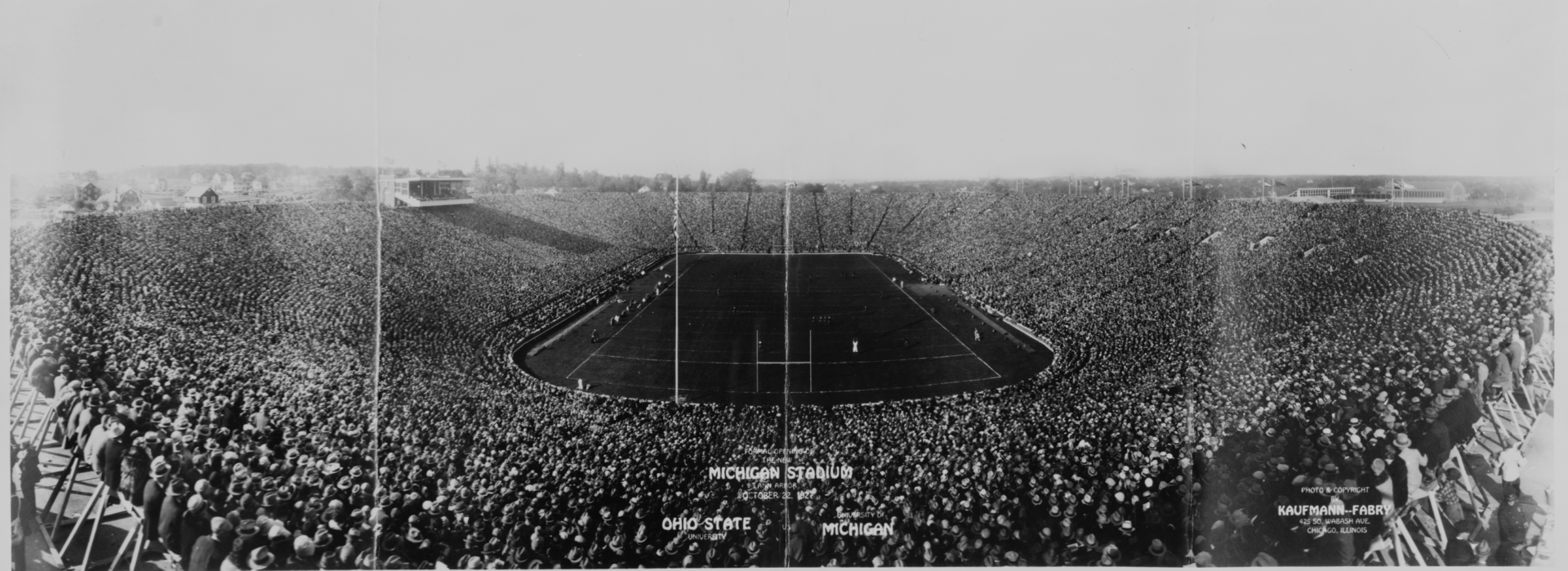
The biggest stadiums in the United States don’t belong to the NFL — they belong to college football. Eight campus venues seat more than 100,000 people, a scale no pro stadium touches in its standard configuration, and the gap at the very top is enormous: Michigan’s Big House alone could swallow an NFL stadium’s overflow crowd and still have room to spare.
This list ranks the 25 largest college football stadiums by capacity, checked against each school’s own listed figures. It also covers the one real wrinkle in the 2026 picture — Penn State’s Beaver Stadium renovation, which could briefly make it the nation’s largest — and explains why college programs built so much bigger than the pros in the first place.
Quick Answer
Michigan Stadium — the Big House, in Ann Arbor — is the largest college football stadium in the United States, with an official capacity of 107,601. Penn State’s Beaver Stadium (106,304) is second. Eight college stadiums seat more than 100,000, which no NFL stadium does in its standard setup.
The 25 Largest College Football Stadiums
The full 2026 ranking is below, with each stadium’s primary college tenant. Stadiums with a ThrillZing profile are linked.
| # | Stadium | School | Opened | Capacity |
|---|---|---|---|---|
| 1 | Michigan Stadium | Michigan | 1927 | 107,601 |
| 2 | Beaver Stadium | Penn State | 1960 | 106,304 |
| 3 | Ohio Stadium | Ohio State | 1922 | 102,780 |
| 4 | Kyle Field | Texas A&M | 1927 | 102,733 |
| 5 | Tiger Stadium | LSU | 1924 | 102,321 |
| 6 | Neyland Stadium | Tennessee | 1921 | 101,915 |
| 7 | Darrell K Royal–Texas Memorial Stadium | Texas | 1924 | 100,119 |
| 8 | Bryant–Denny Stadium | Alabama | 1929 | 100,077 |
| 9 | Sanford Stadium | Georgia | 1929 | 93,033 |
| 10 | Rose Bowl | UCLA | 1922 | 89,702 |
| 11 | Ben Hill Griffin Stadium | Florida | 1930 | 88,548 |
| 12 | Jordan–Hare Stadium | Auburn | 1939 | 88,043 |
| 13 | Memorial Stadium | Nebraska | 1923 | 85,458 |
| 14 | Memorial Stadium (Death Valley) | Clemson | 1942 | 81,500 |
| 15 | Gaylord Family Oklahoma Memorial Stadium | Oklahoma | 1923 | 80,126 |
| 16 | Notre Dame Stadium | Notre Dame | 1930 | 77,622 |
| 17 | Williams–Brice Stadium | South Carolina | 1934 | 77,559 |
| 18 | Los Angeles Memorial Coliseum | USC | 1923 | 77,500 |
| 19 | Donald W. Reynolds Razorback Stadium | Arkansas | 1938 | 76,212 |
| 20 | Camp Randall Stadium | Wisconsin | 1917 | 76,057 |
| 21 | Spartan Stadium | Michigan State | 1923 | 74,866 |
| 22 | Husky Stadium | Washington | 1920 | 70,083 |
| 23 | Kinnick Stadium | Iowa | 1929 | 69,250 |
| 24 | Acrisure Stadium | Pittsburgh | 2001 | 68,400 |
| 25 | Lincoln Financial Field | Temple | 2003 | 67,594 |
Could Beaver Stadium Pass Michigan in 2026?
Penn State is in the middle of a roughly $700 million renovation of Beaver Stadium, and the project has created a real, if temporary, shake-up at the top of this list. Athletic director Patrick Kraft has said temporary bleacher seating installed during construction could push Beaver Stadium’s capacity toward 109,000 for the 2026 season — enough to briefly overtake Michigan Stadium as the nation’s largest, before those temporary sections come out once the permanent lower bowl is finished.
Penn State has not confirmed a final certified capacity for the season, so this ranking uses each school’s last officially listed figure. If Penn State does post a verified number above 107,601 this season, Beaver Stadium would take the top spot for as long as the extra bleachers remain in place.
Why College Football Stadiums Outgrew the Pros
Most of the stadiums at the top of this list are nearly a century old. Michigan Stadium, Ohio Stadium, and Neyland Stadium all opened in the 1920s, when the only way to sell more tickets was to pour more concrete — and each one kept expanding decade after decade as Saturday football grew into a regional institution. Unlike NFL venues, which are privately financed and squeezed into expensive urban real estate, these stadiums were built and repeatedly enlarged by public universities with enormous student bodies, loyal alumni networks, and decades-long season-ticket waiting lists to fill the extra rows.
Seating density plays a role too: college bench and bleacher seating packs fans closer together than the all-chairback bowls typical of modern NFL stadiums, so a campus venue can out-seat a pro stadium that occupies a similar footprint. The SEC and Big Ten combine to own most of the top ten spots on this list, a reflection of how concentrated both fan bases and historic stadium investment have been in those two conferences.
How These Stadiums Compare to the NFL
No NFL stadium seats 100,000 fans in its standard configuration — AT&T Stadium in Arlington can be expanded past that mark for special events like boxing or the College Football Playoff, but its normal football capacity sits well below the eight college venues on this list. Nine college stadiums hold more than 90,000, a tier that only a handful of NFL stadiums even approach.
Pro Crossovers at the Bottom of the List
The tail of the list is where the NFL shows up directly: Pitt plays at Acrisure Stadium (68,400), shared with the Pittsburgh Steelers, and Temple plays at Lincoln Financial Field (67,594), shared with the Philadelphia Eagles. Just outside the top 25 sit Florida State’s Doak Campbell Stadium (67,277, trimmed from 79,560 in a 2024–25 renovation that added premium seating), South Florida at Raymond James Stadium, and UNLV at Allegiant Stadium.
The Los Angeles Memorial Coliseum (77,500, USC) deserves special mention: it has hosted two Olympics, a World Series, and a Super Bowl, and remains the grandest multi-use relic in American sports.
Photos
A see-through purse that looks like a purse. Works for most stadium, arena and concert bag policies.
Bleachers for three hours, but with back support. Folds flat and clips to the bench.
For upper-deck seats. Watch line play at the stadium, or the far side of the park from the top of a lift hill.
25 Largest College Football Stadiums FAQs
What is the largest college football stadium?
Michigan Stadium in Ann Arbor — the Big House — is the largest college football stadium in the United States, with an official capacity of 107,601.
How many college football stadiums hold more than 100,000 fans?
Eight: Michigan Stadium, Beaver Stadium, Ohio Stadium, Kyle Field, Tiger Stadium, Neyland Stadium, Darrell K Royal–Texas Memorial Stadium, and Bryant–Denny Stadium all hold more than 100,000.
Could Beaver Stadium become the largest college football stadium in 2026?
Possibly, and only temporarily. Penn State’s ongoing renovation includes temporary bleacher seating that officials have said could push Beaver Stadium’s capacity toward 109,000 for the 2026 season, which would top Michigan Stadium until the permanent bowl is finished and the temporary sections come out.
Are college football stadiums bigger than NFL stadiums?
The biggest ones are. Nine college stadiums hold more than 90,000, and no NFL stadium seats 100,000 in its standard configuration — AT&T Stadium can be expanded past that for special events only.
Which conference has the most massive college football stadiums?
The SEC and Big Ten combine to hold most of the top ten spots on this list, reflecting both conferences’ large, long-established fan bases.
Get More from ThrillZing
Log the coasters, stadiums, and venues you’ve experienced, rate largest college football stadiums, and see what your friends thought. Get the ThrillZing app.
Want the day’s theme park news in your inbox? Subscribe to ThrillZing Daily — free.