
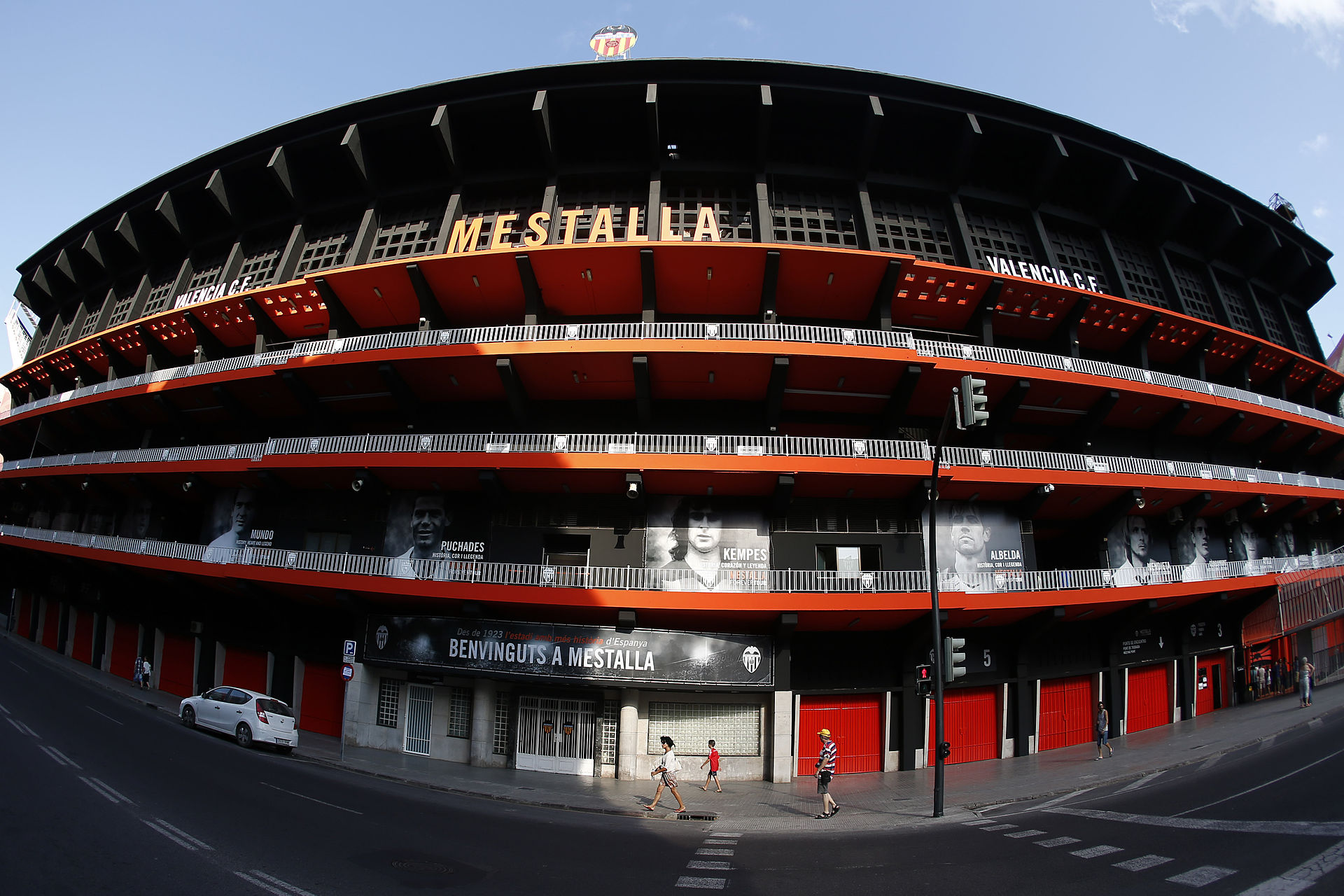
Mestalla Stadium has stood at the heart of Valencia CF since May 20, 1923, making it one of the oldest top-flight football grounds still in regular use in Spain. Officially known as Estadio de Mestalla, it takes its name from a centuries-old irrigation canal that once ran through the area, a legacy of the city’s Moorish-era water network.
Beyond its history, Mestalla is famous for something you feel the moment you walk in: a steep, compact bowl that puts fans almost on top of the pitch. This guide covers what you actually need to know if you’re researching the stadium, from its capacity and UEFA category to how to book a tour, get there on match day, and what’s happening with its planned replacement, Nou Mestalla.
Quick Answer
Mestalla Stadium is the home ground of Valencia CF in Valencia, Spain, open since May 20, 1923, with a capacity of about 49,430 and a UEFA Category Four rating. It’s known for one of the steepest upper tiers in European football, and it hosts the official Mestalla Forever Tour for fans who want to see the pitch, dressing rooms, and trophy room. Valencia CF plans to eventually move to the new Nou Mestalla stadium, with an opening currently targeted for summer 2027.
History and the Meaning of the Name ‘Mestalla’
The ground takes its name from the Sequia de Mestalla, a historic irrigation channel that ran through this part of Valencia and traces back to the city’s Moorish-era water network. Over the decades the stadium has carried different official names: it was rebranded Estadio Luis Casanova between 1969 and 1994, in honor of a former club president, before reverting to the Mestalla name that fans had always used anyway.
Its résumé goes well beyond Valencia CF’s own trophies. Mestalla hosted all three of Spain’s first-round group matches at the 1982 FIFA World Cup, against Honduras, Yugoslavia, and Northern Ireland, and it staged football matches during the 1992 Barcelona Olympics. It has also been the venue for ten Copa del Rey finals, more than almost any other ground in the competition’s history, cementing its status as one of Spanish football’s most storied venues.
A Steep, Intimate Atmosphere
What sets Mestalla apart from most modern stadiums is its sheer verticality. The steepest sections of the upper tier climb at an incline of roughly 34 to 35 degrees, placing it right at the edge of the 37-degree safety limit set by FIFA and UEFA, and it’s widely regarded as the steepest top tier in European football. That pitch puts fans unusually close to the action and gives Mestalla its reputation as one of the loudest, most intimidating atmospheres in La Liga.
The closeness is partly a product of the stadium’s age and setting. Mestalla was expanded and rebuilt in stages across the 20th century, hemmed in by the dense residential streets that grew up around it, rather than designed from scratch on an open site to modern stadium standards. The result is a compact bowl that concentrates noise directly over the field — visiting fans sometimes note that reaching the away section means climbing around 19 flights of stairs, a small but memorable reminder of just how vertically the stadium is built.
Capacity and UEFA Category
Mestalla holds roughly 49,430 spectators, which still makes it one of the larger grounds in La Liga despite its age. It carries a UEFA Category Four rating, the governing body’s top classification for hosting regular Champions League and Europa League matches as well as major European club fixtures. That rating doesn’t mean Mestalla is in line to host a Champions League final, though: UEFA has in recent seasons picked only stadiums with capacities well above 60,000 for the final, so Mestalla’s roughly 49,430 seats fall short of what a final-hosting venue typically needs.
Tickets and Touring Mestalla
On non-matchdays, Valencia CF runs the official Mestalla Forever Tour, a roughly one-hour guided visit conducted in Spanish and English. It takes visitors through the press room, the home dressing room, out through the players’ tunnel, and onto the edge of the pitch, along with the club’s trophy room. The tour typically runs Monday through Saturday with morning and afternoon time slots, and Sunday mornings only, closing entirely on match days and official training days — exact daily time slots shift by season, so always check before planning a visit.
Pricing is tiered: there’s a standard adult rate, a discounted rate for Valencia CF club members (socios), and a further reduced rate for children, seniors, and people with disabilities, with young children typically admitted free. Because both the tour schedule and pricing change periodically, treat any numbers you see elsewhere as approximate and confirm current hours, prices, and availability directly on the official Mestalla Forever Tour page, which is also where match tickets and club membership information are listed.
Getting to Mestalla
Mestalla sits at Avenida de Suecia, s/n, in central Valencia, inside a dense residential neighborhood with limited on-street parking, so most fans and visitors arrive by public transport rather than driving. The stadium is served by Metro lines 3 and 5, with the Aragón and Facultats stops both within easy walking distance, as well as several city bus routes and a stop on Valencia’s hop-on-hop-off tourist bus line.
On match days, expect the surrounding streets to be closed to traffic for a few hours before and after kickoff, which is another reason metro and bus access tends to be faster and far less stressful than arriving by car.
The Move to Nou Mestalla
Valencia CF has been building a replacement stadium, Nou Mestalla, on a site close to the current ground, after years of stalled construction. Work has picked up pace again, with the roof structure, stair towers, and façade all progressing, and the club is currently targeting an opening around summer 2027. The new stadium is designed to hold just over 70,000 seats, well above Mestalla’s current capacity.
One remaining hurdle is unrelated to the stadium bowl itself: local planning rules tied to two towers planned alongside the new ground mean construction on those towers needs to have at least broken ground before Valencia CF can be cleared to play there. Until the move happens, the historic Mestalla remains the club’s home, and its World Cup, Olympic, and Copa del Rey history mean it will close out its era as one of the more decorated grounds in European football before Valencia shifts to its larger, modern venue.
Photos
A see-through purse that looks like a purse. Works for most stadium, arena and concert bag policies.
Bleachers for three hours, but with back support. Folds flat and clips to the bench.
For upper-deck seats. Watch line play at the stadium, or the far side of the park from the top of a lift hill.
Mestalla Stadium visitor guide FAQs
When did Mestalla Stadium open?
Mestalla opened on May 20, 1923, as the home of Valencia CF, making it one of the oldest top-flight grounds still in regular use in Spain.
What is the capacity of Mestalla Stadium?
Mestalla holds about 49,430 spectators and carries a UEFA Category Four rating, the governing body’s highest classification.
Why is it called Mestalla?
The name comes from the Sequia de Mestalla, a historic irrigation canal that ran through the area and dates back to the Moorish period in Valencia.
How steep is Mestalla’s upper tier?
The steepest section of the upper tier climbs at roughly 34 to 35 degrees, close to the 37-degree limit set by FIFA and UEFA, making it one of the steepest top tiers in European football.
Can you take a tour of Mestalla?
Yes. Valencia CF runs the official Mestalla Forever Tour, a guided visit of about an hour covering the pitch, dressing rooms, players’ tunnel, press room, and trophy room, usually available Monday through Saturday and Sunday mornings, except on match and training days. Check the official site for current hours and prices.
How do you get to Mestalla by public transport?
Mestalla is served by Metro lines 3 and 5, with the Aragón and Facultats stops nearby, plus several city bus routes and a stop on Valencia’s tourist bus line. Most visitors prefer public transport since street parking around the stadium is limited, especially on match days.
When will Valencia CF move to Nou Mestalla?
Construction on Nou Mestalla is progressing after years of delay, with an opening currently targeted for around summer 2027. Until then, Valencia CF continues to play at the historic Mestalla.
Get More from Mestalla Stadium visitor guide
Log the coasters, stadiums, and venues you’ve experienced, rate Mestalla Stadium visitor guide, and see what your friends thought. Get the ThrillZing app.
Want the day’s theme park news in your inbox? Subscribe to ThrillZing Daily — free.