
Balboa Stadium opened in 1914 next to San Diego High School as part of the 1915 Panama-California Exposition, and it has stayed in continuous use for more than a century, longer than almost any other venue of its era on the West Coast. Built with steam shovels to carve out its bowl-shaped seating area, the stadium has worn several different sizes over the decades, from an original 15,000 seats up to a peak of 34,000 during its run as a professional football home.
Its biggest stretch of fame came between 1961 and 1966, when the San Diego Chargers played their first AFL seasons there after relocating from Los Angeles. The stadium also hosted San Diego State’s football team in the 1920s and 1930s, drew Charles Lindbergh’s hero’s-welcome celebration in 1927, and put the Beatles on its field in 1965. Seismic safety concerns led to the demolition of the original structure in the 1970s, and a smaller 3,000-seat replacement opened in 1978 that still serves San Diego High School athletics today.
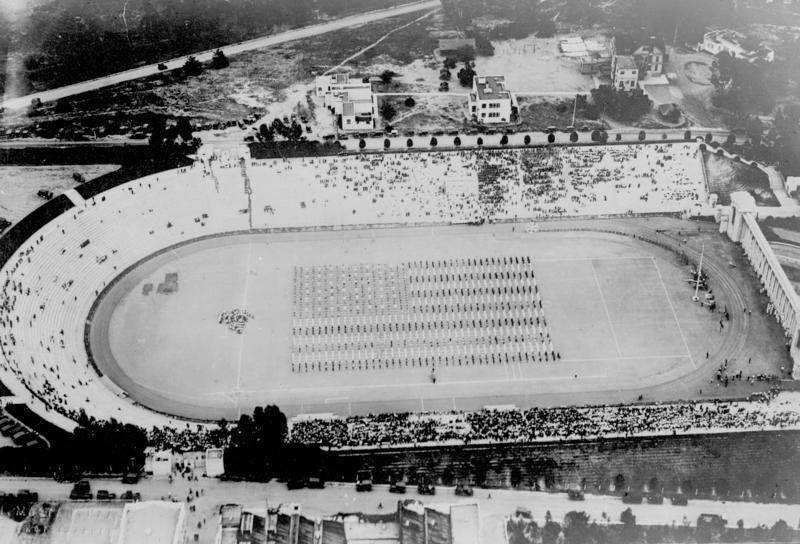
- Los Angeles Chargers played here 1961–1966. See every Chargers stadium →
Stats at a Glance
- Team(s): San Diego Chargers (AFL, 1961–1966); San Diego State Aztecs football (1921–1935); San Diego High School Cavers (1915–present)
- Location: San Diego, California
- Opened: 1914 (rebuilt 1978)
- Capacity: About 3,000 today; peaked at 34,000 in the 1960s
- Original Capacity: 15,000 (1914)
- Famous For: Hosting the Beatles’ 1965 San Diego concert
From World’s Fair Showpiece to AFL Battleground
Balboa Stadium began as a civic showpiece built for the 1915 Panama-California Exposition in Balboa Park. Over the following decades it was expanded repeatedly, growing to 23,000 seats by 1960 and then to 34,000 with a new upper deck in time for the Chargers’ arrival in 1961. That expansion made it a viable, if modest, pro football venue during the AFL’s early scramble for stadium space, and the Chargers played there through the 1966 season before moving to what later became Qualcomm Stadium.
A Smaller Stadium with a Long Second Life
After engineers flagged the aging structure for seismic safety issues, the original stadium was torn down in the 1970s and replaced in 1978 with a simpler, 3,000-seat facility on the same site. Though far smaller than its AFL-era peak, the rebuilt stadium preserved the site’s unbroken run as a sports venue. It remains the home field for San Diego High School, whose teams have played there since the stadium’s earliest days, keeping Balboa Stadium active well into its second century.

Explore more: Explore more historic and modern stadiums.
USB-charged warmers for cold night games — no disposable packets.
Keeps chili hot from the tailgate to the fourth quarter.
Team-color face paint in a twist-up stick — no brushes, no mess in the car.
Balboa Stadium FAQs
Is Balboa Stadium still standing?
Yes. The original 1914 structure was demolished in the 1970s, but a smaller 3,000-seat stadium was rebuilt on the same site in 1978 and is still in use by San Diego High School.
Did the San Diego Chargers play at Balboa Stadium?
Yes, the Chargers played their home games at Balboa Stadium from 1961 to 1966 during their early years in the American Football League.
How big was Balboa Stadium at its largest?
It reached a peak capacity of about 34,000 seats in the 1960s after an upper deck was added, up from its original 1914 capacity of 15,000.
Get More from Balboa Stadium
Log the coasters, stadiums, and venues you’ve experienced, rate Balboa Stadium, and see what your friends thought. Get the ThrillZing app.
Photo: Eric Bekins / CC BY-SA 4.0, via Wikimedia Commons.