
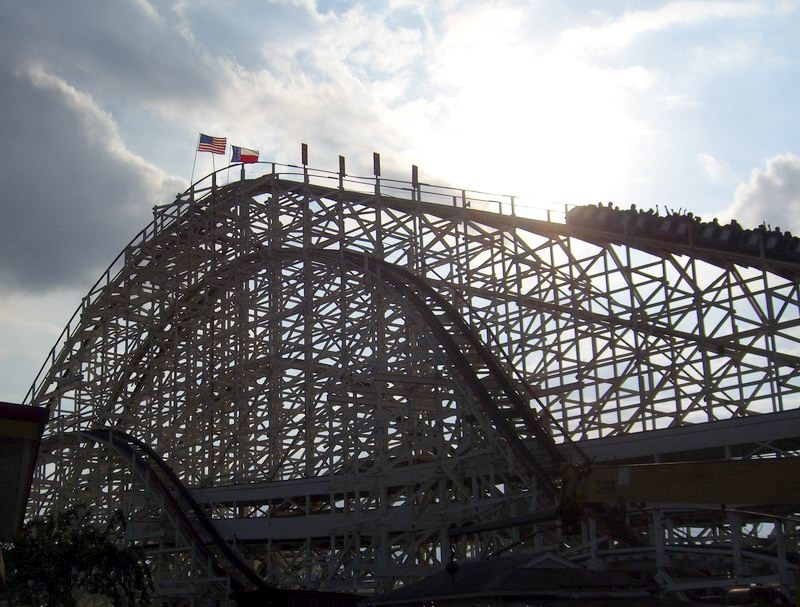
Houston once had its own answer to Coney Island, and for 29 years it rattled, dropped, and floated riders out of their seats on a wooden out-and-back called Texas Cyclone. Built at Six Flags AstroWorld as a bigger, faster homage to New York’s legendary Cyclone, it became one of the most beloved wooden coasters of the 1970s revival era, and one of the most mourned losses when the park shut down for good.
This guide covers everything there is to know about Texas Cyclone: how it compared to the original Coney Island Cyclone, what went wrong (and right) during construction, what its ride experience was actually like, and what happened to the ride, its trains, and the AstroWorld site after the park closed in 2005.
Quick Answer
Texas Cyclone was a 93-foot wooden roller coaster at Six Flags AstroWorld in Houston, Texas, open from June 12, 1976, to October 30, 2005. Designed by William Cobb and Don Rosser as a larger, faster mirror image of the original Coney Island Cyclone, it was demolished in March 2006; its trains were shipped to La Ronde in Montreal as spare parts for that park’s Le Monstre coaster, and a section of its track is preserved at the National Roller Coaster Museum and Archives.
Texas Cyclone vs. the Coney Island Cyclone
AstroWorld’s original plan wasn’t to build a tribute at all — park management first looked into actually buying New York’s Coney Island Cyclone, which by the mid-1970s was aging and at risk of demolition, and relocating it to Houston. Once the cost and logistics of moving a 1927 wooden structure proved too high, designer William Cobb opted for the next best thing: a mirror-image replica, flipped left-to-right from the original’s layout.
Cobb and co-designer Don Rosser didn’t just copy the Coney Island Cyclone, though — they improved on it. Texas Cyclone was built taller and faster than its New York namesake, and when it opened in 1976 it ranked among the tallest and fastest wooden coasters anywhere in the world. Fans and coaster enthusiasts who rode both often debated which Cyclone hit harder, but Texas Cyclone’s reputation for brutal, unpredictable negative-g airtime gave it a cult following all its own.
Construction: A Storm-Delayed Build
Texas Cyclone’s construction, handled by the Frontier Construction Company, began in the summer of 1975 and wasn’t smooth. In early January 1976, high winds tore into the still-incomplete north turnaround, collapsing a section of structure that had taken five weeks to build and pushing the project roughly eight weeks behind schedule.
Crews rebuilt the damaged section in about three weeks, but the delay was enough to push the coaster’s planned spring debut back to June 12, 1976 — the date it finally opened to AstroWorld guests as the centerpiece of the park’s new Coney Island-themed area.
The Ride Experience
Texas Cyclone’s chain lift climbed to 93 feet before releasing riders down an 80-foot first drop angled at 53 degrees, launching the train into a rapid-fire sequence of twisting turns and camelback hills. The out-and-back wooden layout was engineered for airtime rather than height, packing a 2-minute, 15-second ride into a compact 3,180-foot footprint typical of classic Cyclone-style coasters.
Six-car trains carrying 24 riders in a 2-across, 2-row arrangement gave the ride a rattling, old-school wooden-coaster feel that fans often compared favorably to its Coney Island namesake. Its reputation for rough, forceful negative-g moments made it a cult favorite among coaster enthusiasts touring Texas parks in the late 20th century.
The ride wasn’t static over its nearly three-decade run, either. In 1979, crews lowered the track on the first turn by about two feet and installed an updated braking system — changes made specifically so the coaster could keep running safely during Houston’s gusty coastal weather without the train stalling mid-circuit.
Closure, Demolition, and Where the Pieces Went
When Six Flags AstroWorld shut its gates for good on October 30, 2005 — a closure driven by the sale of the park’s land rather than any problem with the rides themselves — Texas Cyclone closed along with the rest of the park and was demolished the following spring, on March 9, 2006.
The ride didn’t disappear entirely, though. Its trains were shipped to La Ronde amusement park in Montreal, Quebec, where they were intended as spare parts for that park’s own wooden coaster, Le Monstre, and stored underneath it rather than put into service — and in one widely shared bit of coaster trivia, the lead car from one of the Texas Cyclone’s trains was later sold off and repurposed as decor in a Montreal coffee shop. A section of the original wooden track, meanwhile, was donated to the National Roller Coaster Museum and Archives for preservation.
What’s at the AstroWorld Site Today
The roughly 75-acre site where AstroWorld once stood, next to NRG Park in Houston, sat vacant for years after the park’s demolition. Part of the land was eventually sold off for commercial development, while the rest has been used as overflow parking for events at neighboring NRG Park, including the Houston Livestock Show and Rodeo. No trace of Texas Cyclone or any other AstroWorld ride remains on the property today.
Texas Cyclone’s Legacy
Though the ride no longer stands, Texas Cyclone is still remembered as one of the defining wooden coasters of the 1970s coaster-building revival — an era that also produced legends like Colossus and The Racer. It’s a frequently cited example in any discussion of AstroWorld’s lost golden-age attractions, and coaster enthusiasts who rode it before 2005 still rank it among the most intense wooden coasters ever built in the American South.
Photos
Ride with your glasses on and keep them. Many parks allow glasses on rides if they're strapped, so check the ride rules first.
Small enough to ride with on most coasters, big enough for a phone, card and keys. Two zippers mean nothing falls out upside down.
A fan and a mist in one, rechargeable. Very popular in queue lines once the afternoon sun hits.


Texas Cyclone FAQs
Where was Texas Cyclone located?
Texas Cyclone operated at Six Flags AstroWorld in Houston, Texas, from June 12, 1976, until the park’s closure on October 30, 2005.
Who built Texas Cyclone?
It was designed by William Cobb and Don Rosser and built by the Frontier Construction Company as a mirror-image tribute to the original Coney Island Cyclone, made taller and faster than the New York original.
Does Texas Cyclone still exist?
No. The ride closed with AstroWorld in October 2005 and was demolished in March 2006. Its trains were shipped to La Ronde in Montreal as spare parts for the park’s Le Monstre coaster and stored underneath it rather than put into operation, and a section of its original track is preserved at the National Roller Coaster Museum and Archives.
Why was Texas Cyclone built instead of moving the real Coney Island Cyclone?
AstroWorld’s operators initially considered buying and relocating the aging, at-risk Coney Island Cyclone from New York, but determined that moving a wooden structure of that size and age would be too costly. They built a mirror-image replica instead, designed to be taller and faster than the original.
How tall and fast was Texas Cyclone?
Texas Cyclone stood about 93 feet tall, reached roughly 60 mph, and featured an 80-foot first drop at a 53-degree angle, covering 3,180 feet of track in about 2 minutes and 15 seconds.
Why did AstroWorld close?
Six Flags AstroWorld closed permanently on October 30, 2005, after its land was sold; the closure was a business and real-estate decision rather than the result of any ride failure or safety issue.
Get More from Texas Cyclone
Log the coasters, stadiums, and venues you’ve experienced, rate Texas Cyclone, and see what your friends thought. Get the ThrillZing app.
Want the day’s theme park news in your inbox? Subscribe to ThrillZing Daily — free.