
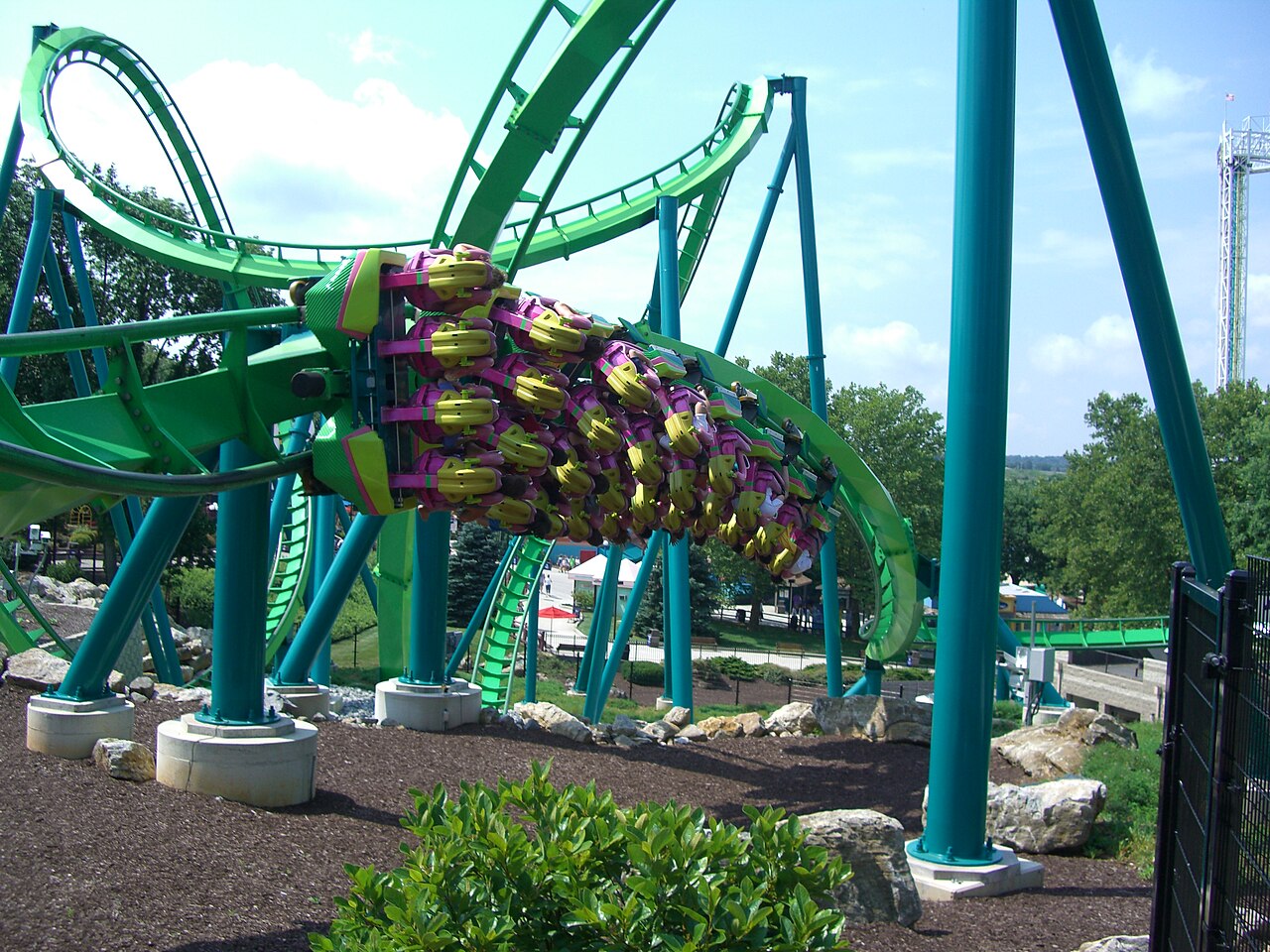
Hydra the Revenge at Dorney Park & Wildwater Kingdom in Allentown, Pennsylvania, is the only roller coaster in the world that turns you upside down before you even climb the lift hill. Seconds after leaving the station, the Bolliger & Mabillard floorless coaster rolls lazily through its signature “jojo roll” — a slow heartline inversion at barely more than walking speed — and only then begins its climb.
That opening move is inversion one of seven, which lands Hydra on our ranking of the roller coasters with the most inversions. Opened on May 7, 2005, the $13 million coaster was designed by Werner Stengel and built on the grave of a fallen giant: the record-breaking wooden coaster Hercules.
Key Stats
| Height | 95 ft (29 m) |
| Drop | 105 ft (32 m) at 68° |
| Speed | 53 mph (85 km/h) |
| Length | 3,198 ft (975 m) |
| Inversions | 7 (including the pre-lift jojo roll) |
| Duration | 2:35 |
| Capacity | 1,245 riders per hour |
| Manufacturer | Bolliger & Mabillard |
| Model | Floorless Coaster |
| Cost | $13 million |
| Opened | May 7, 2005 |
The Jojo Roll and a Terrain-Hugging Layout
The jojo roll is Hydra’s calling card. The floor drops, the gates open, and the train creeps straight out of the station into a full heartline rotation — no lift, no drop, just a slow-motion barrel roll that hangs you in your seat. It remains one of the strangest and most beloved opening elements on any coaster.
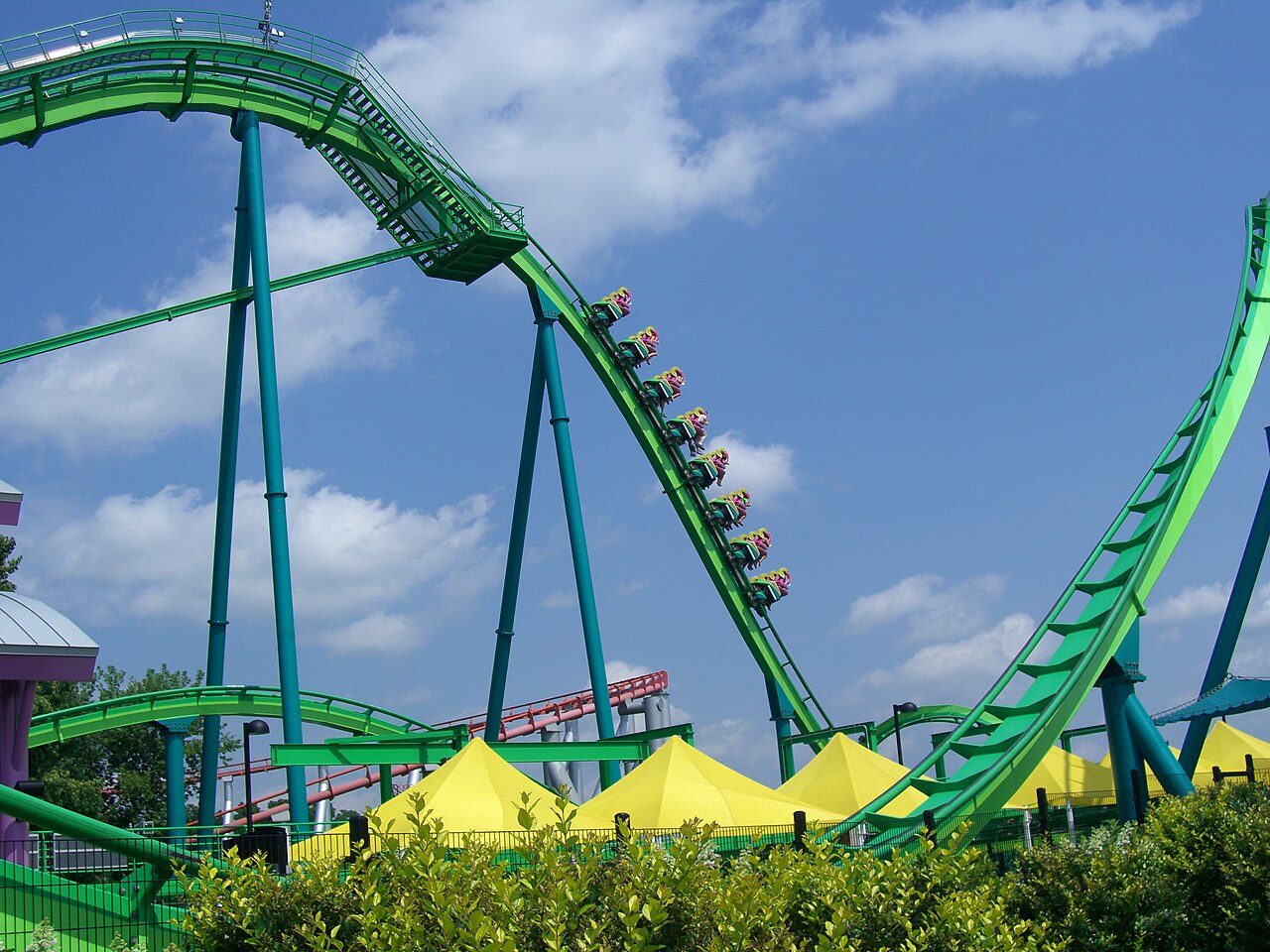
From there the train climbs 95 feet and drops 105 — the extra 10 feet come courtesy of the terrain, as the ride plunges below grade at a 68-degree angle. The rest of the layout weaves through the hillside with an inclined dive loop, a zero-g roll, a cobra roll, and a corkscrew finale, for seven inversions in all across 3,198 feet of track.
Born from Greek Mythology
Hydra was built on the site of Hercules, a wooden coaster that closed after the 2003 season and was demolished to make way for its steel successor. Dorney Park leaned into the symbolism: in Greek myth, Hercules slew the many-headed Lernaean Hydra. In the park’s version of the story, the serpent’s immortal head slowly regenerated underground — and returned for revenge on the very spot where Hercules once stood.
%
The park announced the $13 million project on September 14, 2004. Track arrived that December, the first guests rode on March 24, 2005, and the coaster officially opened to the public on May 7, 2005.
Riding Hydra Today
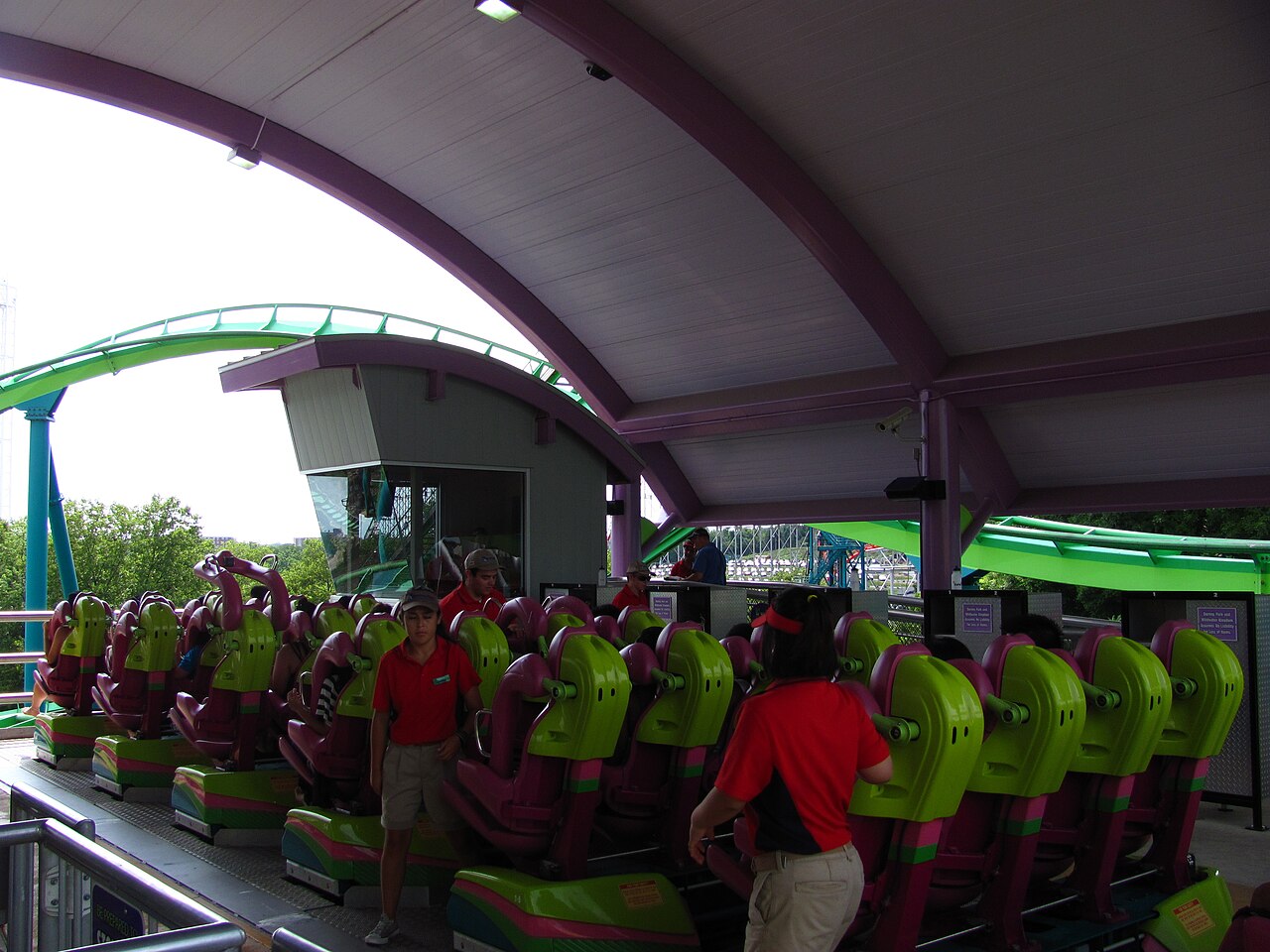
Hydra runs two floorless trains of eight four-across cars, moving up to 1,245 riders per hour. At 53 mph it’s not about raw speed — it’s a glassy-smooth, terrain-hugging inversion machine that’s remarkably re-rideable. The minimum height requirement is 54 inches.
%
Compared with its floorless siblings — rides like Scream! at Six Flags Magic Mountain or Superman / la Atracción de Acero in Madrid — Hydra trades height and speed for character. No other B&M floorless opens with an inversion, and none uses its terrain quite so cleverly. It’s proof that a coaster doesn’t need 200 feet of steel to be unforgettable.
A fan and a mist in one, rechargeable. Very popular in queue lines once the afternoon sun hits.
Build a working coaster on the kitchen table and learn why the first drop has to be the tallest. A good gift for young coaster fans.
Over 3,700 pieces, a real vertical loop and a working chain lift. Display it on a shelf in the coaster room.


FAQ
What is the jojo roll on Hydra the Revenge?
It’s a slow heartline roll taken immediately after the train leaves the station — before the lift hill. Hydra is famous for inverting riders at near-walking speed as the very first element of the ride.
How many inversions does Hydra have?
Seven, counting the pre-lift jojo roll. The lineup also includes an inclined dive loop, a zero-g roll, a cobra roll, and a corkscrew.
Why is it called Hydra the Revenge?
It stands on the former site of the Hercules wooden coaster. In Greek mythology Hercules slew the Hydra — so when a serpentine steel coaster replaced him in 2005, the park cast it as the monster’s revenge.
Photo: Atwngirl via Wikimedia Commons (CC BY-SA 4.0)