
Trent Bridge exists because a publican’s husband fenced off the field behind the pub. William Clarke married the proprietress of the Trent Bridge Inn, captained his own All-England Eleven, and in 1841 opened the ground on the land at the back. It has been the home of Nottinghamshire County Cricket Club ever since — 185 years and counting.
The Inn is still there on the corner. So is the ground, now a 17,500-capacity Test venue on the West Bridgford bank of the River Trent, a few minutes’ walk from Nottingham Forest’s City Ground and Notts County’s Meadow Lane. It sits fourth on our ranking of the oldest stadiums in the world still in use.
Key Stats
| Opened | 1841 (first recorded match on the site in 1838) |
| Location | West Bridgford, Nottinghamshire, England |
| Capacity | 17,500 |
| Tenants | Nottinghamshire CCC (1841–present); England cricket team (1899–present); Notts County F.C. (1883–1910) |
| Sport | Cricket (formerly football) |
| First Test match | 1–3 June 1899, England v Australia |
| Ends | Stuart Broad End and Radcliffe Road End |
The Pub, the Publican and the Ground
The first recorded cricket match at Trent Bridge was played on ground behind the Trent Bridge Inn in 1838. Three years later William Clarke — husband of the Inn’s proprietress and the driving force behind the touring All-England Eleven that took first-class cricket around the country — formally opened the enclosed ground. Nottinghamshire have played there from that year onwards.
Clarke got his memorial late: the William Clarke Stand, containing the Rushcliffe Suite, opened in 1990. The ground also has a habit of being early to technology. In 1950 it installed an electronically operated scoreboard that was, at the time, the largest at any cricket stadium in the world.
The Ground Today
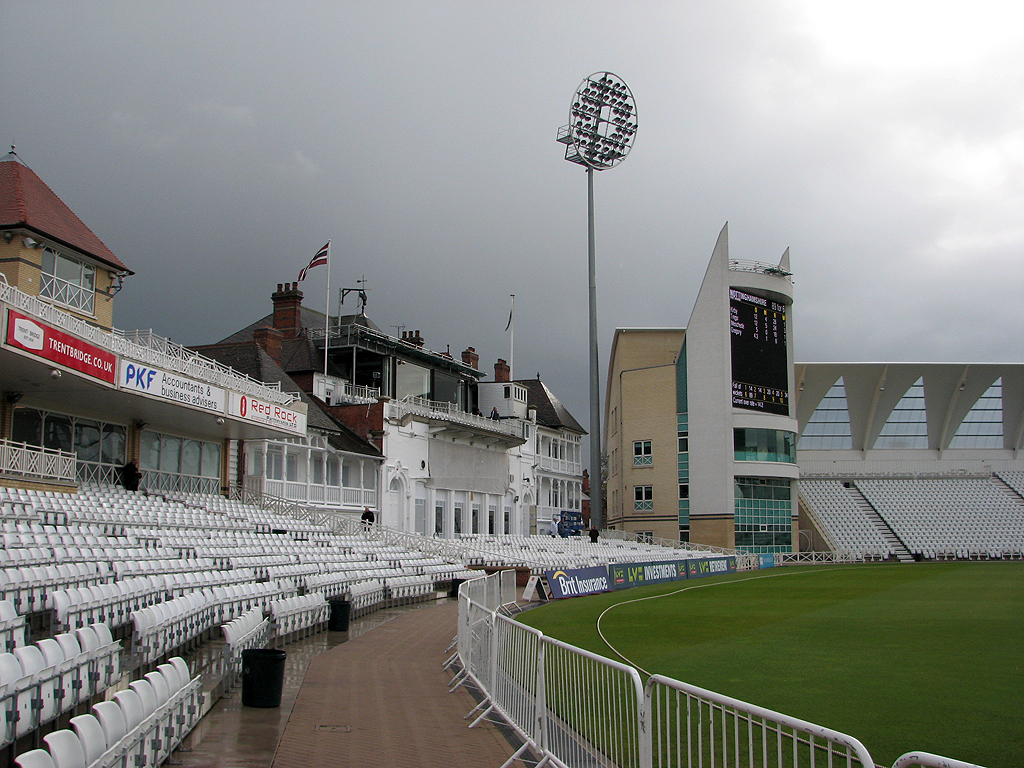
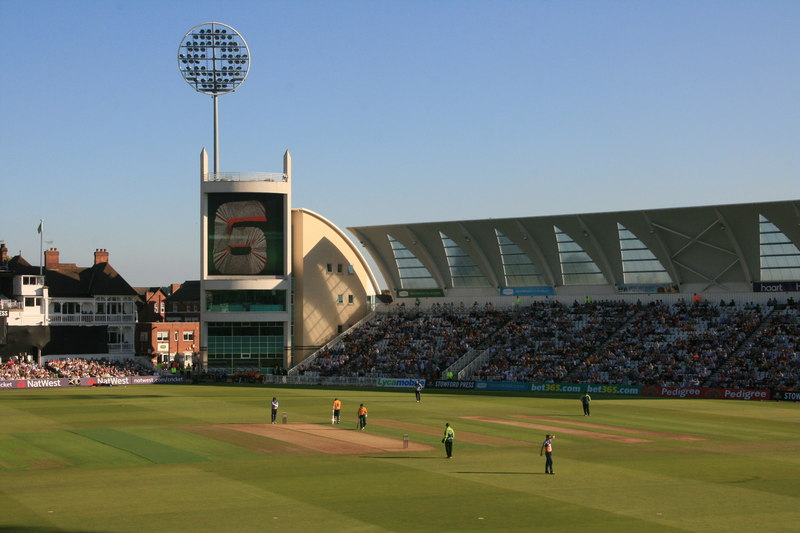
Trent Bridge is regularly called one of the most beautiful grounds in world cricket, and the reason is the collision of eras around the boundary. The pavilion keeps the architectural parameters of its 1889 foundation and sits at an angle to the wicket, a quirk no modern designer would allow. Opposite it, the £1.9 million Fox Road Stand opened in 2002 with a modernist aircraft-wing roof and a stack of architectural awards — and a planning row with neighbours over the sunlight it blocked.
The £7.2 million Radcliffe Road Cricket Centre followed in 1998. From 2007 the Parr Stand and West Wing were replaced and extra rows added at the front of several stands, lifting capacity from 15,358 to 17,500 in time for the 2008 Test against New Zealand; Prince Philip opened the new stand on 5 June. It was known simply as the New Stand, then the Bridgford Road Stand, before becoming the Smith Cooper Stand under a sponsorship deal in March 2016.
Bowling is from the Radcliffe Road End and the Stuart Broad End — the latter called the Pavilion End until September 2023, with the renaming for Nottinghamshire’s own 600-Test-wicket seamer made official on 18 July 2024.
Records Made Here
Trent Bridge is where England broke the world one-day international record for a team total, making 444/3 against Pakistan in 2016 — then beat their own mark on the same ground two years later with 481/6 against Australia. In the 2013 Ashes Test, Australia’s Ashton Agar produced the highest Test score ever made by a number-eleven batter.
The ground also has a football past. Notts County used it for important matches from the 1860s and moved in permanently in 1883 when Nottingham Forest left, though fixtures at either end of the season had to be staged elsewhere because of the cricket. County finally left for Meadow Lane in 1910. Trent Bridge even hosted an England international: a 6–0 win over Ireland on 20 February 1897.
12 x 10.5 x 6 in. — built to the common stadium clear-bag size. Check your venue's rules.
USB-charged warmers for cold night games — no disposable packets.
Keeps chili hot from the tailgate to the fourth quarter.
FAQ
Why is it called Trent Bridge?
The ground takes its name from the road bridge over the River Trent immediately alongside it — and from the Trent Bridge Inn, the pub behind which the first matches were played in 1838.
When did Trent Bridge host its first Test match?
June 1899, England against Australia. It has been a regular England Test venue ever since and also staged matches at the 2009 ICC World Twenty20, including the South Africa v Pakistan semi-final.
How big is Trent Bridge?
17,500, after redevelopment completed for the 2008 Test against New Zealand raised it from 15,358.
Photo: Mattbuck via Wikimedia Commons (CC BY-SA 3.0)