
Staley Field was a small company athletic ground in Decatur, Illinois, owned by the A. E. Staley Manufacturing Company. In 1920 it served as the home turf of the Decatur Staleys, a team of company employees coached, managed, and played for by a young George Halas, making the modest grass field one of the earliest homes of what became the National Football League.
The field sat at 521 North 7th Street (later renumbered 22nd Street) and had already hosted minor-league baseball for the Decatur Commodores in the years before football arrived. Its tiny 1,500-seat capacity made the Staleys’ 1920 season a financial strain, a problem that directly led Halas to relocate the franchise to Chicago the following year.
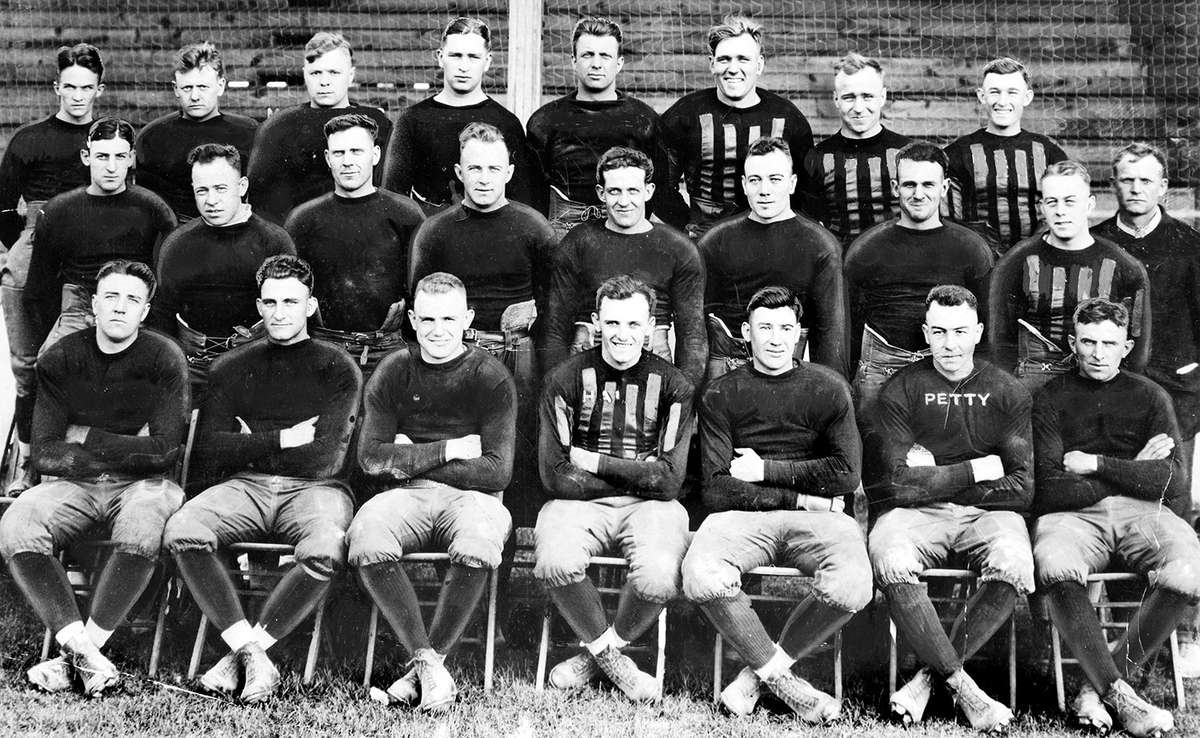
- Chicago Bears played here 1920. See every Bears stadium →
Stats at a Glance
- Team(s): Decatur Staleys (1920); Decatur Commodores (baseball, 1901-1915, 1922-23)
- Location: Decatur, Illinois
- Opened: By 1901 (exact date unrecorded)
- Closed: About 1929 (last appeared in city directories)
- Capacity: About 1,500
- Surface: Grass
- Notable fact: Birthplace of the franchise that became the Chicago Bears
A Company Field Turns Pro
Staley Field began as the athletic grounds for the A. E. Staley Manufacturing Company, a corn-processing business in Decatur that fielded company sports teams for its workers. The Decatur Commodores played minor-league baseball there in the early 1900s, and by 1919 the company had organized an amateur football squad of its employees, which won the Central Illinois Championship that year.
In 1920, that company team, the Decatur Staleys, joined the newly formed American Professional Football Association, the league that became the NFL. George Halas, hired by Staley to run the athletic program, coached, managed, and played for the Staleys at the field that bore the company’s name.
Too Small to Last
Staley Field’s charm couldn’t overcome its economics. With only about 1,500 seats, a $1 ticket price, and a 50 percent discount for company employees, the gate receipts simply couldn’t support a professional football operation even as the Staleys drew enthusiastic local crowds.
Facing those losses, the A. E. Staley Company sold the team to Halas and his partners, who moved games to Cubs Park (now Wrigley Field) in Chicago for 1921, keeping the Staley name for one final season before renaming the club the Chicago Bears in 1922. Staley Field itself faded from use, dropping out of Decatur city directories by around 1929.
Explore more: Explore more historic stadiums.
12 x 10.5 x 6 in. — built to the common stadium clear-bag size. Check your venue's rules.
USB-charged warmers for cold night games — no disposable packets.
Keeps chili hot from the tailgate to the fourth quarter.
Staley Field FAQs
What was Staley Field used for?
It was the company athletic field of the A. E. Staley Manufacturing Company in Decatur, Illinois, hosting minor-league baseball and, in 1920, the Decatur Staleys professional football team.
Why did the Decatur Staleys leave Staley Field?
The field’s roughly 1,500-seat capacity and discounted employee tickets couldn’t generate enough revenue, so owner A. E. Staley sold the team to George Halas, who moved it to Cubs Park in Chicago in 1921.
Is Staley Field connected to the Chicago Bears?
Yes. The Decatur Staleys who played at Staley Field in 1920 relocated to Chicago in 1921 and were renamed the Chicago Bears in 1922.
Get More from Staley Field
Log the coasters, stadiums, and venues you’ve experienced, rate Staley Field, and see what your friends thought. Get the ThrillZing app.
Photo: Unknown authorUnknown authorDigital editing by Tim Davenport (“Carrite”) for Wikipedia, no copyright claimed for the work. File released to the public domain without restriction. / Public domain, via Wikimedia Commons.