
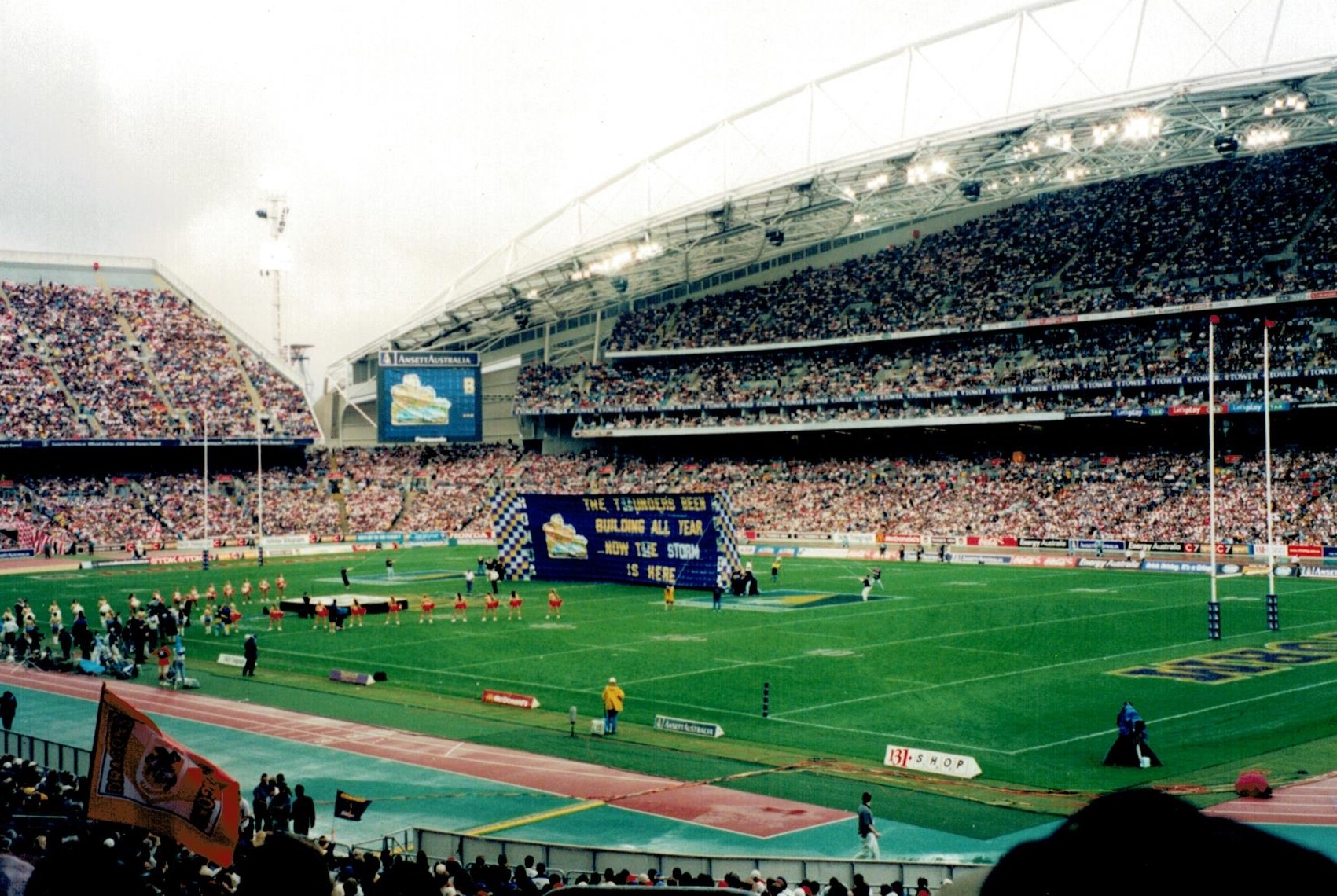
Stadium Australia opened on March 6, 1999, at Sydney Olympic Park as the centerpiece venue built for the 2000 Summer Olympics. Designed by HOK Sport (now Populous) at a cost of about A$690 million, it held roughly 115,000 seats in its original Olympic configuration, making it one of the largest stadiums ever built for a single Games.
The venue has carried several commercial names since opening — Telstra Stadium, ANZ Stadium, and today’s Accor Stadium — but Sydneysiders and record books still often call it by its original name. This guide covers everything you need if you’re attending an event: current capacity, how the naming history fits together, how to get there, where to park, and how tickets and stadium tours work.
Quick Answer
Stadium Australia and Accor Stadium are the same venue at Sydney Olympic Park — Accor Stadium is simply the current naming-rights brand (since November 2021). It seats around 83,000 for sport in its current rectangular-pitch configuration, down from its 115,000-seat Olympic bowl, and is the home of the NRL Grand Final, NSW State of Origin, and the Australia national rugby and soccer teams.
Capacity and Seating
The stadium opened with a 115,000-seat oval-style Olympic bowl, the configuration used for the 2000 Games. After the Olympics, temporary end-zone seating was removed and the lower bowl was pulled in closer to the field to better suit rectangular-pitch sports like rugby league, rugby union, and soccer, settling capacity at roughly 83,000. That makes it Australia’s largest dedicated rectangular-pitch stadium, though the oval-shaped Melbourne Cricket Ground remains the country’s largest stadium overall, with a capacity of just over 100,000.
A large video screen installed above one end in 2022, nicknamed the “Great Southern Screen,” replaced a small block of seats, which is why some current listings show capacity in the low-80,000s rather than exactly 83,000. For a seat-by-seat breakdown of bays, levels, and sightlines for your specific event, use the official seating map on the Accor Stadium website rather than relying on third-party charts, since layouts shift slightly between rugby league, rugby union, soccer, and concert configurations.
Naming History: From Stadium Australia to Accor Stadium
The venue opened as Stadium Australia in 1999. It became Telstra Stadium in 2002 under the first naming-rights deal, then ANZ Stadium from January 2008 after a long-running sponsorship with ANZ Bank. When that deal ended, the stadium reverted to its original non-commercial name, Stadium Australia, in December 2020.
In November 2021, hotel group Accor signed a seven-year naming-rights agreement, and the venue became Accor Stadium — the name it still carries today. Despite the rebrand, NSW legislation and most long-time fans still refer to it as Stadium Australia, and both names are used interchangeably in media coverage.
Planning Your Visit: Tickets, Getting There, and Parking
Tickets for NRL matches, State of Origin, Wallabies and Socceroos/Matildas fixtures, and concerts at Accor Stadium are sold through Ticketmaster or the relevant code’s membership and travel packages; some major events use AXS instead. Pricing is tiered by level and bay (lower bowl versus upper tier, sideline versus behind the goal) and varies by event, so check the specific event listing rather than assuming a flat price. Always buy through the official event ticketing link rather than resale sites to avoid invalid tickets.
Sydney Olympic Park has its own train station a short walk from the stadium, and trains run direct from Lidcombe and Central with extra services added before and after major events; public transport is included in many event tickets. Drivers can pre-book parking in the official Stadium Australia car park on Edwin Flack Avenue, which is strongly recommended over turning up on the day, since on-site parking sells out for big fixtures like the NRL Grand Final and Bledisloe Cup. For current timetables, parking bookings, gate times, and bag policy, check the official Accor Stadium site, which is the authoritative source since these details change by event.
Behind-the-scenes stadium tours — through the players’ tunnel, change rooms, and pitch-side areas — are occasionally offered as part of event travel packages and third-party tour operators rather than as a standalone daily public tour. Check the official site or your event’s travel package for current tour availability before you visit.
An Olympic Legacy
Stadium Australia was purpose-built for the 2000 Sydney Olympics, hosting both the opening and closing ceremonies as well as the athletics program. It was here that Cathy Freeman won the 400m gold medal in front of a reported crowd of over 112,000, one of the most celebrated moments in Australian sporting history. The closing ceremony drew a record 114,714 spectators, among the largest crowds for a single event at a modern Olympic Games.
Beyond track and field, the stadium’s Olympic-era bowl was engineered to later be reshaped, allowing seating to be pulled in closer to the field once the temporary end-zone stands were removed after the Games — the reconfiguration that produced today’s rectangular-pitch layout.
Home of Australian Rugby League and Major Events
The stadium has served as the traditional home of the NRL Grand Final, hosting the decider every year from 1999 through 2020 and again from 2022 onward; the 2021 final was the lone exception, moved to Suncorp Stadium in Brisbane because of COVID-19 restrictions in Sydney. The venue also regularly stages NSW State of Origin matches and hosts the Australian national rugby union and soccer teams.
Its rectangular-pitch layout, adapted from the original oval-friendly Olympic design, has also let it host major football fixtures, including the final of the 2003 Rugby World Cup and the final of the 2023 FIFA Women’s World Cup.
Photos
Stadium Australia (Accor Stadium) FAQs
Is Stadium Australia the same as Accor Stadium?
Yes. The venue opened in 1999 as Stadium Australia and has since carried sponsor names including Telstra Stadium (2002), ANZ Stadium (2008), and currently Accor Stadium (since November 2021) under a naming-rights deal. The underlying stadium and location have never changed.
What is the capacity of Stadium Australia?
The stadium currently seats around 83,000 for sport, down from its original 2000 Olympics configuration of roughly 115,000. A large video screen added in 2022 trimmed a small number of seats from one end.
Is Stadium Australia the largest stadium in Australia?
It’s Australia’s largest rectangular-pitch stadium, but not the largest overall. The oval-shaped Melbourne Cricket Ground holds a bigger crowd, with a capacity of just over 100,000.
Where do you buy tickets for events at Accor Stadium?
Most NRL, rugby union, and soccer tickets are sold through Ticketmaster Australia, with some major events using AXS or code-specific travel packages. Buy directly through the official event listing to avoid invalid resale tickets.
How do you get to Accor Stadium, and is there parking?
Sydney Olympic Park train station is a short walk from the stadium and runs extra services for events; public transport is included with many tickets. Drivers should pre-book parking in the official Stadium Australia car park on Edwin Flack Avenue, since on-site parking fills up for major events.
What events has Stadium Australia hosted?
It hosted the 2000 Sydney Olympics opening and closing ceremonies and athletics events, the NRL Grand Final in nearly every year since 1999 (all except 2021, when the final moved to Suncorp Stadium in Brisbane due to COVID-19 restrictions), the 2003 Rugby World Cup final, and the 2023 FIFA Women’s World Cup final.
Does Accor Stadium offer behind-the-scenes tours?
Stadium tours through areas like the players’ tunnel and change rooms are generally offered as part of event travel packages or through third-party tour operators rather than as a daily public tour program, so check the official site for current availability.
Get More from Stadium Australia (Accor Stadium)
Log the coasters, stadiums, and venues you’ve experienced, rate Stadium Australia (Accor Stadium), and see what your friends thought. Get the ThrillZing app.
Want the day’s theme park news in your inbox? Subscribe to ThrillZing Daily — free.