
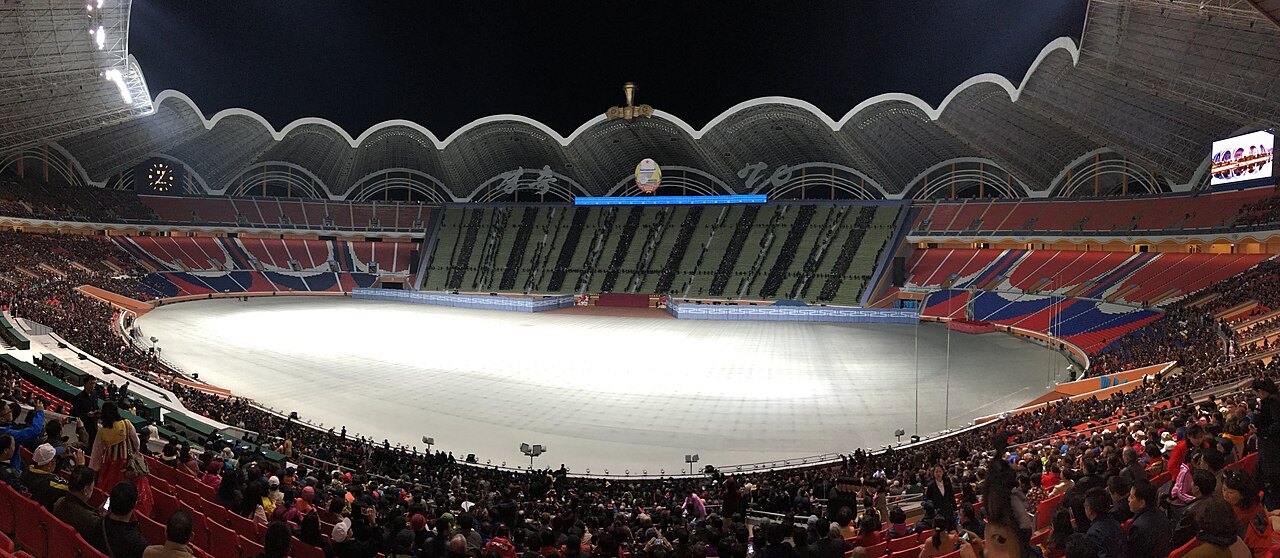
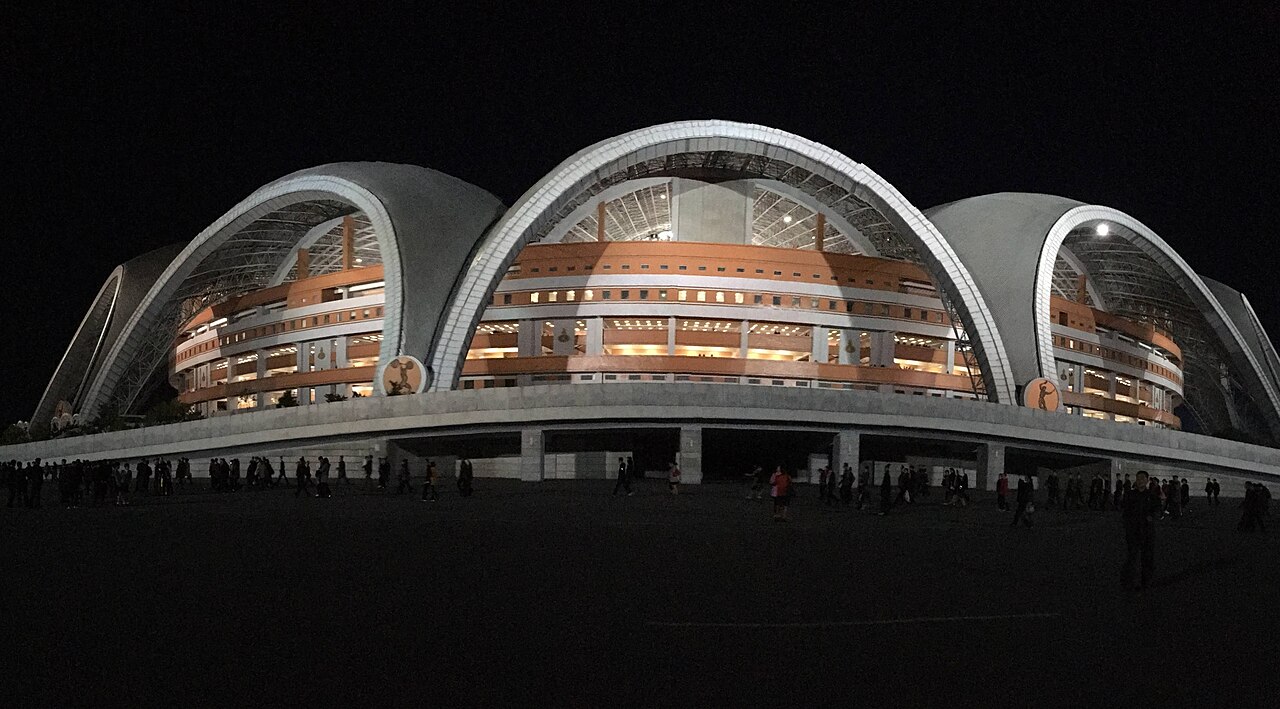
Rising from Rungra Island in the middle of Pyongyang’s Taedong River, the Rungrado 1st of May Stadium is one of the most extraordinary — and least visited — sports venues on Earth. Its scalloped roof of 16 concrete arches, designed to resemble a magnolia blossom, crowns a structure that covers more than 20 hectares and once claimed a capacity of 150,000, a figure that made it the largest stadium in the world for decades. Today, after a mid-2010s renovation replaced long benches with individual seats, its capacity is generally put at 113,281 — still enough to rank it second on our list of the largest stadiums in the world.
Key Stats
| Capacity | 113,281 (originally claimed at 150,000) |
| Opened | May 1, 1989 |
| Primary use | Football, athletics and the Arirang Mass Games |
| Location | Rungra Island, Pyongyang, North Korea |
| Record attendance | 190,000 — Collision in Korea wrestling event, April 29, 1995 (per local authorities) |
A Stadium Built to Make a Statement
The Rungrado 1st of May Stadium was born out of Cold War rivalry. After Seoul won the right to host the 1988 Summer Olympics, North Korea answered by securing the 13th World Festival of Youth and Students for Pyongyang in 1989 and launching a wave of monumental construction projects. The stadium opened on May 1, 1989 — International Workers’ Day, which gives the venue its name — and hosted the festival’s opening and closing ceremonies. At completion it was the largest stadium ever built in Asia.
The building itself is enormous by any measure. Its eight stories contain more than 207,000 square meters of floor space, the main pitch covers 22,500 square meters, and the lobes of the ringed roof peak more than 60 meters (200 feet) above the ground. For nearly three decades its official 150,000 capacity stood unchallenged at the top of world stadium rankings, until India’s Narendra Modi Stadium opened in 2020 and the Rungrado’s own renovation trimmed its seat count.
Mass Games, Wrestling Records and Rare Football
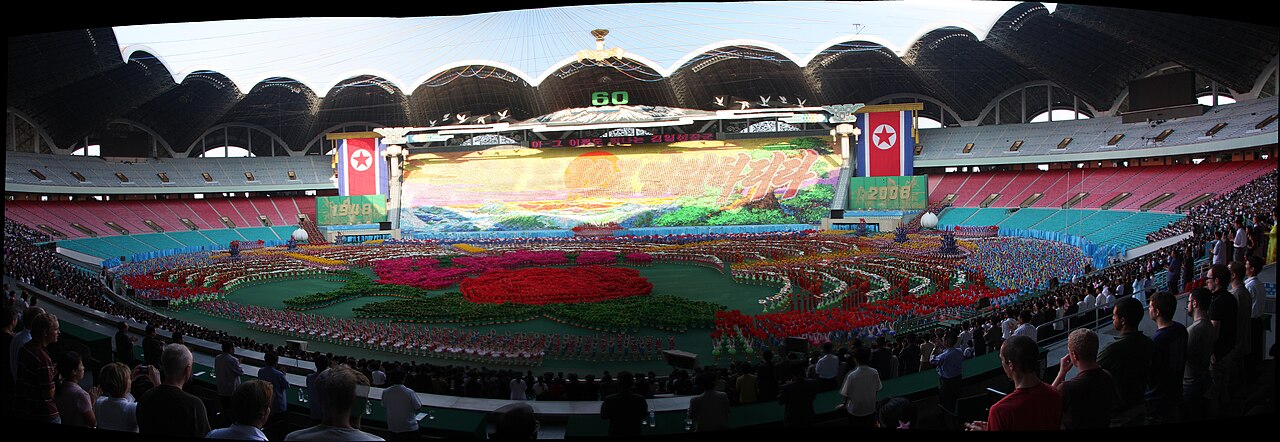
Although football matches and occasional athletics meets are staged here — including six group-stage matches of 2018 AFC U-23 Championship qualification in July 2017 — the stadium is best known as the home of the Arirang Mass Games. These synchronized gymnastics-and-arts spectacles involve as many as 100,000 performers, and in 2007 Guinness World Records recognized the Arirang Festival as the largest gymnastics display ever staged, with 100,090 participants.
The stadium also holds one of the strangest records in sports entertainment: Collision in Korea, a two-night professional wrestling event held on April 28–29, 1995, remains the largest wrestling pay-per-view ever staged, with local authorities reporting crowds of 150,000 and 190,000 on its two nights. More recently, the venue hosted a landmark political moment — in September 2018, South Korean president Moon Jae-in addressed roughly 150,000 North Korean spectators alongside Kim Jong Un during the Pyongyang inter-Korean summit — and since the end of 2022 it has served as Pyongyang’s main stage for New Year’s Eve celebrations.
Visiting and the View from Pyongyang
Seeing the Rungrado 1st of May Stadium in person is possible only on tightly controlled guided tours of North Korea, and event access generally means attending a Mass Games performance when they are scheduled. The stadium’s island setting makes it one of Pyongyang’s most photographed landmarks: its white, petal-like roof dominates the skyline along the Taedong River, particularly when illuminated at night. The annual Pyongyang Marathon has also used the stadium, giving a small number of foreign runners the rare experience of finishing inside its vast bowl.
Sherpa-lined and windproof, with a waterproof back for wet bleachers. Folds into its own pouch.
For late-season football, outdoor hockey and October park nights. Shake, pocket, and stay warm for hours.
12 x 10.5 x 6 in. — built to the common stadium clear-bag size. Check your venue's rules.
FAQ
Is Rungrado 1st of May Stadium the biggest stadium in the world?
Not anymore. It held that title for roughly 30 years under its original claimed capacity of 150,000, but it now ranks second behind India’s 132,000-seat Narendra Modi Stadium. With a renovated capacity of 113,281, it remains the largest stadium outside India — see the full ranking of the world’s largest stadiums.
Why is it called the 1st of May Stadium?
The stadium opened on May 1, 1989 — International Workers’ Day, a major holiday in socialist countries — and is named for that date. “Rungrado” refers to Rungra Island, its site in the Taedong River.
What is the stadium used for today?
It hosts occasional football matches and athletics events, but its signature use is the Arirang Mass Games — gigantic synchronized performances with up to 100,000 participants — along with major state ceremonies and, in recent years, New Year’s Eve concerts.
Photo: Mike Connolly via Wikimedia Commons (CC BY 2.0)
It is so deserving that the people of North Korea can have at least one nice thing!