
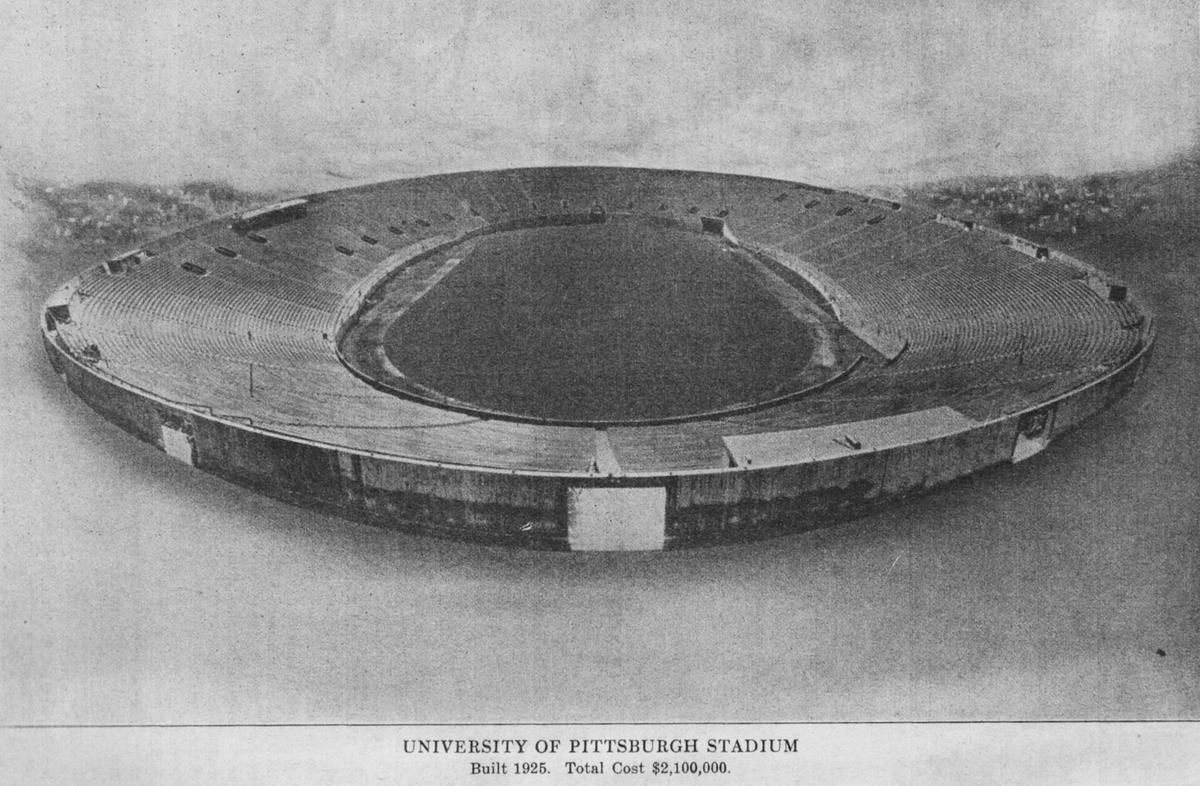
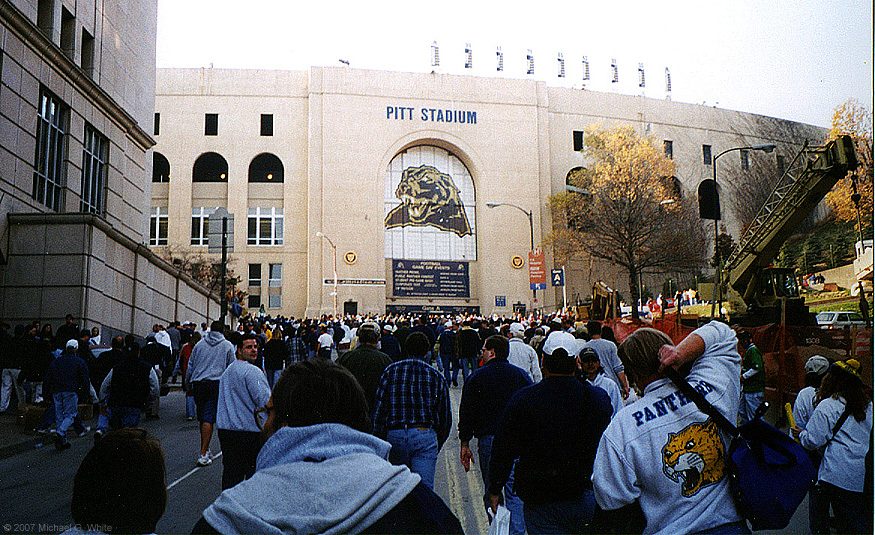
Pitt Stadium stood on Terrace Street in Pittsburgh’s Oakland neighborhood from 1925 until 1999, serving as the home field for University of Pittsburgh football across nearly eight decades of program history. Designed by Pitt graduate W. S. Hindman and built for about $2.1 million, the stadium opened on September 1, 1925, and quickly became one of the signature venues in college football during an era when Pitt teams under coaches like Jock Sutherland built national reputations.
Beyond college football, Pitt Stadium had an unusual second life as an NFL venue, hosting the Pittsburgh Steelers on a shared or exclusive basis from the 1940s through 1969 before Three Rivers Stadium opened. The stadium closed on November 13, 1999, after the Panthers beat Notre Dame 37-27 in the final game, and was demolished that December to make way for the Petersen Events Center, which opened on the same site in 2002.
- Pittsburgh Steelers played here 1958–1969. See every Steelers stadium →
Stats at a Glance
- Team(s): Pittsburgh Panthers football; Pittsburgh Steelers (1942, 1958-1969)
- Location: Terrace Street, Oakland, Pittsburgh, Pennsylvania
- Opened: September 1, 1925
- Closed/Demolished: Closed November 13, 1999; demolished December 1999
- Capacity: 69,400 (1925-c.1949); reduced to 56,500 (c.1949-1999)
- Record attendance: 68,918 vs. Fordham on October 29, 1938
A Home Built for Championship Football
Pitt Stadium rose during a golden era for Pittsburgh football, and its original 69,400-seat capacity reflected the massive crowds the program drew in the late 1920s and 1930s. The seating bowl was later trimmed to roughly 56,500 due to updated fire and safety codes and wider individual seats, but the stadium remained one of the largest and loudest venues in the sport for most of the 20th century.
The record crowd of 68,918 packed in for a 1938 win over Fordham, a reminder of how central the stadium was to campus and city life. Over the decades it also hosted Pitt basketball, soccer, baseball, and track and field events, making it a true multi-sport hub for the university long before dedicated arenas became standard.
Shared Ground With the Steelers
For much of the mid-20th century, Pitt Stadium doubled as an NFL venue. The Pittsburgh Steelers played there in a 1942 exhibition and then split or fully occupied the stadium from 1958 through 1969, before Three Rivers Stadium opened downtown. That overlap produced one of football’s most famous images, a 1964 photograph of New York Giants quarterback Y. A. Tittle, bloodied and helmetless, taken on the Pitt Stadium field.
When the stadium closed after the 1999 season, the Panthers played briefly at Three Rivers Stadium before settling into Heinz Field in 2001. Demolition crews recycled much of the stadium’s concrete into the construction of the Petersen Events Center, which now occupies the same Oakland site.
Explore more: Explore more legendary stadiums.
Sherpa-lined and windproof, with a waterproof back for wet bleachers. Folds into its own pouch.
For late-season football, outdoor hockey and October park nights. Shake, pocket, and stay warm for hours.
12 x 10.5 x 6 in. — built to the common stadium clear-bag size. Check your venue's rules.
Pitt Stadium FAQs
When did Pitt Stadium open and close?
It opened on September 1, 1925, and closed on November 13, 1999, before being demolished in December 1999.
What was Pitt Stadium’s capacity?
It originally seated about 69,400 fans; that was reduced to roughly 56,500 starting around 1949 due to safety code changes and wider seats.
What replaced Pitt Stadium?
The Petersen Events Center, which opened in April 2002, was built on the former stadium site along with student housing.
Get More from Pitt Stadium
Log the coasters, stadiums, and venues you’ve experienced, rate Pitt Stadium, and see what your friends thought. Get the ThrillZing app.
Photo: Crazypaco at English Wikipedia / CC BY 2.5, via Wikimedia Commons.