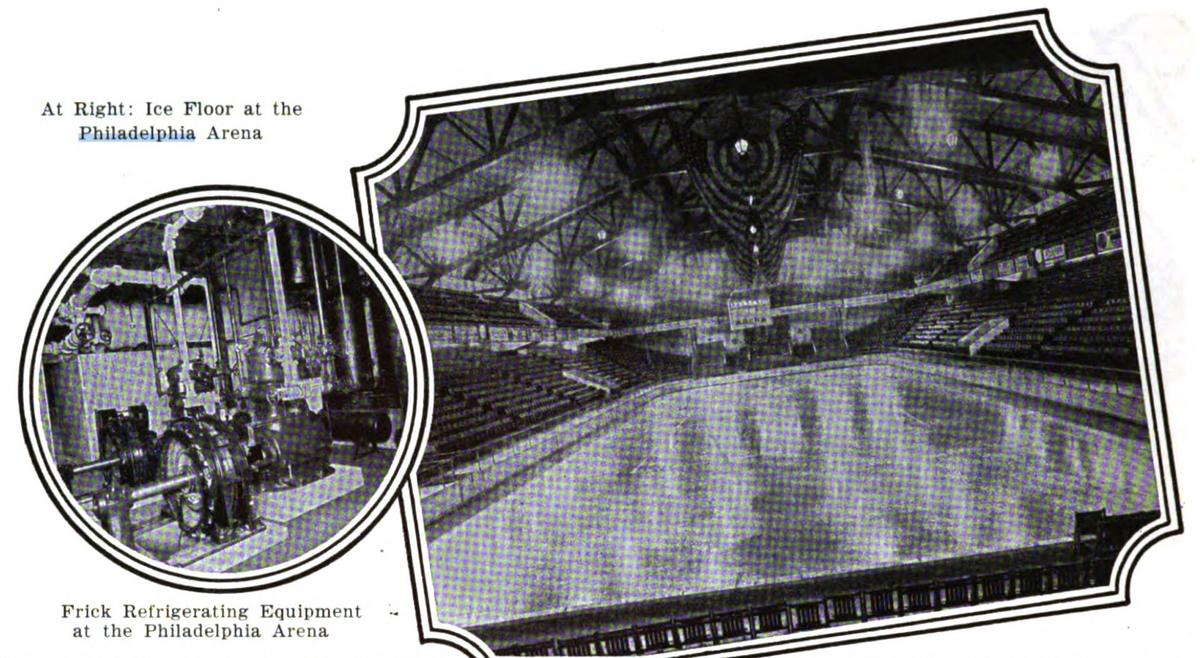
The Philadelphia Arena opened on February 14, 1920, at 4530 Market Street in West Philadelphia, originally built as the Philadelphia Auditorium and Ice Palace. Constructed by George F. Pawling, it debuted with a college hockey game between Yale and Princeton before a crowd of over 4,000, and movie-theater magnate Jules Mastbaum acquired it in 1922, and it was renamed simply The Arena in 1925.
Over six decades the building became one of Philadelphia’s most important sports venues, hosting the NHL’s short-lived Philadelphia Quakers, a string of minor-league hockey clubs, boxing and wrestling cards featuring stars like Sugar Ray Robinson, and the Philadelphia Warriors, who won the BAA’s inaugural championship there in 1947. The venue was briefly renamed in honor of Martin Luther King Jr. in 1980, closed in 1981 after years of decline, and was destroyed by arson in 1983.
- Golden State Warriors played here 1946–1962. See every Warriors arena →
- Philadelphia 76ers played here 1963–1967. See every 76ers arena →
Stats at a Glance
- Team(s): Philadelphia Quakers (NHL), Philadelphia Warriors & 76ers (NBA)
- Location: 4530 Market Street, West Philadelphia, PA
- Opened: February 14, 1920
- Closed/Demolished: Closed 1981; destroyed by arson August 24, 1983
- Capacity: About 4,000–9,300 depending on era and configuration
- Notable fact: Hosted the Philadelphia Warriors’ 1947 BAA championship win
A Home for Hockey, Boxing, and Basketball
Built first as an ice-skating palace, the Arena quickly grew into a multi-sport hub. It hosted the Philadelphia Quakers during their only NHL season in 1930–31, along with a succession of minor-league hockey teams including the Arrows, Ramblers, and Rockets. Boxing and wrestling cards packed the building for decades, drawing crowds that at times topped 10,000 for marquee fights.
Basketball became the Arena’s most lasting legacy. The Philadelphia Warriors made it their primary home from 1946 to 1952, clinching the Basketball Association of America’s first-ever championship there in 1947. The 76ers later used the Arena part-time through the mid-1960s before the Spectrum opened in 1967 and drew the city’s major sports tenants away.
Decline and a Fiery End
As Philadelphia’s newer arenas and the Spectrum absorbed major tenants through the 1960s and 70s, the aging Market Street building slipped into secondary use. In 1980 new owners renamed it the Martin Luther King Jr. Arena, hoping to find it new purpose, but the effort was short-lived and the building closed in 1981.
On August 24, 1983, the building was destroyed by arson, closing the book on a venue that had hosted everything from Yale-Princeton hockey to NBA championship basketball. Nothing of the original Arena remains at the Market Street site today.
Explore more: More historic stadiums.
Sized to the NFL's 12x6x12 clear-bag rule. Fits snacks, a jacket and a rally towel.
A see-through purse that looks like a purse. Works for most stadium, arena and concert bag policies.
Bleachers for three hours, but with back support. Folds flat and clips to the bench.
Philadelphia Arena FAQs
What made the Philadelphia Arena historically significant?
It was the home court where the Philadelphia Warriors won the Basketball Association of America’s first-ever championship in 1947, and it also hosted the NHL’s Philadelphia Quakers during their only season.
When did the Philadelphia Arena close?
It closed in 1981 after the Spectrum took over as the city’s primary sports venue, and the building was destroyed by arson on August 24, 1983.
Where was the Philadelphia Arena located?
It stood at 4530 Market Street in West Philadelphia, near 46th and Market Streets.
Get More from Philadelphia Arena
Log the coasters, stadiums, and venues you’ve experienced, rate Philadelphia Arena, and see what your friends thought. Get the ThrillZing app.
Photo: Ice and Refrigeration / Public domain, via Wikimedia Commons.