
Olympiastadion Berlin opened on August 1, 1936, as the centerpiece of that year’s Summer Olympics, a monumental stone-clad bowl designed by architect Werner March under the Nazi regime’s grand urban planning vision. Nearly nine decades later, the stadium still stands in the Westend district of Charlottenburg-Wilmersdorf, having survived World War II, a divided Berlin, and a complete modernization to become one of Europe’s most storied sporting venues.
Today the stadium seats 74,475 spectators and serves as the home ground of Hertha BSC, which competes in 2. Bundesliga for the 2026-27 season. The venue’s résumé remains remarkable regardless of its tenant’s division: it hosted the 2006 FIFA World Cup final, the 2015 UEFA Champions League final, and the Euro 2024 final, in addition to staging the men’s DFB-Pokal final every year since 1985, an arrangement now extended through 2030. Few stadiums anywhere can claim a century-spanning history quite like it.
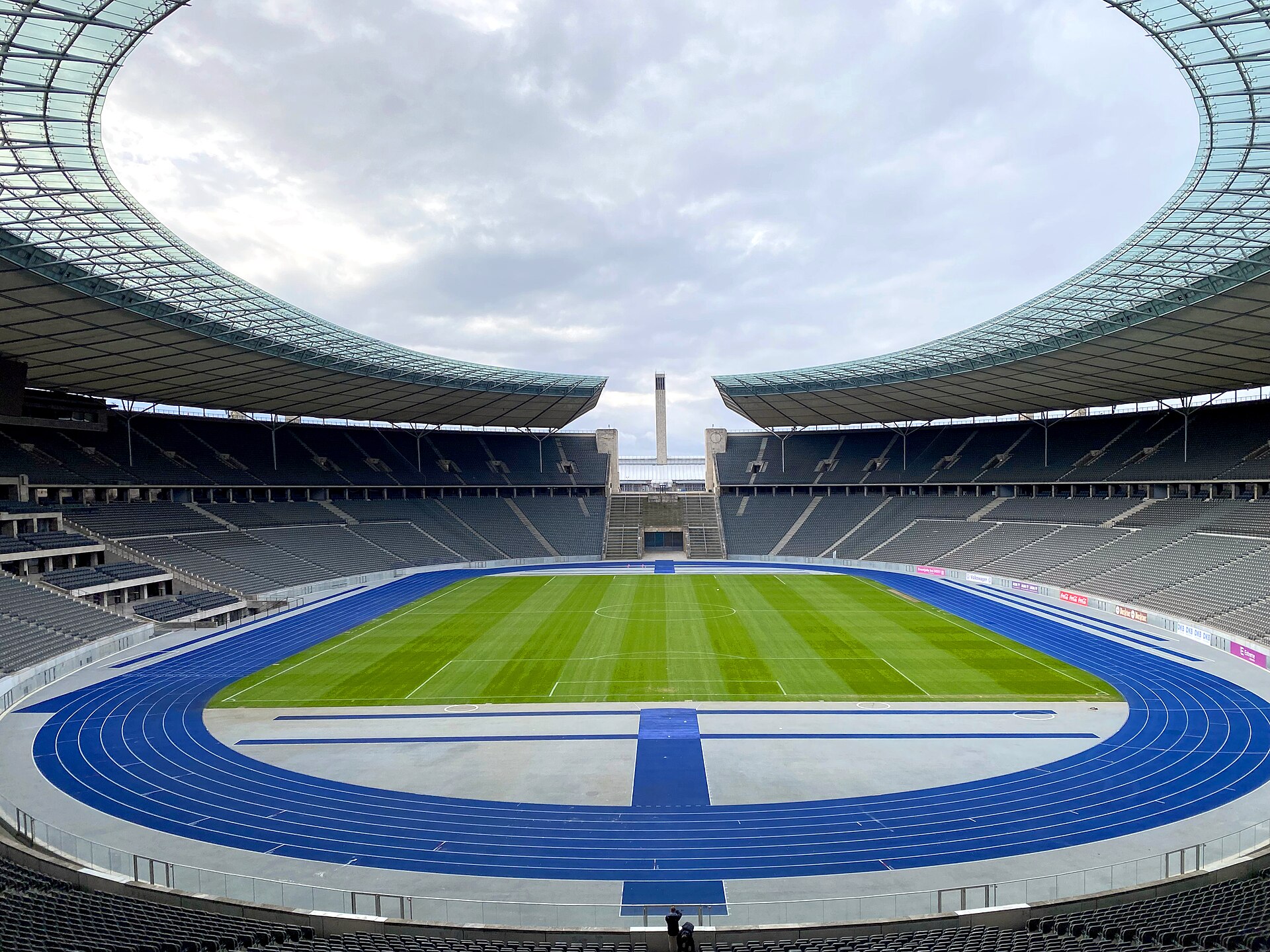
Stats at a Glance
- Team(s): Hertha BSC (2. Bundesliga)
- Location: Berlin, Germany
- Opened: August 1, 1936
- Capacity: About 74,475
- Architect: Werner March (original); renovated by gmp Architekten (2000–2004)
- Notable fact: Hosted the 2006 World Cup final and Euro 2024 final
The Stadium Experience
Visitors entering Olympiastadion pass beneath the original 1936 limestone colonnades before reaching a modern bowl that was extensively rebuilt between 2000 and 2004 for roughly €242 million. That renovation lowered the pitch, added a translucent roof spanning about 37,000 square meters, and brought the venue up to modern safety and comfort standards while preserving its historic outer shell. The result is a rare hybrid: a protected architectural landmark that still functions as a top-tier international sports venue.
On matchdays, the Olympic bell tower, the Marathon Gate, and the Maifeld parade grounds surrounding the stadium give visitors a sense of the site’s Olympic-era scale, while inside, sightlines were redesigned so every seat in the bowl faces the action directly, unlike the running-track-era layout of the original build.
A Century of Major Events
Beyond the 1936 Olympics, Olympiastadion has hosted 1974 World Cup group matches, the 2006 World Cup final between Italy and France, the 2011 FIFA Women’s World Cup, the 2015 UEFA Champions League final, the 2023 Special Olympics World Summer Games, and the 2024 UEFA European Championship final. It has also hosted the men’s DFB-Pokal final every year since 1985, with an agreement extending that tradition through at least 2030.
Explore more: Explore more legendary stadiums.
For late-season football, outdoor hockey and October park nights. Shake, pocket, and stay warm for hours.
12 x 10.5 x 6 in. — built to the common stadium clear-bag size. Check your venue's rules.
USB-charged warmers for cold night games — no disposable packets.
Olympiastadion Berlin FAQs
How old is Olympiastadion Berlin?
It opened on August 1, 1936, for the Berlin Summer Olympics, making it nearly 90 years old, though a major 2000-2004 renovation modernized much of its interior.
What is the capacity of Olympiastadion Berlin?
The stadium seats approximately 74,475 spectators for football matches, following its early-2000s renovation.
Which team plays at Olympiastadion Berlin?
Hertha BSC has called the stadium home since 1963 and competes in 2. Bundesliga for the 2026-27 season; the venue also hosts the annual DFB-Pokal final and German national team matches.
Get More from Olympiastadion Berlin
Log the coasters, stadiums, and venues you’ve experienced, rate Olympiastadion Berlin, and see what your friends thought. Get the ThrillZing app.
Photo: Matthias Süßen / CC BY-SA 4.0, via Wikimedia Commons.