
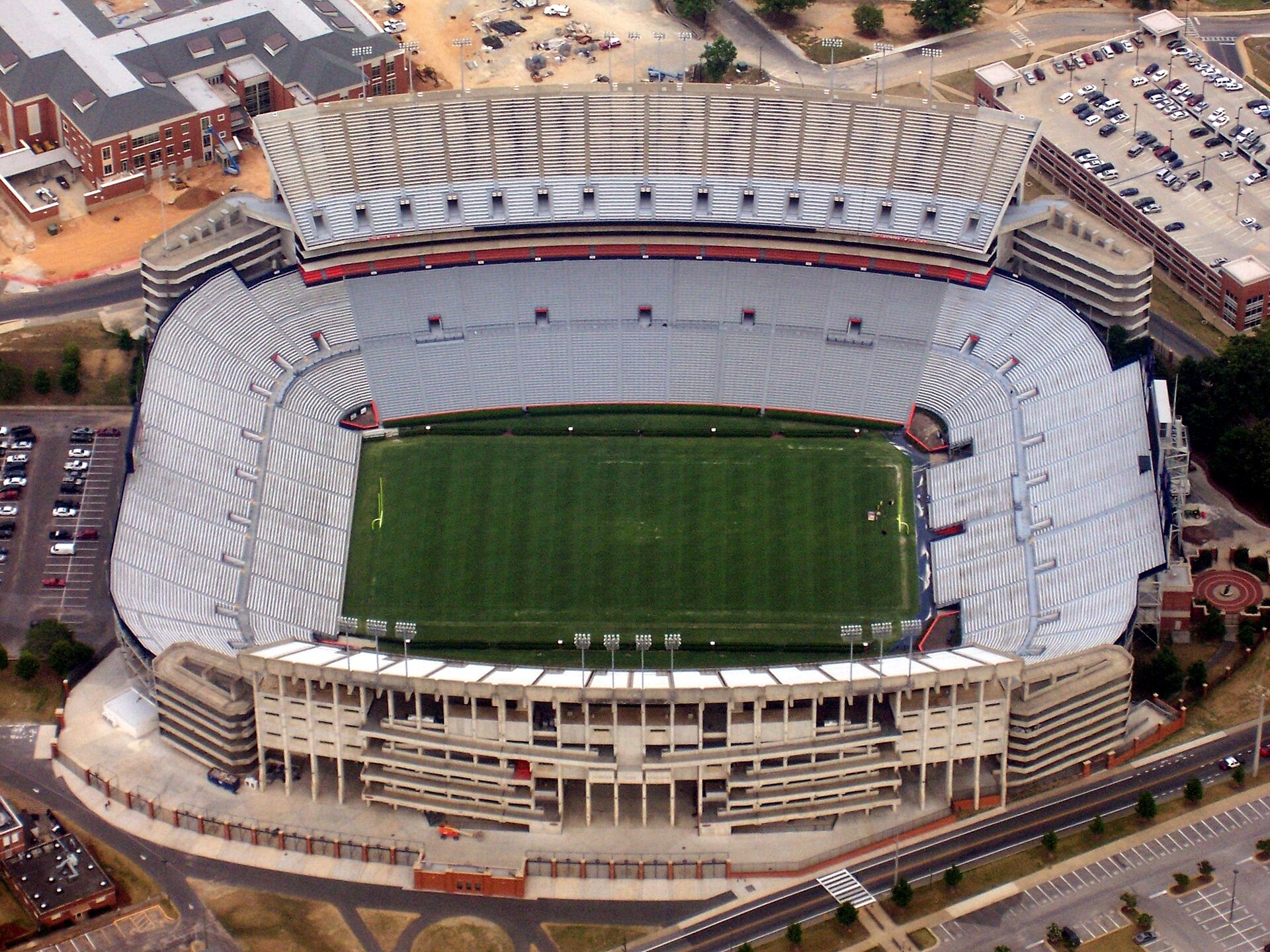
Jordan–Hare Stadium has served as the home field of the Auburn Tigers football team on the Auburn University campus in Auburn, Alabama, since it opened on November 9, 1939. Originally called Auburn Stadium and later Cliff Hare Stadium, the venue took its current name in 1973 to honor both Cliff Hare, a member of Auburn’s first football team and later dean of the university, and Ralph “Shug” Jordan, Auburn’s winningest head coach.
Through decades of expansions in the 1960s, 1970s, and again in the 2000s and 2010s, the stadium grew from a modest grandstand into one of the largest on-campus venues in college football. Today it is officially known as Pat Dye Field at Jordan–Hare Stadium, honoring the coach who led Auburn through a successful era in the 1980s, and it remains one of the sport’s most recognizable settings for its pregame Tiger Walk and eagle flight traditions.

Stats at a Glance
- Team(s): Auburn Tigers (NCAA, SEC)
- Location: Auburn, Alabama
- Opened: November 9, 1939
- Capacity: About 88,043
- Surface: Tifway 419 Bermuda grass
- Notable fact: One of the largest on-campus stadiums in NCAA football
The Gameday Experience
On football Saturdays, Jordan–Hare Stadium swells to become one of the largest cities in Alabama for a few hours. The pregame Tiger Walk sees players make their way through a corridor of fans toward the stadium, and games are preceded by the flight of Auburn’s live eagle mascot circling the field before landing at midfield, a tradition tied closely to the team’s “War Eagle” battle cry.
The stadium’s bowl shape, completed through renovations in 1970 and expanded further in subsequent decades, concentrates crowd noise onto the field, and its videoboard—among the largest in college athletics—has become a fixture of the modern gameday atmosphere.
Growth and Renovation
What began as a stadium with grandstand seating for a few thousand fans grew through repeated expansions to its current capacity of roughly 88,000. Renovation projects in the 2000s, 2010s, and 2020s added upper decks, premium seating, and video technology while preserving the horseshoe-turned-bowl layout established decades earlier.
The playing surface was dedicated as Pat Dye Field in 2005, recognizing the coach’s contributions to the program, layering another name onto a venue whose identity has evolved alongside Auburn football itself.
Explore more: Explore more legendary stadiums.
Sized to the NFL's 12x6x12 clear-bag rule. Fits snacks, a jacket and a rally towel.
A see-through purse that looks like a purse. Works for most stadium, arena and concert bag policies.
Bleachers for three hours, but with back support. Folds flat and clips to the bench.
Jordan–Hare Stadium FAQs
When did Jordan–Hare Stadium open?
The stadium opened on November 9, 1939, originally known as Auburn Stadium.
What is the capacity of Jordan–Hare Stadium?
Jordan–Hare Stadium seats about 88,043 fans, making it one of the largest on-campus stadiums in college football.
Why is it called Jordan–Hare Stadium?
It is named for Cliff Hare, a member of Auburn’s first football team and later university dean, and Ralph “Shug” Jordan, Auburn’s winningest football coach.
Get More from Jordan–Hare Stadium
Log the coasters, stadiums, and venues you’ve experienced, rate Jordan–Hare Stadium, and see what your friends thought. Get the ThrillZing app.
Photo: Auburn Alumni Association / CC BY 2.0, via Wikimedia Commons.