
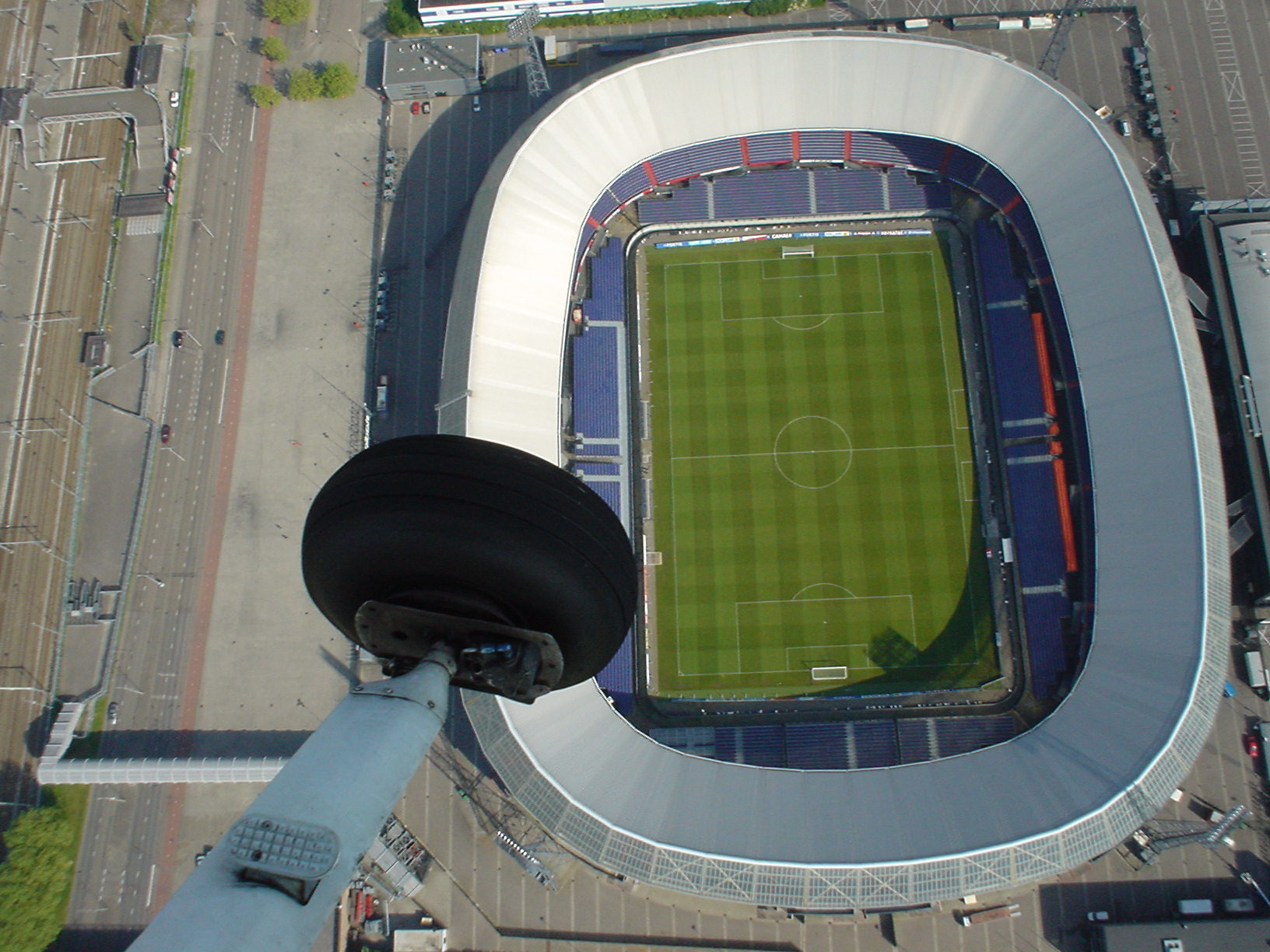
De Kuip, officially known as Stadion Feijenoord, opened on March 27, 1937, in Rotterdam, Netherlands, and has served as the home ground of Feyenoord ever since. Designed by architect Leendert van der Vlugt, the stadium earned its nickname, which translates to “the Tub,” thanks to its distinctive bowl-shaped double-tier seating that wraps tightly around the pitch without a running track breaking up the atmosphere.
Over nearly nine decades, De Kuip has become one of European football’s most storied venues, surviving a scrap-metal threat from German occupiers during World War II and later undergoing a major 1994 renovation that converted it into an all-seater stadium. It has also hosted the Dutch national team for select matches and, for decades, welcomed major touring musicians before the city curtailed concerts there after mid-2025.

Stats at a Glance
- Team(s): Feyenoord (since 1937); Netherlands national team (selected matches)
- Location: Rotterdam, Netherlands
- Opened: March 27, 1937
- Capacity: About 47,500 (football); up to 50,000 for concerts/events
- Architect: Leendert van der Vlugt (original); Broekbakema (1994 renovation)
- Notable Fact: Has hosted a record ten UEFA club competition finals, plus the UEFA Euro 2000 final separately
The Ride Experience
Fans inside De Kuip sit close to the action thanks to its steep, two-tiered bowl design with no athletics track separating the stands from the pitch. The compact footprint amplifies crowd noise, making it one of the more intimidating away trips in Dutch football, especially when Feyenoord’s vocal supporters fill the lower tier.
The stadium’s structure has changed relatively little since the 1994 renovation, preserving a classic mid-century European stadium feel that contrasts with the newer, more corporate arenas built across the continent in recent decades.
A History of Big Matches
De Kuip has hosted a record ten UEFA club competition finals, including the 1972 European Cup final between Ajax and Inter Milan, six UEFA Cup Winners’ Cup finals between 1963 and 1997, and two UEFA Cup finals, most recently in 2002 when home club Feyenoord beat Borussia Dortmund. Separately, the stadium also hosted the UEFA Euro 2000 final, where France beat Italy 2-1 after extra time, and the 2023 UEFA Nations League final.
Feyenoord explored building a new stadium along the Rotterdam waterfront for years before dropping those plans in 2022. In June 2026 the club became the owner of De Kuip, which continues to serve as its home, and has committed to renovating the stadium.
Explore more: Explore more legendary stadiums.
Keeps chili hot from the tailgate to the fourth quarter.
Team-color face paint in a twist-up stick — no brushes, no mess in the car.
Sized to the NFL's 12x6x12 clear-bag rule. Fits snacks, a jacket and a rally towel.
De Kuip FAQs
What does “De Kuip” mean?
De Kuip is Dutch for “the Tub,” a nickname referencing the stadium’s deep, bowl-shaped seating bowl.
Who plays at De Kuip?
Feyenoord has played its home matches at De Kuip since the stadium opened in 1937, and the Netherlands national team occasionally uses it for select fixtures.
How many European finals has De Kuip hosted?
De Kuip has hosted a record ten UEFA club competition finals, including two European Cup finals, six Cup Winners’ Cup finals, and two UEFA Cup finals. It has also separately hosted the UEFA Euro 2000 final and the 2023 UEFA Nations League final.
Get More from De Kuip
Log the coasters, stadiums, and venues you’ve experienced, rate De Kuip, and see what your friends thought. Get the ThrillZing app.
Photo: Vincenzo.togni / CC BY-SA 4.0, via Wikimedia Commons.