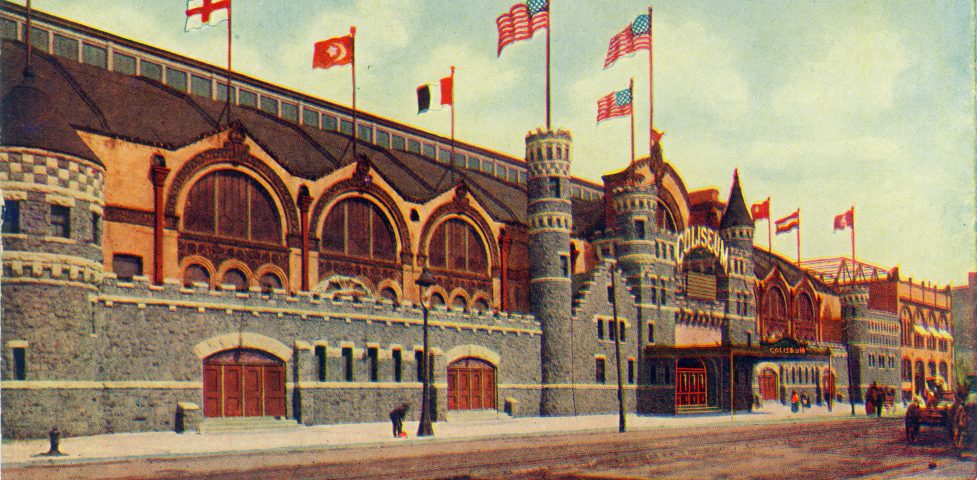
The Chicago Coliseum was a cavernous arena at 1513 South Wabash Avenue on Chicago’s Near South Side, built in 1899 by candy magnate and museum promoter Charles F. Gunther. Its most unusual feature wasn’t a scoreboard or grandstand but its walls: a castellated stone facade salvaged from the old Libby Prison, a Confederate Civil War prison Gunther had shipped brick by brick from Richmond, Virginia, and displayed in Chicago as a war museum before rebuilding the site into the Coliseum.
Over more than seven decades, the Coliseum served as one of Chicago’s great multipurpose halls, drawing national political conventions, early NHL and NBA games, boxing cards, and the nation’s first roller derby. It closed in 1971 as newer arenas drew events away, and after years of decline the structure was finally cleared in the early 1990s, leaving little trace of a building that had once shaped both American sports and American politics.
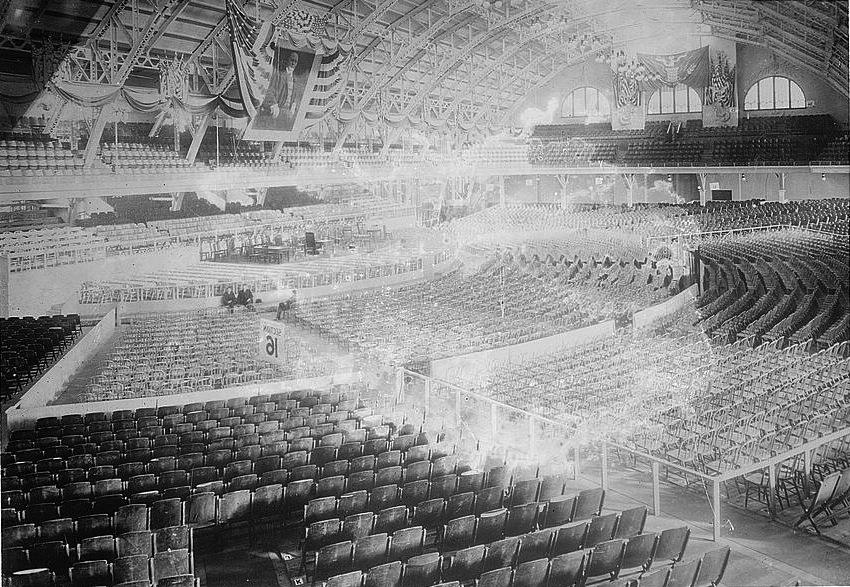
- Chicago Blackhawks played here 1926–1929. See every Blackhawks arena →
- Washington Wizards played here 1962–1963. See every Wizards arena →
Stats at a Glance
- Team(s): Chicago Black Hawks (NHL, 1926–1929), Chicago Zephyrs (NBA, 1962–1963)
- Location: 1513 S. Wabash Avenue, Chicago, Illinois
- Opened: 1899
- Closed: 1971 (demolished in the early 1990s)
- Capacity: About 6,000–7,000 for sporting events
- Political Conventions Hosted: 5 Republican National Conventions (1904, 1908, 1912, 1916, 1920)
- Built From: Salvaged stone walls of the Civil War-era Libby Prison
A Civil War Prison Reborn as an Arena
The Coliseum’s backstory is as strange as any in American stadium history. In 1889, Charles Gunther had Richmond’s Libby Prison dismantled and shipped north to Chicago, where he reassembled it as a Civil War museum. A decade later, when the museum closed, Gunther tore down most of the building but kept its distinctive crenellated stone wall, folding it into the facade of a brand-new exhibition hall: the third and final Chicago Coliseum.
That hybrid building quickly became a civic landmark, hosting everything from livestock shows to the Lincoln Jubilee of 1915, which marked the 50th anniversary of the end of the Civil War and emancipation.
From Political Conventions to Pro Sports
The Coliseum’s size and central location made it a natural fit for presidential politics. It hosted five Republican National Conventions between 1904 and 1920, along with Progressive Party conventions in 1912 and 1916, cementing Chicago’s role as a convention city in the early 20th century.
It also had a quieter life as a sports venue. The NHL’s Chicago Black Hawks played there from 1926 to 1929 before Chicago Stadium opened, and the NBA’s Chicago Zephyrs used it during the 1962–63 season. The building hosted the world’s first roller derby in 1935 and later shifted toward boxing, wrestling, and rock concerts before closing in 1971.
Explore more: Explore more historic stadiums.
Bleachers for three hours, but with back support. Folds flat and clips to the bench.
For upper-deck seats. Watch line play at the stadium, or the far side of the park from the top of a lift hill.
Sherpa-lined and windproof, with a waterproof back for wet bleachers. Folds into its own pouch.
Chicago Coliseum FAQs
Why was the Chicago Coliseum built with Civil War prison walls?
Developer Charles Gunther had already shipped Richmond’s Libby Prison to Chicago in 1889 to run as a war museum. When that museum closed around 1899, he reused the prison’s stone facade in the new Coliseum built on the same site.
What NHL and NBA teams played at the Chicago Coliseum?
The Chicago Black Hawks played their first NHL seasons there from 1926 to 1929, and the NBA’s Chicago Zephyrs played home games there during the 1962–63 season before the franchise relocated to Baltimore.
When was the Chicago Coliseum demolished?
The building closed for regular use in 1971 and was sold for redevelopment in 1982. Parts of the structure remained standing until it was fully cleared in the early 1990s.
Get More from Chicago Coliseum
Log the coasters, stadiums, and venues you’ve experienced, rate Chicago Coliseum, and see what your friends thought. Get the ThrillZing app.
Photo: George R. Lawrence / Public domain, via Wikimedia Commons.