
This ranks the 15 largest soccer stadiums in Europe by published seating capacity, as of November 2026. Every venue here is open and currently hosting matches. Several are shared with rugby or athletics, and a handful carry different seated or standing totals for domestic league play versus UEFA and FIFA competitions; in those cases, the wider figure used for most home matches is listed. Figures are drawn from the clubs, stadium operators, federations, or Wikipedia and cross-checked across sources.
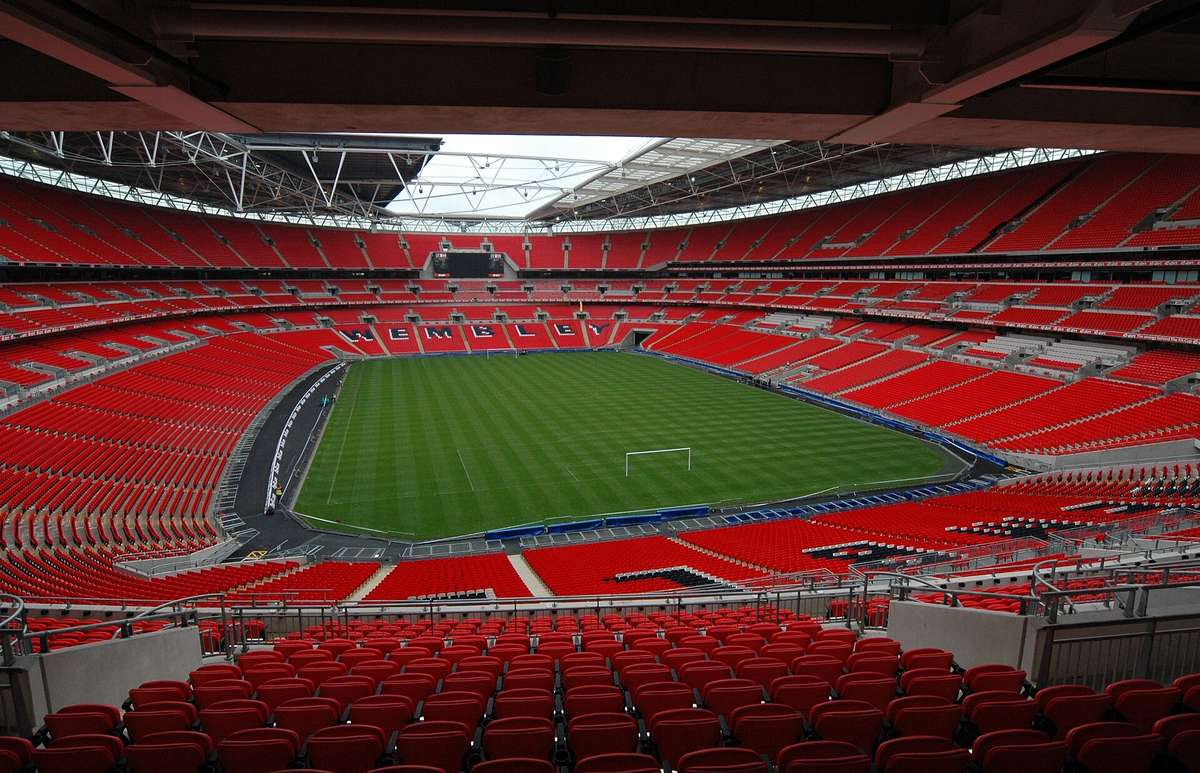
Wembley Stadium leads at 90,000 seats, about 8,600 more than Signal Iduna Park in Dortmund, the largest club-owned ground on the list. Real Madrid’s Santiago Bernabéu sits just behind Signal Iduna Park at 81,000, the figure the club has used since its post-renovation reopening, though Real Madrid has never published one definitive number and other sources have cited anywhere from 78,297 to 85,000. That 81,000 figure effectively ties the Bernabéu with Luzhniki Stadium in Moscow, Russia’s national stadium, which was deliberately cut to the same round number ahead of the 2018 World Cup. The biggest surprise is Camp Nou: still planned to reach 105,000 once Barcelona’s rebuild is finished, it is currently operating at a reduced 62,652 seats while construction continues, which puts it near the bottom of this list rather than the top.
The Full Ranking
Capacities below reflect each stadium’s seating as actually in use in November 2026, not a blueprint or future target.
| # | Stadium | Location | Capacity |
|---|---|---|---|
| 1 | Wembley Stadium | London, England | 90,000 |
| 2 | Signal Iduna Park | Dortmund, Germany | 81,365 |
| 3 | Santiago Bernabéu | Madrid, Spain | 81,000 (disputed, see below) |
| 4 | Luzhniki Stadium | Moscow, Russia | 81,000 |
| 5 | Stade de France | Saint-Denis, France | 80,698 |
| 6 | Atatürk Olympic Stadium | Istanbul, Turkey | 77,563 |
| 7 | San Siro (Stadio Giuseppe Meazza) | Milan, Italy | 75,817 |
| 8 | Allianz Arena | Munich, Germany | 75,000 |
| 9 | Olympiastadion Berlin | Berlin, Germany | 74,475 |
| 10 | Old Trafford | Manchester, England | 74,158 |
| 11 | Principality Stadium | Cardiff, Wales | 73,931 |
| 12 | Riyadh Air Metropolitano | Madrid, Spain | 70,813 |
| 13 | Stadio Olimpico | Rome, Italy | 70,634 |
| 14 | Tottenham Hotspur Stadium | London, England | 62,850 |
| 15 | Camp Nou | Barcelona, Spain | 62,652 |
Wembley’s Lead, and the Chasing Pack
Wembley Stadium, rebuilt on the site of the old Wembley and reopened in 2007, is England’s national stadium and the regular home of England internationals, the FA Cup final, and League Cup final. At 90,000 seats it is the largest venue on this list built and run primarily for soccer, rather than shared with another sport.
Signal Iduna Park’s 81,365 includes the Südtribüne, a large standing terrace used for Bundesliga matches; for UEFA competition the terrace is converted to seating and capacity drops to roughly 65,800, a reminder that one published number does not always apply to every match. The Santiago Bernabéu and Luzhniki Stadium both land at 81,000, though for different reasons: the Bernabéu’s figure is the club’s own post-renovation statement, while Luzhniki’s is a fixed total set by Russian authorities before the 2018 World Cup.
How the Capacity Count Works, and Why It Shifts
The Santiago Bernabéu’s capacity is the most contested figure on this list. Real Madrid’s multi-year renovation, completed in 2024, added a retractable roof and a closed-in facade, and the club has not published one definitive post-renovation number. The 81,000 figure used here matches what the club has stated since reopening and is close to the stadium’s pre-renovation capacity of 81,044. Other figures in circulation include 78,297, cited in Spain’s bid book for the 2030 World Cup and close to the 78,107 crowd recorded at a post-renovation El Clásico, and reports that Real Madrid plans to expand toward 85,000 ahead of hosting a potential 2030 World Cup match. Readers should treat the Bernabéu’s exact current capacity as unsettled rather than fixed.
Several other entries here are multi-purpose national stadiums rather than a single club’s permanent home: Stade de France (French national team, also athletics), Luzhniki Stadium (Russian national team, after Spartak Moscow moved out in 2014), Atatürk Olympic Stadium (an all-seater national stadium with no permanent club tenant, listed by the Turkish Football Federation at 77,563), and Principality Stadium (Wales national football and rugby teams, retractable roof). Capacity also isn’t fixed even at club grounds: Allianz Arena holds 75,000 for Bundesliga games but is reduced to roughly 70,000 for UEFA matches, San Siro’s figures range between a 75,817 operating limit and an 80,018 maximum on record, and Atlético Madrid’s Riyadh Air Metropolitano has been expanded in stages since its 2017 reopening, from 68,456 seats to 70,460 in 2023, 70,692 after a further upgrade, and 70,813 in 2026.
Notable Entries and Visiting Tips
Camp Nou’s position at the bottom of this list is temporary. Barcelona’s plan calls for the stadium to pass 100,000 seats again as renovation work finishes in stages, with full completion targeted for before the 2028-29 season; if that holds, it would retake the top spot in Europe. Manchester United has separately floated a roughly 100,000-seat replacement for Old Trafford, though that project hadn’t broken ground as of late 2026.
For anyone planning a visit, note that the shared national stadiums on this list (Stade de France, Luzhniki, Atatürk, Principality) don’t host a resident club’s matches week to week, so check the event calendar before booking a stadium tour or ticket around a specific team.
Explore more: Browse more stadium rankings.
Keeps chili hot from the tailgate to the fourth quarter.
Team-color face paint in a twist-up stick — no brushes, no mess in the car.
Sized to the NFL's 12x6x12 clear-bag rule. Fits snacks, a jacket and a rally towel.
Biggest Soccer Stadiums in Europe FAQs
What is the biggest soccer stadium in Europe?
Wembley Stadium in London, with 90,000 seats, is the largest soccer stadium currently operating in Europe. Camp Nou in Barcelona is planned to reach 105,000 once its renovation is complete, but it currently seats 62,652 while work continues.
Is the Santiago Bernabéu or Signal Iduna Park bigger?
Signal Iduna Park in Dortmund has a confirmed capacity of 81,365, ahead of the Santiago Bernabéu’s stated 81,000. Real Madrid has never published one definitive post-renovation figure for the Bernabéu; other sources have cited numbers from 78,297 up to a planned 85,000.
Why isn’t Camp Nou the biggest stadium in Europe right now?
Camp Nou has been under a multi-year renovation since 2023. Barcelona returned to a partially rebuilt stadium in November 2025, and capacity has been raised in stages to 62,652 as of November 2026, well below its planned final capacity of 105,000.
Get More from Biggest Soccer Stadiums in Europe
Log the coasters, stadiums, and venues you’ve experienced, rate Biggest Soccer Stadiums in Europe, and see what your friends thought. Get the ThrillZing app.
Photo: Arne Müseler / CC BY-SA 3.0 de, via Wikimedia Commons.