
Autodromo Nazionale Monza is a motor racing circuit set inside a royal park just north of Milan, Italy. Opened on September 3, 1922, it was the world’s third purpose-built race track after Brooklands and Indianapolis, and it was built in about 110 days. Its nickname, the “Temple of Speed,” comes from long straights and fast corners that make it the quickest circuit on the Formula 1 calendar.
It has hosted the Italian Grand Prix in every year of the F1 World Championship (since 1950) except 1980, when the race went to Imola. This guide covers the key facts, the records set here, the layout corner by corner, the abandoned banked oval, and how to plan a visit, whether you come for race weekend or a quiet day in the park.
Quick Answer
Autodromo Nazionale Monza is a 5.793 km (3.6 mile) circuit in the Parco di Monza near Milan. It opened in 1922, holds about 118,865 spectators, and hosts the Formula 1 Italian Grand Prix, with a contract that runs through 2031. In 2025 it saw the fastest F1 lap and fastest F1 race on record, and Juan Pablo Montoya’s 372.6 km/h (231.5 mph) from 2005 is the Guinness-recognised top speed in a Grand Prix.
Monza Circuit at a Glance
Location: Parco di Monza, Monza, about 15 km north-east of central Milan. Opened: September 3, 1922. Current Grand Prix layout: 5.793 km (3.6 miles) with 11 corners. Capacity: about 118,865. Nickname: the Temple of Speed. Main event: the Formula 1 Italian Grand Prix, which is booked at Monza through the 2031 season. FIA grade: Grade 1.
The circuit also hosts other international series through the year, such as endurance racing, and it is the home of the Italian motorsport scene. Ferrari fans treat it as a second home race, and the grandstands are famous for turning red on race day.
Monza’s Records: Speed, Laps and Race Pace
Monza is the fastest track in F1 by average speed. At the 2025 Italian Grand Prix, Max Verstappen took pole with a 1:18.792 lap, which was the fastest qualifying lap in World Championship history at an average of about 264.6 km/h. In the race, Lando Norris set the current lap record of 1:20.901, an average of about 257.8 km/h, and Verstappen won the fastest race in championship history ahead of Norris and Oscar Piastri.
For outright top speed, the figure people quote is Juan Pablo Montoya’s 372.6 km/h (231.5 mph) in a McLaren-Mercedes during the 2005 Italian Grand Prix, recognised by Guinness World Records as the fastest speed in an F1 Grand Prix. Modern cars typically spend a very large share of each lap at full throttle, which is why teams run low-drag, low-downforce setups here.
The event has produced storylines to match. Ferrari is the most successful constructor in the Italian Grand Prix, and Michael Schumacher and Lewis Hamilton share the driver record with five wins each at Monza. In 2026, Kimi Antonelli won from 19th on the grid to become the first Italian to win the Italian Grand Prix since 1966.
Track Layout: Corners to Know
The lap is built around long straights joined by heavy braking zones and a few flowing bends. The main corners are:
Variante del Rettifilo (the first chicane): the first big braking zone after the start straight and the classic place for lap-one chaos. Curva Grande: a long, fast right-hander that cars take at very high speed. Variante della Roggia: a tight chicane that rewards good traction. Curve di Lesmo: two fast right-handers running through the trees. Variante Ascari: a quick left-right-left sequence leading onto the back straight. Curva Parabolica, now officially named Curva Alboreto after Michele Alboreto: a long, sweeping final corner that feeds cars onto the main straight.
Slipstreaming matters more here than almost anywhere, so qualifying often comes down to who gets a tow and whether drivers can time their laps to help each other.
The Abandoned Banked Oval (Sopraelevata)
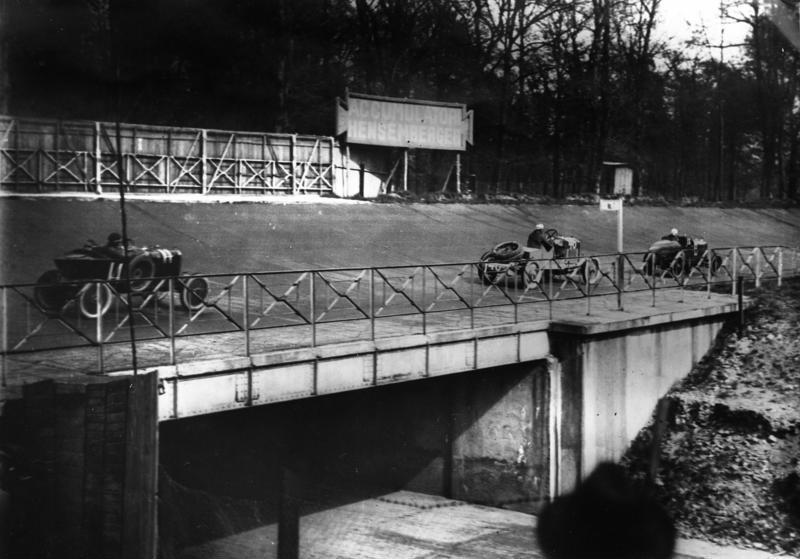
Monza’s steep concrete-and-asphalt banked oval, the Sopraelevata, is the circuit’s most photographed relic. A first banked oval dated from the early years, and a new high-speed oval was built in 1954. F1 used a combined road-and-banking layout in 1955, 1956, 1960 and 1961, after which the banking was judged too dangerous for Grand Prix racing. Some other events continued on the oval into the late 1960s, but it has not been used for major racing for decades.
The crumbling banking still rises behind the modern track, and on non-event days it is generally open to visitors on foot or by bicycle. Walking it is one of the best free-to-cheap things to do in the park: you can feel how steep the curve is and see cracks and weeds pushing through the old surface. Because conditions and access rules can change, check the circuit’s official information before you go.
A Short History of the Temple of Speed
Monza was built in 1922 and staged its first Italian Grand Prix that September. Early decades brought tragedy, including a 1928 accident that killed spectators and the 1933 “Black Day,” which took the lives of three drivers, and both events pushed safety changes. The track closed around World War II and reopened in 1948, and it became a fixture of the F1 World Championship from its 1950 start.
The only Italian Grand Prix in the championship era not held at Monza was 1980, when the circuit was being refurbished and the race moved to Imola. Recent upgrades to the circuit, paddock and facilities helped Monza secure a six-year extension with F1 that keeps the Italian Grand Prix here until 2031. About 335,000 fans attended across the 2024 race weekend, showing how strongly the race still draws crowds.
Planning Your Visit
The circuit sits inside the Parco di Monza, one of Europe’s largest enclosed city parks, so a visit can combine track history with a park walk or bike ride. On non-race days, visitors can generally explore the park and, subject to current rules, walk parts of the banking. Guided options run by the circuit include a Tour Experience (photo gallery, press room, briefing room, podium and race control), a minivan Track Tour around the circuit, a Tour Race package on race weekends with a hospitality terrace and a minivan visit to the banking, and premium or private group versions. Karting, driving experiences, track days and bike rental are also offered.
Tour and event tickets are sold online through the circuit’s official ticketing partner, with prices varying by tour type and by age category, and discounts for children. Race-weekend tickets are priced in tiers, from general admission areas to reserved grandstands and hospitality. Sprint-format weekends and demand for Ferrari-heavy sections can push prices up, so buy early and compare seat views.
Getting there from Milan is straightforward. Regional Trenord trains connect Milan with Monza station in roughly 15 minutes, and from there you continue by local bus, shuttle or on foot into the park; on race weekends dedicated shuttle buses run to the circuit. The Biassono-Lesmo station is another option close to the Lesmo corners. Expect a 10 to 20 minute walk inside the park in either case, so wear comfortable shoes. For current opening details, tour schedules, ticket prices and the latest access rules, use the official Autodromo Nazionale Monza website.
Tips for Race Weekend
Arrive early: park entrances and shuttles get crowded, and the walk to your grandstand can be long. Bring ear protection, sun cover and water, and check the official site for bag and item policies before you travel. Grandstands near the first chicane and along the main straight offer the best views of starts and pit action, while spots near the Lesmo and Parabolica corners let you watch cars at speed. Book Milan accommodation early, since hotels in Monza and central Milan fill up fast for the Grand Prix.
Photos
Keeps chili hot from the tailgate to the fourth quarter.
Team-color face paint in a twist-up stick — no brushes, no mess in the car.
Sized to the NFL's 12x6x12 clear-bag rule. Fits snacks, a jacket and a rally towel.
Autodromo Nazionale Monza FAQs
When did Autodromo Nazionale Monza open?
The circuit opened on September 3, 1922, just before hosting that year’s Italian Grand Prix. It was the world’s third purpose-built race track, after Brooklands and Indianapolis.
How long is the Monza circuit?
The current Grand Prix layout is 5.793 km (3.6 miles) long with 11 corners.
What is the lap record at Monza?
Lando Norris set the race lap record of 1:20.901 at the 2025 Italian Grand Prix, an average of roughly 257.8 km/h. Max Verstappen’s 1:18.792 pole lap that weekend was the fastest qualifying lap in F1 history.
What is the fastest speed ever recorded at Monza?
Juan Pablo Montoya reached 372.6 km/h (231.5 mph) in a McLaren-Mercedes during the 2005 Italian Grand Prix, which Guinness World Records recognises as the fastest speed in an F1 Grand Prix.
Is the Monza banked oval still used for racing?
No. F1 last used the banking in 1961, and it has not hosted major races for decades. Sections remain on site and can generally be walked on non-event days, though access rules can change.
How long is Monza’s F1 contract?
The Italian Grand Prix is contracted to stay at Monza through the 2031 season under a six-year extension.
Why is Monza called the Temple of Speed?
Because its long straights and fast corners produce the highest average speeds in F1, and because of its long history as one of the sport’s oldest and most revered circuits.
How do I get from Milan to Monza circuit?
Take a regional Trenord train from Milan to Monza station (roughly 15 minutes), then use a local bus, race-weekend shuttle or walk into the Parco di Monza, where the circuit is a further 10 to 20 minute walk. Biassono-Lesmo station is another nearby option.
Can you visit Monza when there is no race?
Yes. Guided tours, karting and driving experiences are offered, and the park around the circuit can be explored on non-event days. Check the official Monza website for current tour schedules and prices.
Get More from Autodromo Nazionale Monza
Log the coasters, stadiums, and venues you’ve experienced, rate Autodromo Nazionale Monza, and see what your friends thought. Get the ThrillZing app.
Want the day’s theme park news in your inbox? Subscribe to ThrillZing Daily — free.