
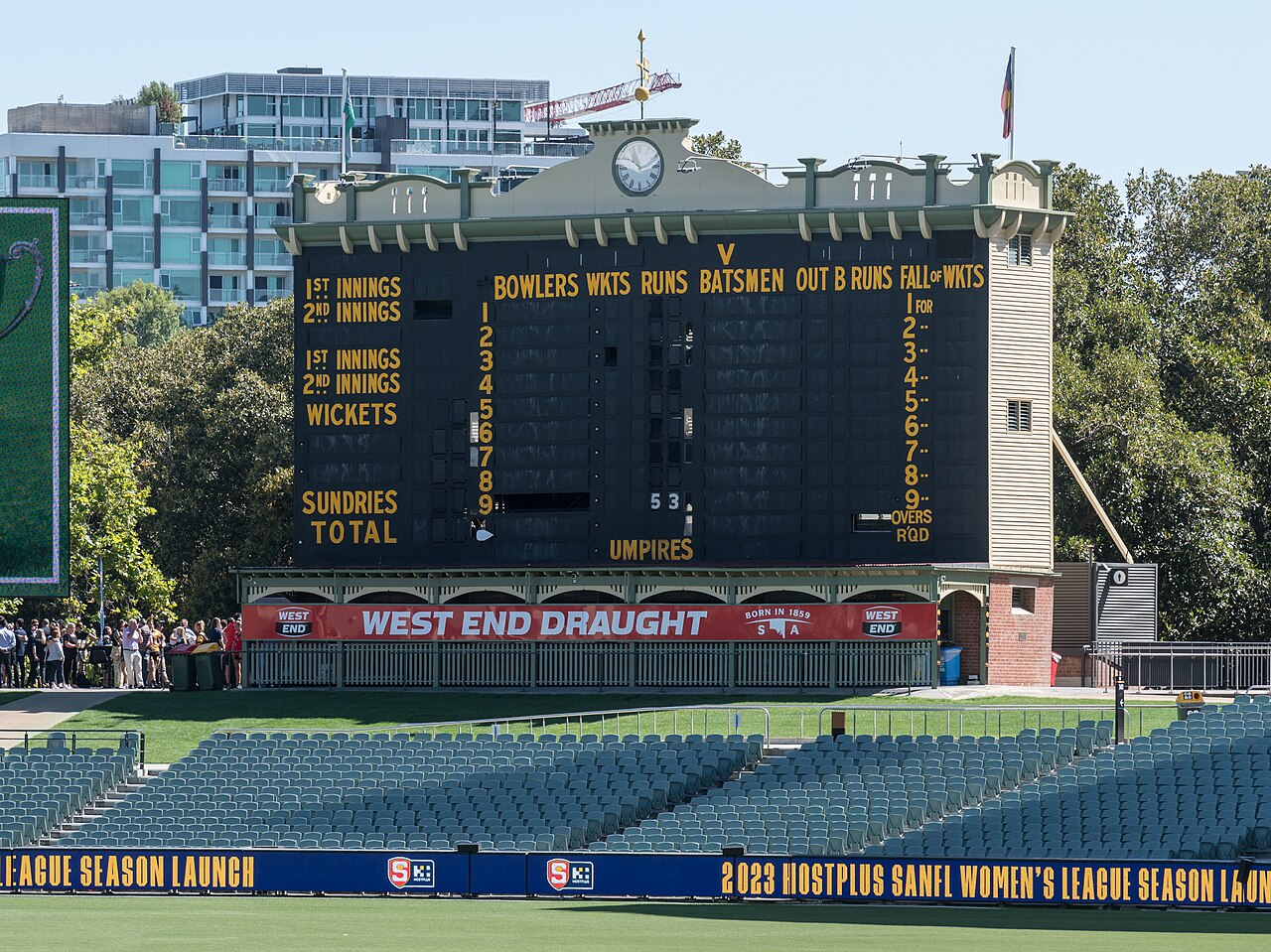
Most stadiums that spend half a billion dollars on a rebuild throw out the old scoreboard. Adelaide Oval kept its. The hand-operated board on the northern mound, designed by architect F. Kenneth Milne and first used in 1911, still posts the score in letters and numerals hung by staff working inside the structure — now standing beside a digital screen roughly four storeys high. It is the only manual scoreboard still operating at a major Australasian cricket venue.
Established in 1871 on leased Adelaide Park Lands between North Adelaide and the River Torrens, the Oval has been the headquarters of the South Australian Cricket Association ever since, and today shares the calendar between Test cricket and the AFL. It sits comfortably inside any list of the oldest stadiums in the world still in use.
Key Stats
| Opened | Established 1871; first cricket match 13 December 1873 |
| Location | War Memorial Drive, North Adelaide, South Australia |
| Capacity | 53,500 |
| Tenants | South Australia (1874–present), Adelaide Strikers (2011–present), Adelaide Crows and Port Adelaide (2014–present); Australia for Test cricket (1884–present) |
| Sport | Cricket and Australian rules football |
| Record attendance | 62,543 — 1965 SANFL Grand Final (Port Adelaide v Sturt) |
| First Test match | 12–16 December 1884, Australia v England |
| Playing dimensions | 167 x 123 m |
From Park Lands Lease to Test Venue
The South Australian Cricket Association was formed on 31 May 1871, and a subsequent meeting recommended finding a central site for a cricket ground. An act of parliament allowed a slice of the Adelaide Park Lands to be leased, and the present grounds were taken up in 1872 by the first trustees — Justice Gwynne, Henry Ayers and Edwin Thomas Smith. Construction was finished by 31 August 1872: twelve acres enclosed, the central half levelled by hand and sown with couch grass.
The Oval opened for cricket on Saturday 13 December 1873 with a match between the Colonials, made up of South Australian-born players, and the British, born overseas. Around 500 spectators turned up. The day before, 2,000 sheep had been driven across the outfield to thin the top of the turf. A grandstand followed in 1882, later renamed for George Giffen, and in 1884 the ground staged its first Test match, England beating Australia by eight wickets. The mound was built and the Moreton Bay fig trees planted for that occasion.
The Scoreboard That Refused to Retire
The scoreboard entered service in 1911 and has been protected ever since: heritage-listed by the National Trust in 1984 and added to the South Australian Heritage Register in 1986. Names on the board are limited to ten letters, so longer surnames get truncated or replaced with nicknames — a quirk that has become part of the ground’s vocabulary. It stands on the Northern Mound, or “The Hill,” a bank created around 1898–1900 from earth dug out of the River Torrens and shaded by figs planted in the 1890s.
The $535 Million Rebuild — and What Survived It
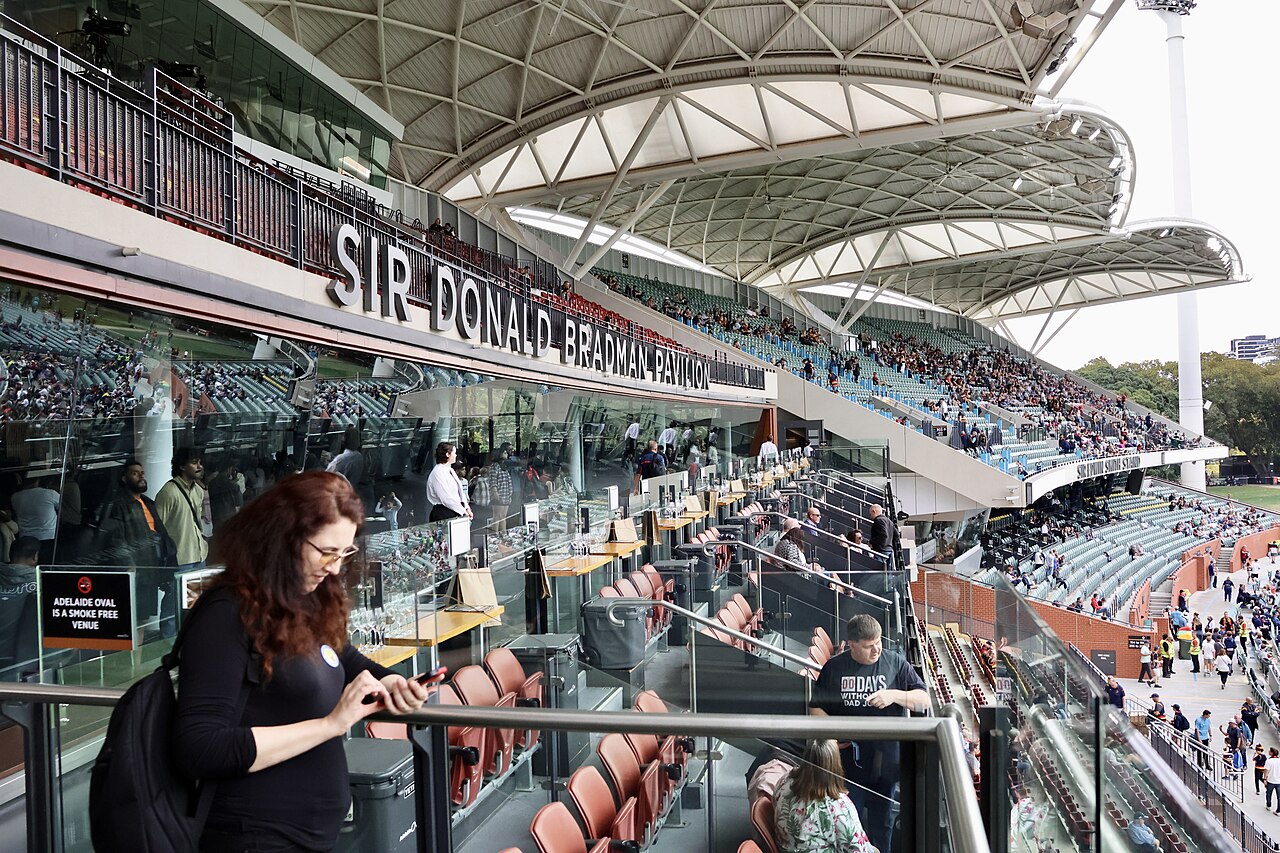
In 2011 the AFL, SANFL, SACA and the state and federal governments agreed to redevelop the Oval so that Adelaide’s two AFL clubs could move in from Football Park. The plan needed a three-quarters majority of SACA members. An online vote on 28 April 2011 fell short at 60 per cent, but when the count closed after an extraordinary meeting on 2 May, 80.37 per cent of all votes cast — 10,078 to 2,461 — were in favour. The state government lifted its funding commitment to $535 million.
Work began in April 2012. The Chappell Stands and the Sir Donald Bradman Stand came down; the Riverbank Stand was finished in late 2013 for that summer’s Ashes Test, and the 19,000-seat Eastern Stand was completed for the 2014 AFL season. Three things were ruled untouchable from the outset: the Northern Mound, the Moreton Bay figs and the heritage-listed scoreboard. The central section of the Western Stand was renamed the Sir Donald Bradman Pavilion in 2014, and Australia’s first stadium hotel, the Oval Hotel, opened on site in 2024.
Records and Big Days
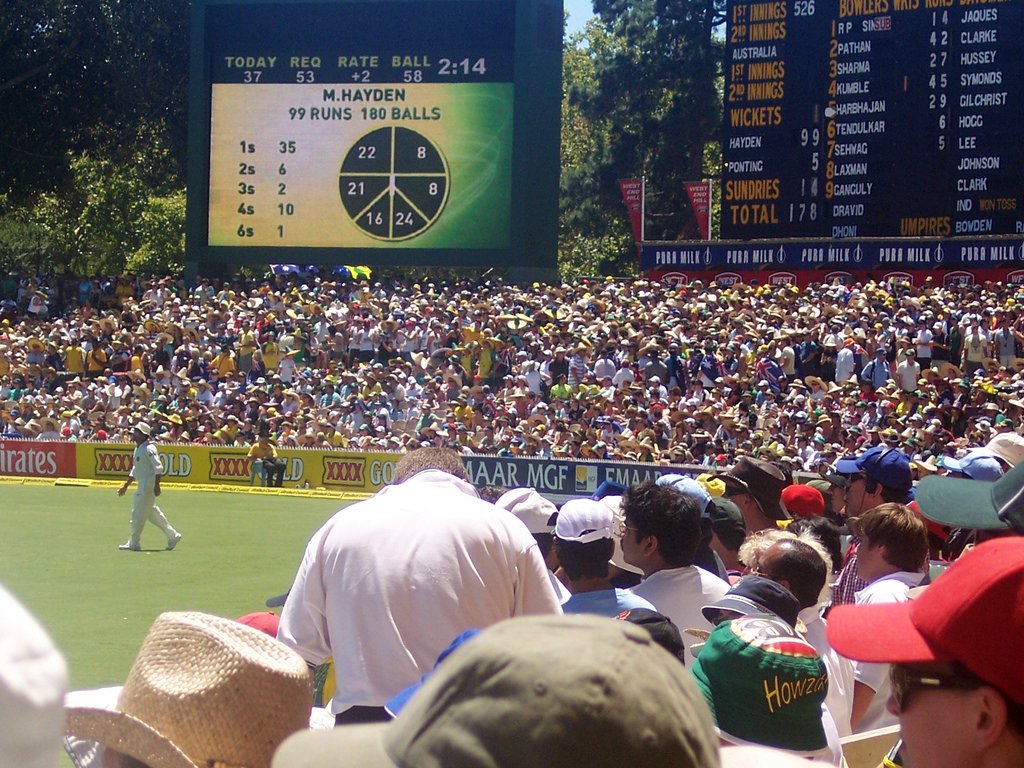
Don Bradman’s 299 not out against South Africa in 1931 stood as the highest Test score at the ground for close to nine decades, and in the same match Clarrie Grimmett took fourteen wickets, still the best match haul recorded here. On 30 November 2019 David Warner passed Bradman’s mark with 335 not out against Pakistan in the day-night Test.
The ground’s biggest crowd came not from cricket but from football: 62,543 for the 1965 SANFL Grand Final between Port Adelaide and Sturt. The all-time capacity record is higher still — a reported 72,000 packed in for the 1927 Royal Visit. Adelaide Oval has also hosted rugby league, with the Adelaide Rams based here in 1997–98 and NRL clubs playing home games at the ground on and off since the early 1990s.
A see-through purse that looks like a purse. Works for most stadium, arena and concert bag policies.
Bleachers for three hours, but with back support. Folds flat and clips to the bench.
For upper-deck seats. Watch line play at the stadium, or the far side of the park from the top of a lift hill.
FAQ
How old is Adelaide Oval?
The ground was established in 1871, when the South Australian Cricket Association was formed and set about securing a central site. Construction finished in August 1872 and the first cricket match was played on 13 December 1873.
Is the old Adelaide Oval scoreboard still used?
Yes. The 1911 scoreboard is operated manually during matches alongside the modern digital screen, and it is the only manual scoreboard still in service at a major Australasian cricket venue. It has been on the South Australian Heritage Register since 1986.
What is the capacity of Adelaide Oval?
Around 53,500 after the 2012–14 redevelopment. The record attendance is 62,543, set at the 1965 SANFL Grand Final, from an era of standing terraces.
Photo: Rajiv Bhuttan via Wikimedia Commons (CC BY 2.0)