If you’ve ever ridden a coaster with a hollow box-section track, open-air trains, and a ride that felt impossibly smooth despite flipping you upside down, there’s a good chance it came from Bolliger & Mabillard. Known throughout the industry simply as B&M, this small Swiss engineering firm has quietly become one of the most influential names in amusement park history.
This guide covers who Bolliger & Mabillard actually are, what B&M stands for, the story of their very first roller coaster, and the ride formats they invented that changed how steel coasters are built.
Quick Answer
Bolliger & Mabillard (B&M) is a Swiss roller coaster design company founded in 1988 by engineers Walter Bolliger and Claude Mabillard in Monthey, Switzerland. B&M built its first roller coaster, Iron Wolf, at Six Flags Great America in 1990, and has since designed more than 120 coasters worldwide, including the inverted, floorless, dive, flying, wing, hyper, and giga coaster formats that now define modern steel coaster design.
Who Are Bolliger & Mabillard?
Walter Bolliger and Claude Mabillard met while working as engineers at Giovanola, a Swiss manufacturer that built ride components for Intamin. In 1988, the pair left to start their own firm under their own names — Bolliger & Mabillard — headquartered in Monthey, Switzerland, where the company still operates today.
B&M stands for Bolliger & Mabillard, the surnames of its two founders — it isn’t an acronym for anything beyond their names. Unlike some competitors, B&M operates primarily as a design and engineering consultancy rather than a full in-house manufacturer: its engineers design and spec each ride, while fabrication of the steel track and supports is handled by partner fabricators, most notably Clermont Steel Fabricators in Ohio for North American installations.
B&M’s First Roller Coaster: Iron Wolf
Bolliger & Mabillard’s first-ever roller coaster was Iron Wolf, a stand-up looping coaster that opened at Six Flags Great America on April 28, 1990. Standing 100 feet tall with roughly 2,900 feet of track and a top speed of about 55 mph, Iron Wolf featured a vertical loop and a corkscrew — at the time, it was the tallest and fastest stand-up coaster in the world.
Iron Wolf proved B&M’s engineering could compete with established manufacturers right out of the gate, and it set the template for the smooth, precision-engineered steel track the company would become known for. The ride operated for 21 years before Six Flags Great America removed it in 2011; its former site was later used for Goliath, a wooden-steel hybrid coaster from RMC that opened in 2014.
Pioneering Ride Formats
B&M’s biggest legacy is the sheer number of coaster categories it invented or popularized, often years ahead of competitors.
The inverted coaster debuted with Batman: The Ride in 1992, seating riders beneath the track with their feet dangling free — a design so successful it was cloned at parks around the world. The dive coaster followed in 1998 with Oblivion at Alton Towers, introducing a suspended pause at the lip of the drop before plunging riders down an 87.5-degree, near-vertical drop, and the floorless coaster arrived in 1999 with Medusa, removing the floor entirely so riders’ feet hung just above the track.
B&M introduced its first hyper coaster, Apollo’s Chariot, in 1999, followed by the flying coaster in 2002 (debuting as Air, later renamed Galactica, at Alton Towers) and the wing coaster in 2011 with Raptor at Gardaland, which seated riders on either side of the track with nothing above or below them. The company scaled up again in 2012 with its first giga coaster, Leviathan at Canada’s Wonderland, crossing the 300-foot mark.
What Makes B&M Coasters Stand Out
Unlike many steel coaster builders, B&M is known for engineering rides that deliver intense forces — tight loops, steep drops, high-speed inversions — without the rough, jarring sensations common to older designs. Much of that reputation comes from B&M’s signature hollow box-section track, which distributes forces more evenly than the tubular track used by many rivals, paired with open, comfortable trains that give riders an unobstructed view.
That consistency has made B&M a favorite among both parks and enthusiasts. Several of its coasters, including Fury 325 at Carowinds, have topped Amusement Today’s Golden Ticket Awards rankings for the world’s best steel coasters.
Notable Bolliger & Mabillard Coasters
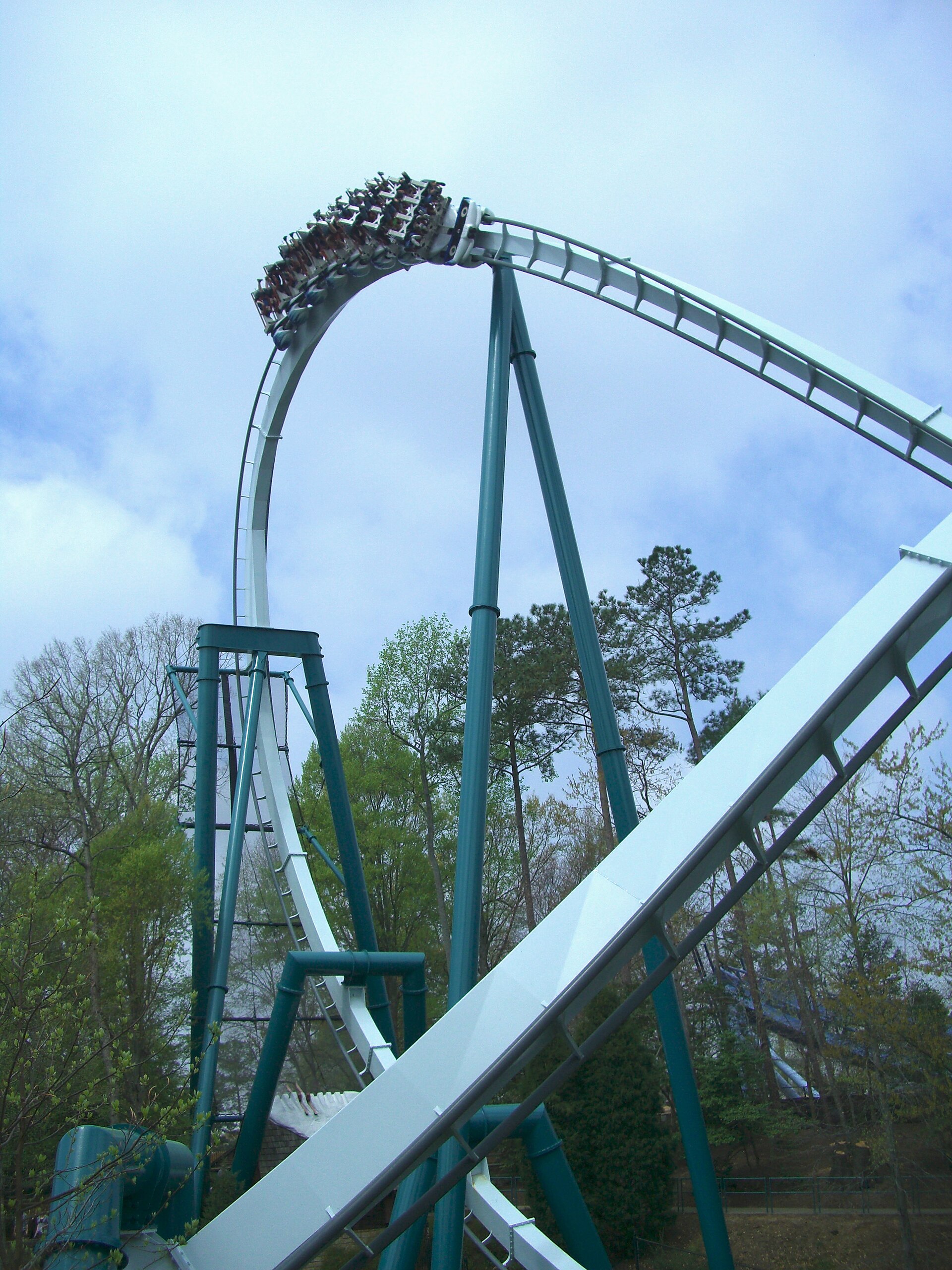
Alpengeist and Apollo’s Chariot at Busch Gardens Williamsburg, Banshee at Kings Island, Fury 325 at Carowinds, GateKeeper at Cedar Point, Behemoth at Canada’s Wonderland, Candymonium at Hersheypark, Black Mamba at Phantasialand, and Dragon Khan at PortAventura Park all carry the B&M signature.
The Batman: The Ride inverted coaster — the design that launched B&M’s inverted coaster format in 1992 — has been cloned so many times it now runs at Six Flags Magic Mountain, Six Flags Over Georgia, Six Flags Great Adventure, Six Flags Great America, and the former Six Flags St. Louis (now Mid America Adventure).
Photos
Bolliger & Mabillard FAQs
What does B&M stand for in roller coasters?
B&M stands for Bolliger & Mabillard, named directly after founders Walter Bolliger and Claude Mabillard. It isn’t an acronym for anything else — it’s simply the company’s name.
What was B&M’s first roller coaster?
B&M’s first roller coaster was Iron Wolf, a stand-up looping coaster that opened at Six Flags Great America on April 28, 1990. It operated for 21 years before being removed in 2011.
Who founded Bolliger & Mabillard?
Bolliger & Mabillard was founded in 1988 by Swiss engineers Walter Bolliger and Claude Mabillard, who had previously worked together at ride manufacturer Giovanola.
Where is Bolliger & Mabillard based?
The company is headquartered in Monthey, Switzerland, where it has operated since its founding in 1988.
Is Iron Wolf still open anywhere?
No. The original Iron Wolf at Six Flags Great America closed in 2011 after 21 years and was removed; its site was later used for the RMC hybrid coaster Goliath, which opened in 2014.
How many roller coasters has B&M built?
Bolliger & Mabillard has designed more than 120 roller coasters operating at parks across North America, Europe, and Asia, including signature formats like the inverted, floorless, dive, flying, wing, hyper, and giga coaster.
Get More from Bolliger & Mabillard
Log the coasters, stadiums, and venues you’ve experienced, rate Bolliger & Mabillard, and see what your friends thought. Get the ThrillZing app.
Want the day’s theme park news in your inbox? Subscribe to ThrillZing Daily — free.