
The Mineirão, officially named Estádio Governador Magalhães Pinto, opened on September 5, 1965, in Belo Horizonte, Minas Gerais, becoming one of Brazil’s largest and most important football venues. Built with a distinctive pseudo-ellipse bowl inspired by studies of Rio de Janeiro’s Maracanã, the stadium quickly became the shared home of the city’s two biggest rivals, Cruzeiro Esporte Clube and Clube Atlético Mineiro, and in 1997 it packed in a reported 132,834 fans for a Campeonato Mineiro final before modern all-seater safety standards permanently changed its capacity.
A major renovation between 2011 and 2013 rebuilt the Mineirão into an all-seater, FIFA-standard arena ahead of the 2013 Confederations Cup and the 2014 World Cup, where it hosted several matches including the semifinal remembered in Brazil as the ‘Mineiraço’ — a 7-1 defeat to Germany that stunned the host nation. The stadium went on to host football during the 2016 Rio Olympics, and while Atlético Mineiro departed for the purpose-built Arena MRV in 2023, Cruzeiro has continued to call the Mineirão home since it first opened.
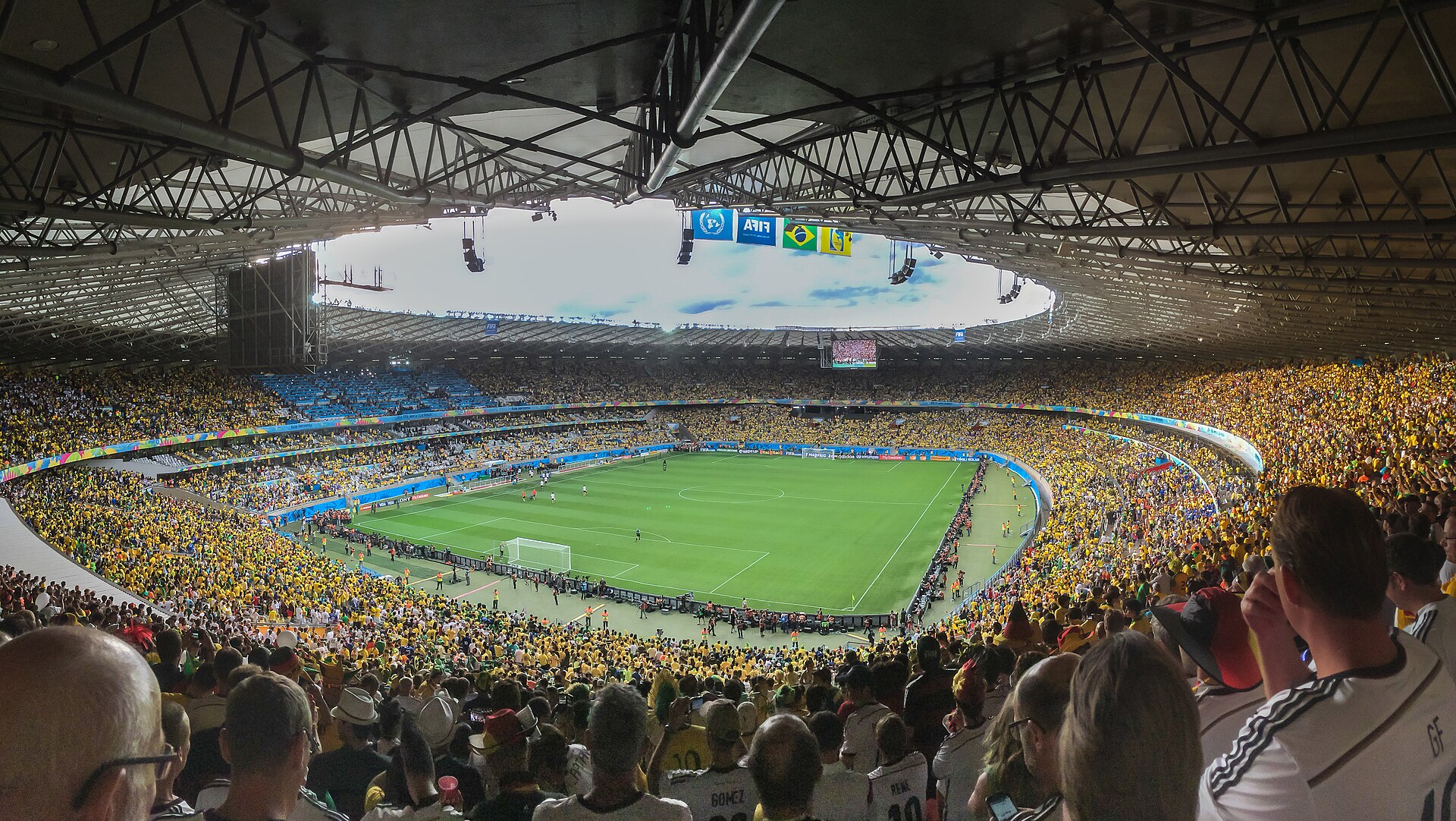
Stats at a Glance
- Team(s): Cruzeiro Esporte Clube (1965–present); formerly Atlético Mineiro (1965–2023)
- Location: Belo Horizonte, Minas Gerais, Brazil
- Opened: September 5, 1965
- Renovated: 2011–2013 (for the World Cup)
- Capacity: About 62,000 seated (listed maximum of 66,658)
- Record attendance: About 132,834 (1997 Campeonato Mineiro final, pre-renovation)
- Notable event: Hosted the 2014 World Cup semifinal, Brazil 1–7 Germany
A Shared Home for Rival Clubs
For decades the Mineirão served as the home ground for both of Belo Horizonte’s major clubs, Cruzeiro and Atlético Mineiro, hosting the city’s fierce ‘Clássico Mineiro’ derby countless times. Its huge original bowl, before the 2011–2013 renovation converted it to an all-seater configuration, allowed it to hold some of the largest crowds ever recorded at a Brazilian football match. Atlético Mineiro eventually moved to its own purpose-built Arena MRV in 2023, leaving Cruzeiro as the stadium’s primary tenant.
World Cup History and the ‘Mineiraço’
The stadium’s renovation ahead of the 2013 Confederations Cup and 2014 FIFA World Cup transformed it into a modern venue that hosted six World Cup matches, most notably the semifinal in which Germany defeated the host nation Brazil 7-1, a result so shocking it became known simply as the ‘Mineiraço.’ During that same tournament, Germany’s Miroslav Klose scored at the Mineirão to become the World Cup’s all-time leading goalscorer, adding another layer of history to the venue.
Explore more: Explore more legendary stadiums.
Mineirão FAQs
Who plays at the Mineirão today?
Cruzeiro Esporte Clube has played its home matches at the Mineirão since the stadium opened in 1965 and remains its primary tenant.
What is the Mineirão’s capacity?
The stadium seats roughly 62,000 spectators following its 2011–2013 renovation, with a listed maximum capacity of 66,658.
Why is the Mineirão famous internationally?
It is best known for hosting the 2014 FIFA World Cup semifinal in which Germany defeated host nation Brazil 7-1, one of the most stunning results in World Cup history.
Get More from Mineirão
Log the coasters, stadiums, and venues you’ve experienced, rate Mineirão, and see what your friends thought. Get the ThrillZing app.
Photo: Governo Federal Brasileiro / CC BY-SA 3.0, via Wikimedia Commons.