
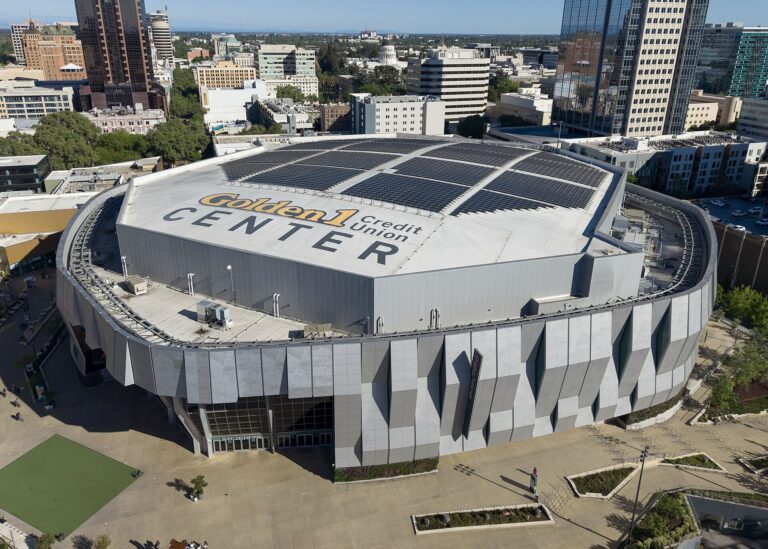
The Kings are the NBA’s oldest franchise and one of its most traveled. Since joining the National Basketball League as the Rochester Royals in 1945, they have played in five cities and nine arenas: two in Rochester, Cincinnati Gardens, a split home in Kansas City and Omaha, and three in Sacramento, ending with Golden 1 Center.
Here is every home in order, with the years the team played there, what made each one matter and what stands on the site today. Each arena with a ThrillZing guide links to it.
Every Kings Arena, 1945 to Today
- Rochester
- 1945–1955
Edgerton Park Arena
An 1892 drill hall turned arena. The Rochester Royals moved in when they joined the NBL in 1945 (the semipro Seagrams dated to 1923), won the 1946 NBL title and the 1951 NBA title here, but the small building lost money.
Today: Demolished in 1956
- 1955–1957
Rochester Community War Memorial
A larger downtown arena on the Genesee River, opened in October 1955. The Royals hosted the 1956 All-Star Game here, then moved to Cincinnati in April 1957.
Today: Renovated and reopened in 1998 as Blue Cross Arena, home of the AHL's Rochester Americans
- Cincinnati
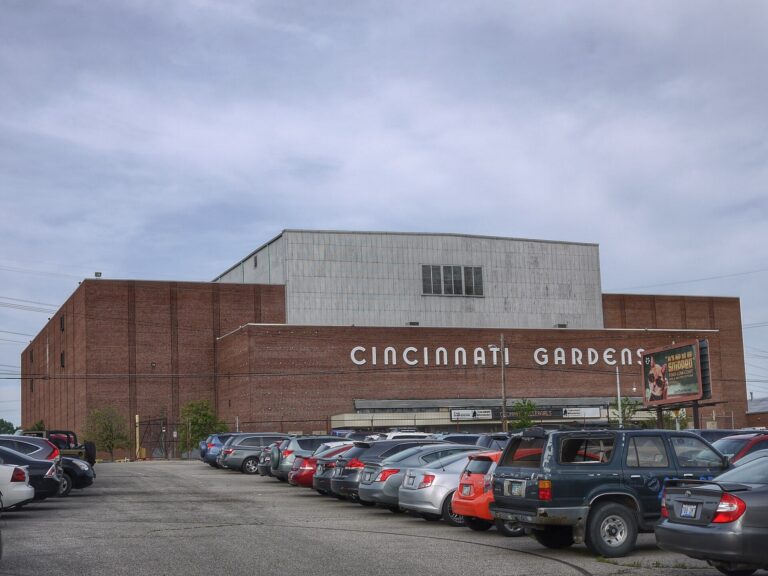 1957–1972
A 1949 brick and limestone arena in Bond Hill. Oscar Robertson's Cincinnati Royals played here, and it hosted the 1966 All-Star Game. Falling attendance after Robertson was traded led to the move to Kansas City.
Today: Closed in 2016 and demolished in March 2018; the site was bought for light manufacturing
Stadium history →- Omaha
- 1972–1978
Omaha Civic Auditorium
The Kansas City–Omaha Kings split home games between two cities, playing 42 regular-season games here from 1972 to 1975. As the Kansas City Kings they kept playing a few games a year here through March 1978.
Today: Closed in 2014 and demolished in 2016; the site is planned for the Civic Square development
- Kansas City
- 1972–1974
Municipal Auditorium
A 1935 Art Deco hall downtown. The renamed Kings (Kansas City already had baseball's Royals) played their first two Kansas City seasons here while Kemper Arena was built.
Today: Still in use, connected by skywalks to the Bartle Hall convention center
- 1974–1979
Kemper Arena
A Helmut Jahn design on the old stockyards in the West Bottoms, its roof hung from exterior trusses. The Kings won the 1978–79 Midwest Division here; weeks later, on June 4, 1979, part of the roof collapsed in a storm.
Today: Converted in 2017–18 into Hy-Vee Arena, a youth sports and community facility
- 1979–1980
Municipal Auditorium
The Kings went back to the much smaller Auditorium for most of the 1979–80 season while Kemper's roof was repaired. Philadelphia's Darryl Dawkins shattered a backboard here in November 1979.
Today: Still in use, connected by skywalks to the Bartle Hall convention center
- 1980–1985
Kemper Arena
Back at the repaired Kemper. The Kings reached the 1981 Western Conference finals, but poor attendance and sponsorship led to a 1983 sale to a Sacramento group, which moved the team when the lease ran out in 1985.
Today: Converted in 2017–18 into Hy-Vee Arena, a youth sports and community facility
- Sacramento
- 1985–1988
ARCO Arena (1985)
A $12 million warehouse conversion built as a temporary home, and the NBA's smallest arena. The Kings played three seasons here while the permanent ARCO Arena went up a mile to the west.
Today: Still standing as an office building, headquarters of the California Department of Consumer Affairs
- 1988–2016
ARCO Arena
Built for $40 million on the city's northern outskirts, and later called Power Balance Pavilion and Sleep Train Arena. Home of the 2001–02 team that went 61–21. In 2011 the owners sought to move the Kings to Anaheim over the lack of a new arena.
Today: Closed in March 2022 and demolished that fall; the site was donated for a medical school and hospital
- 2016–presentCurrent home
A downtown arena on part of the old Downtown Plaza mall, approved by the city council in May 2014, a year after Vivek Ranadivé's group bought the team. The first regular-season game here was on October 27, 2016.
Visiting guide →
Kings Arena FAQ
Where did the Kings play before Sacramento?
In Kansas City, from 1972 to 1985, at Municipal Auditorium and Kemper Arena, with some home games in Omaha through 1978. Before that they were the Cincinnati Royals at Cincinnati Gardens (1957–1972) and the Rochester Royals at Edgerton Park Arena and the Rochester War Memorial (1945–1957). The Royals won the 1951 NBA title in Rochester.
How many arenas have the Kings had?
Nine buildings: Edgerton Park Arena, the Rochester War Memorial, Cincinnati Gardens, Omaha Civic Auditorium, Kansas City’s Municipal Auditorium, Kemper Arena, the first ARCO Arena, the second ARCO Arena and Golden 1 Center. Counting the 1979–80 season spent back at Municipal Auditorium after Kemper’s roof collapsed, that is 11 stints.
Why did the Kings move so often?
Mostly money. The Royals lost money in their small Rochester arena and moved to Cincinnati in 1957. Attendance fell there after the Oscar Robertson trade, and the team left for Kansas City in 1972, renaming itself the Kings because the city already had baseball’s Royals. In Kansas City the Kings ran third behind the Chiefs and Royals, and a Sacramento group bought the team in 1983 and moved it in 1985.
Is ARCO Arena still standing?
The second one is not. The 1988 ARCO Arena, later Sleep Train Arena, hosted a farewell event under its original name in March 2022 and was demolished that fall; the land was donated to California Northstate University for a medical school and hospital. The first ARCO Arena, a converted warehouse, is still an office building. Kemper Arena survives as Hy-Vee Arena, and Kansas City’s Municipal Auditorium is still in use.
Where do the Kings play now?
At Golden 1 Center in downtown Sacramento, which seats 17,608 for basketball. The publicly owned arena opened in 2016 at a cost of about $558 million, split between the team and the city.