
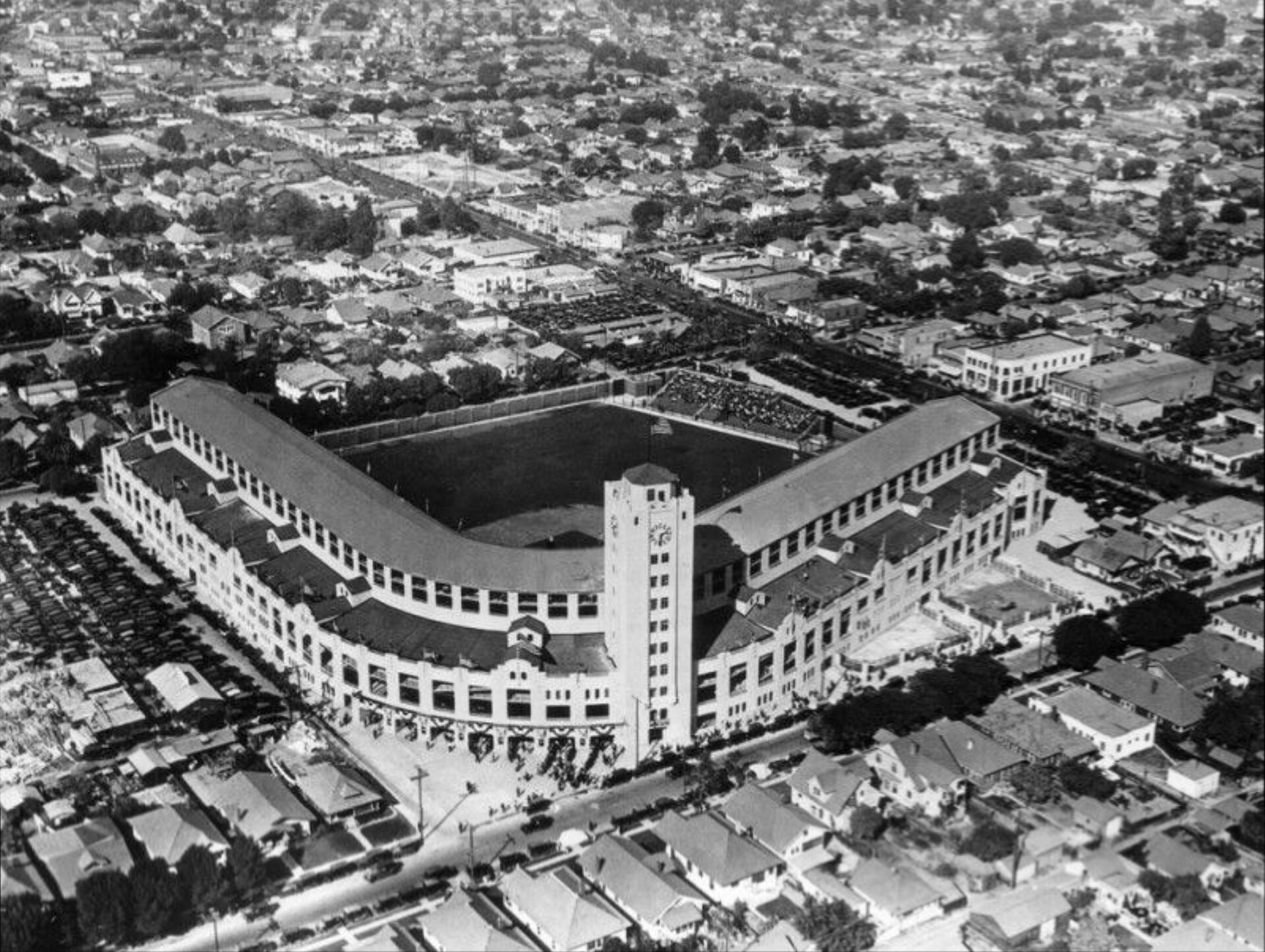
Wrigley Field in Los Angeles was a Spanish-style baseball stadium that stood at 425 E. 42nd Place in South Central Los Angeles from 1925 until its demolition in March 1969. Built by chewing-gum magnate and Chicago Cubs owner William Wrigley Jr. for $1.5 million, it was designed by architect Zachary Taylor Davis — the same man who designed Cubs Park (later renamed Wrigley Field) in Chicago and Comiskey Park. The ballpark opened on September 29, 1925, and quickly earned a reputation as one of the most handsome minor league venues in the country.
For over three decades, the stadium served as the home of the Los Angeles Angels of the Pacific Coast League, sharing its diamond with the Hollywood Stars for portions of that era. In 1961, the park hosted the expansion Los Angeles Angels in their inaugural major league season, during which a record 248 home runs were hit — a mark that stood for more than 30 years. Beyond baseball, Wrigley Field hosted the first NFL Pro Bowl in January 1939, world championship boxing bouts, international soccer matches, film productions including ‘The Pride of the Yankees,’ and a landmark civil rights rally headlined by Dr. Martin Luther King Jr. in May 1963.
Stats at a Glance
- Primary Tenant(s): LA Angels (PCL, 1925–1957); LA Angels (MLB, 1961)
- Location: 425 E. 42nd Place, South Central Los Angeles, CA
- Opened: September 29, 1925
- Demolished: March 1969
- Capacity: About 22,000 (1925); 20,457 (1961)
- Architect: Zachary Taylor Davis
- Construction Cost: $1.5 million
- Notable Fact: First NFL Pro Bowl hosted here, January 15, 1939
Architecture and Design
Wrigley Field Los Angeles was celebrated for its striking Spanish Colonial Revival exterior, setting it apart from the utilitarian ballparks of its era. Its most distinctive feature was a 150-foot office tower at the main entrance, adorned with four large clocks visible from across the surrounding neighborhood. The double-decked grandstand was built from iron and steel, offering covered seating and an observation platform that reportedly provided views stretching from the San Gabriel Mountains to the Pacific Ocean on clear days.
The playing field itself featured notably angled outfield fences and relatively short foul-line distances — around 338 to 340 feet — with center field stretching to 412 feet. The left-field wall was later planted with ivy, echoing the famous ivy walls at Chicago’s Wrigley Field. The intimate dimensions made the park a hitter-friendly environment, a characteristic that defined the 1961 expansion Angels’ record-breaking home run season.
Legacy and Demolition
After the Angels vacated for Dodger Stadium in 1962 and eventually moved to Anaheim, Wrigley Field lost its primary tenant. The city of Los Angeles acquired the property, and the stadium hosted community events and a memorable civil rights rally featuring Dr. Martin Luther King Jr. before closing permanently. In March 1969 the ballpark was razed to make way for the Gilbert W. Lindsay Community Center, a health center, and a public park.
Though no trace of the stadium remains today, Wrigley Field Los Angeles left a durable cultural footprint. It appeared in multiple Hollywood productions, shaped a generation of Pacific Coast League fans, and introduced major league baseball to Los Angeles before Dodger Stadium existed. The Los Angeles Historic Theatre Foundation and local historians have continued to document its significance as one of the finest ballparks of the early twentieth century.
Explore more: Explore more historic stadiums.
A see-through purse that looks like a purse. Works for most stadium, arena and concert bag policies.
Bleachers for three hours, but with back support. Folds flat and clips to the bench.
For upper-deck seats. Watch line play at the stadium, or the far side of the park from the top of a lift hill.
Wrigley Field (Los Angeles) FAQs
When was Wrigley Field in Los Angeles built and demolished?
Wrigley Field Los Angeles opened on September 29, 1925, and was demolished in March 1969, giving it a lifespan of about 44 years.
Which teams played at Wrigley Field in Los Angeles?
The Los Angeles Angels of the Pacific Coast League were the primary tenant from 1925 to 1957. The Hollywood Stars also shared the park for portions of that era. In 1961, the expansion major league Los Angeles Angels played their entire inaugural season there.
Was Wrigley Field in Los Angeles related to the one in Chicago?
Both parks were owned by William Wrigley Jr. and designed by the same architect, Zachary Taylor Davis. The Los Angeles ballpark actually predated the Chicago park’s Wrigley name — the Chicago venue was still called Cubs Park when the Los Angeles stadium opened in 1925.
Get More from Wrigley Field (Los Angeles)
Log the coasters, stadiums, and venues you’ve experienced, rate Wrigley Field (Los Angeles), and see what your friends thought. Get the ThrillZing app.
Photo: Unknown authorUnknown author / Public domain, via Wikimedia Commons.