
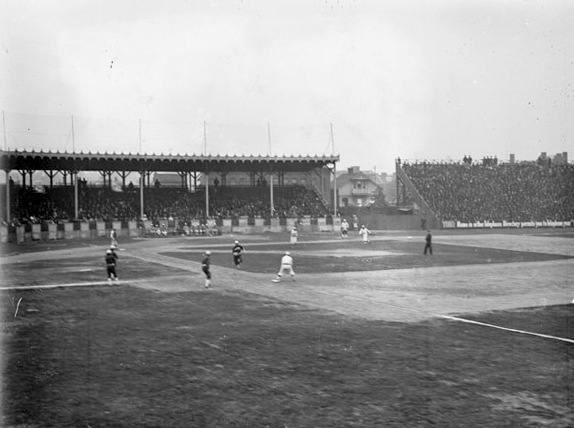
Sportsman’s Park stood at the corner of Grand Boulevard and Dodier Street on the north side of St. Louis, Missouri, serving as one of baseball’s most storied addresses for more than six decades. The modern steel-and-concrete structure opened on April 23, 1902, as home to the St. Louis Browns of the American League, and in 1920 the National League’s St. Louis Cardinals arrived as tenants—making it the only major-league ballpark simultaneously shared by two big-league franchises for an extended period.
During its 64-year run the park witnessed some of the sport’s most memorable chapters. The Cardinals captured ten National League pennants and seven World Series championships while playing at Sportsman’s Park, cementing it as one of the most successful home venues in baseball history. The Browns, though perpetual underdogs, contributed their own unforgettable moments before departing for Baltimore in 1953. The Cardinals played their final game at the park on May 8, 1966, and the stadium was demolished shortly afterward, with the site today occupied by the Boys & Girls Clubs of Greater St. Louis.
Stats at a Glance
- Teams: St. Louis Browns (AL, 1902–1953) & St. Louis Cardinals (NL, 1920–1966)
- Location: Grand Blvd & Dodier Street, St. Louis, Missouri
- Opened: April 23, 1902
- Closed: May 8, 1966
- Demolished: 1966
- Peak Capacity: 34,023 (1926–1946)
- Final Capacity: 30,500 (1953–1966)
- World Series Hosted: 1926, 1928, 1930, 1931, 1934, 1942, 1943, 1944, 1946, 1964 (10 total)
A Ballpark Shared by Two Rivals
The Cardinals arrived as tenants of Browns owner Phil Ball in 1920, and the arrangement proved oddly fruitful for St. Louis fans who could watch both leagues under one roof. The park’s capacity grew substantially in 1925 when the grandstands were double-decked to both foul poles, pushing seating to around 30,500. The most surreal chapter of the shared tenancy came in the 1944 World Series—dubbed the ‘Streetcar Series’—when both clubs met in the Fall Classic and every game was played at Sportsman’s Park, the only World Series ever contested entirely in a single stadium. The Cardinals won in six games.
The Browns sold the park to Cardinals owner August Busch Jr. in 1953, and it was briefly renamed Busch Stadium before the Browns relocated to Baltimore. The Cardinals continued to call it home until their new downtown Busch Stadium opened in May 1966, bringing an end to nearly a century of professional baseball on the North Grand site.
Legends and Lasting Moments
Sportsman’s Park served as the home field for Stan Musial’s entire 22-year career (1941–1963), making it the backdrop for one of baseball’s greatest individual legacies. The stadium also hosted three MLB All-Star Games (1940, 1948, and 1957) and witnessed Bill Veeck’s famous publicity stunt on August 19, 1951, when 3-foot-7 Eddie Gaedel pinch-hit for the Browns in a regulation game, drawing four pitches high and walking to first base in the only plate appearance of his major-league life.
The right-field wall carried its own quirks: at just 310 feet from home plate, it was topped by a 25-foot screen added in 1929 to protect a pavilion beyond, giving left-handed pull hitters a friendly target while creating one of the most distinctive outfield profiles in the game. Those physical oddities, combined with decades of shared use, earned the field a reputation as one of the rougher playing surfaces in the majors—yet none of that diminished its place in baseball lore.
Explore more: Explore more historic and modern stadiums.
Team-color face paint in a twist-up stick — no brushes, no mess in the car.
Sized to the NFL's 12x6x12 clear-bag rule. Fits snacks, a jacket and a rally towel.
A see-through purse that looks like a purse. Works for most stadium, arena and concert bag policies.
Sportsman’s Park FAQs
Why did two Major League Baseball teams share Sportsman’s Park?
The Cardinals became tenants of the Browns at Sportsman’s Park in 1920 for financial reasons—the Cardinals were a struggling franchise that needed an affordable home, and the Browns’ ownership agreed to lease the stadium. The arrangement lasted until the Browns sold the park to Cardinals owner August Busch Jr. in 1953 and later relocated to Baltimore.
What was the ‘Streetcar Series’ played at Sportsman’s Park?
The 1944 World Series pitted the Cardinals against the Browns in an all-St. Louis matchup. Because both clubs called Sportsman’s Park home, every game of the series was played in the same stadium—the only time in World Series history that has happened. St. Louis fans could travel to every game by streetcar, giving the series its nickname. The Cardinals won in six games.
What stands on the site of Sportsman’s Park today?
After the Cardinals moved to the new downtown Busch Stadium in May 1966, Sportsman’s Park was demolished later that year. The site at Grand Boulevard and Dodier Street in north St. Louis is now home to the Boys & Girls Clubs of Greater St. Louis, including an athletic field.
Get More from Sportsman’s Park
Log the coasters, stadiums, and venues you’ve experienced, rate Sportsman’s Park, and see what your friends thought. Get the ThrillZing app.