
🏛 Historic Stadium
Shibe Park stood at the corner of 21st Street and Lehigh Avenue in North Philadelphia as one of the most significant venues in American baseball history. When it opened on April 12, 1909, it became the first steel-and-concrete stadium in Major League Baseball, setting the architectural standard that would define the sport for decades. Designed by William Steele & Sons and built for roughly $301,000, the park featured a striking Beaux Arts octagonal tower at its main entrance and an original seating capacity of around 23,000.
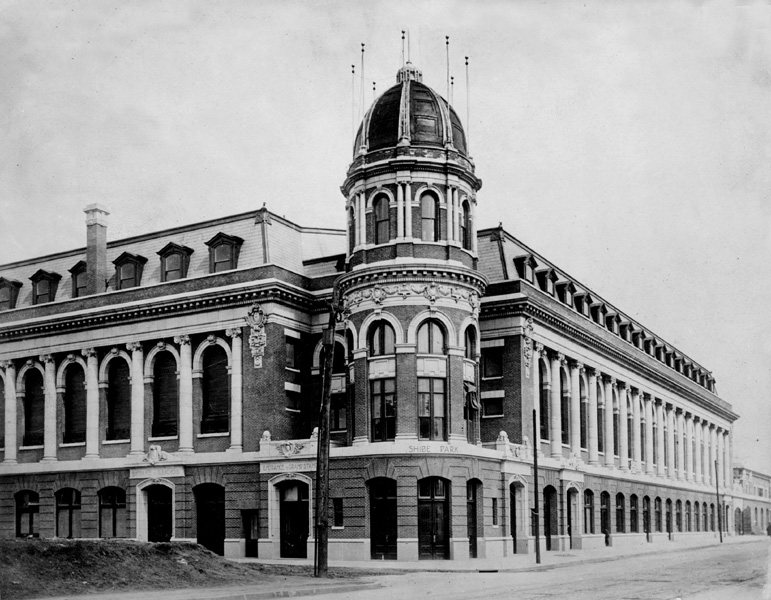
Over its 61-year lifespan the park served multiple Philadelphia franchises, hosted championship baseball at the highest level, and witnessed landmark moments in the sport. It was renamed Connie Mack Stadium in 1953 to honor the legendary Athletics manager, and its final game was played on October 1, 1970, before the remaining structure was demolished in 1976. The site today is occupied by a church, leaving only photographs and records to mark where one of America’s great early ballparks once stood.
Stats at a Glance
- Location: 21st Street & Lehigh Avenue, North Philadelphia, PA
- Primary Tenants: Philadelphia Athletics (AL, 1909–1954), Philadelphia Phillies (NL, 1938–1970), Philadelphia Eagles (NFL, 1940 & 1942–1957)
- Opened: April 12, 1909
- Closed: October 1, 1970
- Demolished: 1976
- Original Capacity: About 23,000
- Peak Capacity: 33,608
- Notable First: First steel-and-concrete stadium in MLB history
A Groundbreaking Design
Before Shibe Park, baseball stadiums were predominantly wood-frame structures prone to fire and decay. The park’s steel-and-concrete construction represented a transformative leap forward, proving that permanent, monumental venues could anchor a franchise for generations. Its ornate French Renaissance facade and domed corner tower gave the ballpark a civic grandeur that communicated baseball’s rising cultural importance in early twentieth-century America.
The park’s original dimensions were famously deep — stretching 515 feet to dead center field — though they were gradually shortened over the decades as the game evolved. A 12-foot concrete wall eventually ringed the outfield, and successive renovations added upper-deck seating, pushing capacity to over 33,000 by the early 1960s.
A Stadium Steeped in History
Shibe Park hosted eight World Series during its lifetime, including three championships won by Connie Mack’s Athletics dynasty in 1910, 1911, and 1913. The stadium also staged MLB All-Star Games in 1943 and 1952. On May 16, 1939, it became the site of the first night game in American League history, when the Athletics lost to the Cleveland Indians 8–3 under newly installed lights.
The Philadelphia Phillies moved in as tenants in July 1938 after abandoning the aging Baker Bowl, and the two NL and AL clubs shared the facility for over 15 seasons. The Eagles of the NFL also called Shibe Park home through much of the 1940s and 1950s. After the Athletics relocated to Kansas City following the 1954 season, the Phillies remained the sole MLB tenant until the team departed for Veterans Stadium, playing the park’s final game on October 1, 1970.
Explore more: Historic Stadiums Hub.
A see-through purse that looks like a purse. Works for most stadium, arena and concert bag policies.
Bleachers for three hours, but with back support. Folds flat and clips to the bench.
For upper-deck seats. Watch line play at the stadium, or the far side of the park from the top of a lift hill.
Shibe Park FAQs
Why was Shibe Park renamed Connie Mack Stadium?
In 1953 the park was renamed Connie Mack Stadium to honor Cornelius ‘Connie’ Mack, the legendary manager and co-owner of the Philadelphia Athletics who had led the team at the ballpark since its 1909 opening.
When was Shibe Park demolished?
The structure was demolished in 1976, six years after the final game was played there. The corner tower came down on July 13, 1976, during the same summer Philadelphia hosted the MLB All-Star Game.
What teams played at Shibe Park?
The Philadelphia Athletics (AL) used the park from 1909 to 1954, the Philadelphia Phillies (NL) from 1938 to 1970, and the Philadelphia Eagles (NFL) from 1940 and again from 1942 to 1957. The Philadelphia Stars of the Negro Leagues also played there in 1943.
Get More from Shibe Park
Log the coasters, stadiums, and venues you’ve experienced, rate Shibe Park, and see what your friends thought. Get the ThrillZing app.