
Seals Stadium stood at the corner of Bryant and 16th Streets in San Francisco’s Mission District from 1931 to 1959, serving as the heart of West Coast professional baseball for nearly three decades. Built at a cost of $1.25 million in concrete and steel, the ballpark opened on April 7, 1931 — with Ty Cobb throwing the ceremonial first pitch before a crowd of roughly 25,000 — and became the long-time home of the Pacific Coast League’s San Francisco Seals and, for seven seasons, the Mission Reds.
The stadium cemented its place in baseball history on April 15, 1958, when the San Francisco Giants defeated the Los Angeles Dodgers 8–0 in the first major league game ever played on the West Coast. The Giants used Seals Stadium as their temporary home for two MLB seasons while Candlestick Park was under construction, drawing capacity crowds of up to 22,900. After the Giants departed, the stadium was demolished in November 1959, with much of its structural material repurposed at Cheney Stadium in Tacoma, Washington.
Stats at a Glance
- Location: Bryant & 16th Streets, Mission District, San Francisco, CA
- Opened: April 7, 1931
- Demolished: November 1959
- Peak Capacity: 22,900 (1958 configuration)
- Teams: SF Seals (PCL, 1931–1957), Mission Reds (PCL, 1931–1937), SF Giants (MLB, 1958–1959)
- Construction Cost: $1.25 million
- Notable Fact: First major league game on the West Coast, April 15, 1958
A Stage for Legends
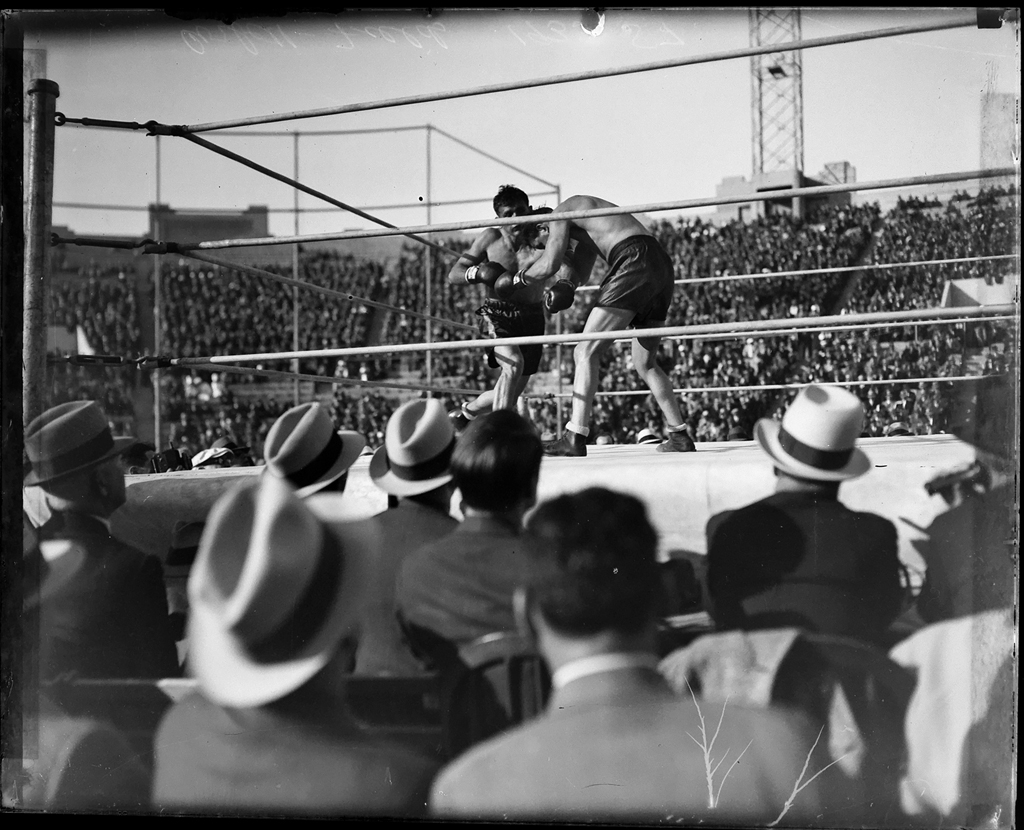
Long before the major leagues came west, Seals Stadium was fertile ground for future immortals. In 1933, an 18-year-old Joe DiMaggio hit safely in 61 consecutive PCL games at the ballpark — a minor league feat that previewed his legendary 56-game MLB hitting streak eight years later. The stadium also pulled double duty as a boxing venue, hosting world championship bouts by Young Corbett III in 1933 and 1938, reflecting the park’s status as San Francisco’s premier outdoor sports destination of the era.
The Giants’ West Coast Welcome
When the Giants relocated from New York in 1958, Seals Stadium gave San Francisco’s first major league team an intimate, electric home. Field dimensions measured 361 feet to left field, 410 to center, and 348 to right — a pitcher-friendly layout that suited the era’s style of play. Fans packed the stands through both seasons, and the Giants drew over 1.2 million spectators across their two years at the old PCL ground, proving that the city was more than ready for big-league baseball even as their permanent home rose across town at Candlestick Point.
Explore more: Explore more historic stadiums.
For upper-deck seats. Watch line play at the stadium, or the far side of the park from the top of a lift hill.
Sherpa-lined and windproof, with a waterproof back for wet bleachers. Folds into its own pouch.
For late-season football, outdoor hockey and October park nights. Shake, pocket, and stay warm for hours.
Seals Stadium FAQs
When did Seals Stadium open and close?
Seals Stadium opened on April 7, 1931, with Ty Cobb throwing the ceremonial first pitch. It was demolished in November 1959 after the San Francisco Giants moved to the newly completed Candlestick Park.
Which teams played at Seals Stadium?
The Pacific Coast League’s San Francisco Seals played there from 1931 to 1957, sharing the park with the Mission Reds from 1931 to 1937. The San Francisco Giants then used it as their MLB home for the 1958 and 1959 seasons.
Why is Seals Stadium historically significant?
Seals Stadium hosted the first major league baseball game ever played on the West Coast on April 15, 1958, when the Giants defeated the Dodgers 8–0. It was also where a teenage Joe DiMaggio hit safely in 61 consecutive PCL games in 1933.
Get More from Seals Stadium
Log the coasters, stadiums, and venues you’ve experienced, rate Seals Stadium, and see what your friends thought. Get the ThrillZing app.