
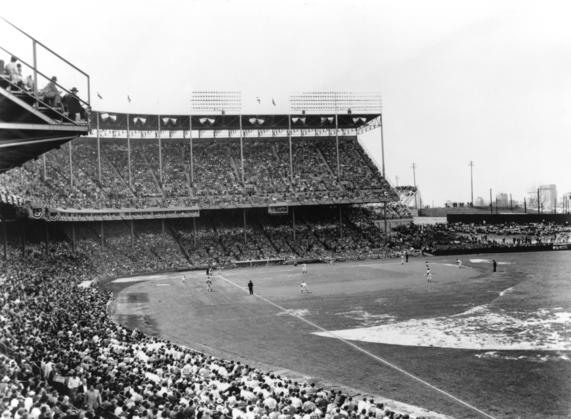
Municipal Stadium stood at 2123 Brooklyn Avenue in Kansas City, Missouri, serving the city’s sports fans for nearly five decades under four different names. Originally built in 1923 as Muehlebach Field for $400,000, the park became the heart of Kansas City athletics, hosting minor league baseball, Negro League legends, and eventually Major League Baseball, professional football, and soccer.
Over the years the stadium was renamed Ruppert Stadium in 1937, Blues Stadium in 1943, and finally Municipal Stadium in 1955 when the Philadelphia Athletics relocated to Kansas City. It was demolished in 1976 after the Royals departed for the newly opened Royals Stadium, leaving behind a site later converted to a community garden and residential development.
Stats at a Glance
- Location: 2123 Brooklyn Avenue, Kansas City, Missouri
- Opened: July 3, 1923 (as Muehlebach Field)
- Demolished: 1976
- Peak Capacity: 35,561 (1971–1972)
- MLB Teams: Kansas City Athletics (1955–1967); Kansas City Royals (1969–1972)
- NFL/AFL Team: Kansas City Chiefs (1963–1971)
- Negro League: Kansas City Monarchs (1923–1931, 1937–1955)
- Notable Event: 1960 MLB All-Star Game (first game)
A Stadium of Many Names and Eras
Municipal Stadium’s story began as Muehlebach Field, a single-tier grandstand built for Kansas City’s minor league Blues and the Negro League’s Kansas City Monarchs. The Monarchs’ 1945 roster included a young Jackie Robinson before he broke Major League Baseball’s color barrier. The stadium was essentially rebuilt from scratch ahead of the 1955 season — completed in just 90 days by crews working around the clock — to accommodate the arriving Kansas City Athletics, expanding capacity from roughly 17,476 to over 30,000.
The park took its final name, Municipal Stadium, in 1955 and went on to host a remarkable breadth of professional sport. The Kansas City Chiefs called it home during their early AFL and NFL seasons, and the stadium witnessed one of the most memorable moments in football history: the 1971 AFC Divisional playoff game on Christmas Day against the Miami Dolphins, which lasted 82 minutes and 40 seconds of playing time, making it the longest game in NFL history at that time.
Historic Moments and Cultural Legacy
Municipal Stadium hosted the first game of the 1960 Major League Baseball All-Star Game, one of the few years the Midsummer Classic was staged as a doubleheader. Beyond baseball and football, the stadium welcomed the Beatles on September 17, 1964, during the height of Beatlemania, drawing fans from across the Midwest. The Kansas City Spurs of the North American Soccer League also used the venue briefly in 1968 and 1969.
After the Royals moved to Royals Stadium following the 1972 season, Municipal Stadium sat unused until the city razed it in 1976. A community garden and later single-family homes replaced the footprint of a venue that had shaped Kansas City’s cultural and sporting identity for generations.
Explore more: Explore more historic stadiums.
12 x 10.5 x 6 in. — built to the common stadium clear-bag size. Check your venue's rules.
USB-charged warmers for cold night games — no disposable packets.
Keeps chili hot from the tailgate to the fourth quarter.
Municipal Stadium FAQs
When did Municipal Stadium open and close?
The stadium opened on July 3, 1923, under the name Muehlebach Field. It operated under several names until 1972, when its last tenant, the Kansas City Royals, moved out. The structure was demolished in 1976.
What teams played at Municipal Stadium?
Tenants included the Kansas City Blues (minor league), the Kansas City Monarchs (Negro Leagues), the Kansas City Athletics (MLB, 1955–1967), the Kansas City Royals (MLB, 1969–1972), the Kansas City Chiefs (AFL/NFL, 1963–1971), and the Kansas City Spurs (NASL, 1968–1969).
What was the most historic game played at Municipal Stadium?
The 1971 AFC Divisional playoff on Christmas Day between the Kansas City Chiefs and the Miami Dolphins is widely regarded as the stadium’s most historic moment. The game lasted 82 minutes and 40 seconds of playing time, making it the longest game in NFL history at the time.
Get More from Municipal Stadium
Log the coasters, stadiums, and venues you’ve experienced, rate Municipal Stadium, and see what your friends thought. Get the ThrillZing app.
Photo: Barth, Harry / Public domain, via Wikimedia Commons.