
Madison Square Garden III stood on Eighth Avenue between 49th and 50th Streets in Manhattan, opening on December 15, 1925. Designed by theater architect Thomas W. Lamb and financed by boxing promoter Tex Rickard—who rallied wealthy backers known as his ‘600 millionaires’—the arena cost $4.75 million and was constructed in less than a year on the site of former trolley-car barns. It was the first Madison Square Garden not located near Madison Square Park itself, quickly earning the nickname ‘The House That Tex Built.’
For more than four decades, MSG III served as the premier indoor venue in the United States. It was home to the New York Rangers (NHL) beginning in 1926 and the New York Knicks (BAA/NBA) from 1946, and also hosted the New York and Brooklyn Americans hockey franchise. Beyond sports, the arena staged Ringling Bros. and Barnum & Bailey Circus performances, the Westminster Kennel Club Dog Show, championship boxing matches, and landmark political gatherings before closing on February 13, 1968 and being demolished the following year.
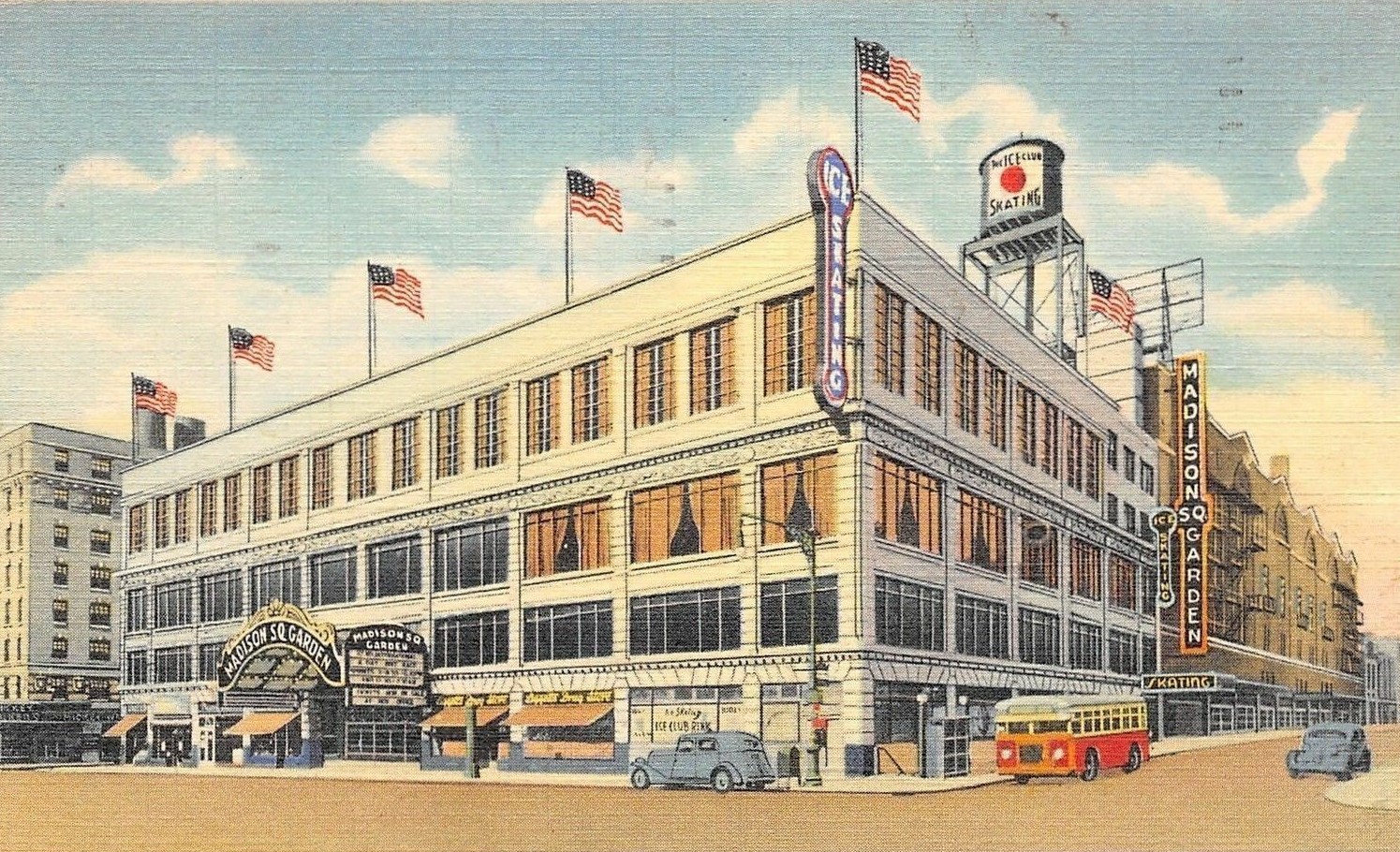
Stats at a Glance
- Teams: NY Rangers (NHL), NY Knicks (NBA), NY/Brooklyn Americans (NHL)
- Location: Eighth Ave. between 49th & 50th Streets, Manhattan, New York City
- Opened: December 15, 1925
- Closed: February 13, 1968
- Demolished: 1968–1969
- Capacity: 18,496 (boxing); 15,925 (ice hockey)
- Architect: Thomas W. Lamb
- Construction Cost: $4.75 million
A Venue That Defined an Era
Madison Square Garden III hosted some of the most significant sporting events of the mid-twentieth century. Boxing was central to the arena’s identity from the start: the building’s first event was a boxing match on December 11, 1925, and its all-time record crowd of 23,190 turned out on January 17, 1941, to watch Fritzie Zivic defend his welterweight title against Henry Armstrong. The arena also staged the prestigious National Invitation Tournament (NIT) from 1938 through 1967, establishing college basketball as a major draw in New York City well before the NBA fully captured the public’s attention.
The Rangers made MSG III their home for the arena’s entire 42-year run, while the Knicks joined as tenants in 1946. St. John’s University also used the building as a home court for college basketball, cementing the Garden’s role as the hub of New York sports life across multiple generations of fans.
Historic Gatherings Beyond Sports
Madison Square Garden III was also a stage for defining moments in American civic history. In 1933, more than 55,000 people gathered in and around the arena to protest Nazi persecution of Jews in Germany—one of the earliest mass demonstrations of its kind in the United States. Six years later, in February 1939, the German American Bund held a pro-Nazi rally before 20,000 attendees inside the Garden while more than 100,000 protesters demonstrated on the streets outside.
In March 1943, the sold-out ‘We Will Never Die’ pageant used the arena to raise global awareness of the Holocaust. These moments illustrated that MSG III was far more than a sports venue—it was a civic arena where New York and the nation confronted the defining issues of the age. The building was torn down in 1968–1969, and the site eventually became One Worldwide Plaza.
Explore more: Explore more historic stadiums.
USB-charged warmers for cold night games — no disposable packets.
Keeps chili hot from the tailgate to the fourth quarter.
Team-color face paint in a twist-up stick — no brushes, no mess in the car.
Madison Square Garden III FAQs
When did Madison Square Garden III open and close?
Madison Square Garden III opened on December 15, 1925, and held its final event on February 13, 1968. The structure was demolished in 1968–1969.
What teams played at Madison Square Garden III?
The New York Rangers (NHL) played there from 1926 to 1968, the New York Knicks (BAA/NBA) from 1946 to 1968, and the New York and Brooklyn Americans (NHL) from 1925 to 1942.
Why was Madison Square Garden III called ‘The House That Tex Built’?
The nickname honored Tex Rickard, the boxing promoter who conceived and financed the arena. Rickard assembled a group of wealthy backers—informally called his ‘600 millionaires’—to fund the $4.75 million construction project.
Get More from Madison Square Garden III
Log the coasters, stadiums, and venues you’ve experienced, rate Madison Square Garden III, and see what your friends thought. Get the ThrillZing app.
Photo: Frank E. Cooper / Public domain, via Wikimedia Commons.