
Goldstone Ground stood on Old Shoreham Road in Hove, East Sussex, and served as the home of Brighton & Hove Albion F.C. for 95 years. First used for football in September 1901, the ground became Brighton’s permanent base from the 1902–03 season and grew into one of the most recognisable venues in south-coast English football. At its peak it packed in over 36,000 supporters, and over the course of its life it witnessed more than 2,100 competitive matches attended by a combined 22.9 million spectators.
The stadium hosted football matches during the 1948 London Summer Olympics — one of only two grounds outside the capital to do so — and saw David Beckham make his professional debut there in September 1992 as a Manchester United substitute in a League Cup tie. Brighton’s rise through the Football League divisions in the late 1970s and early 1980s filled the terraces week after week, cementing the Goldstone as the spiritual heart of the club. Its sale and subsequent demolition in 1997 provoked widespread protest from supporters and became one of the most controversial episodes in the history of English football.
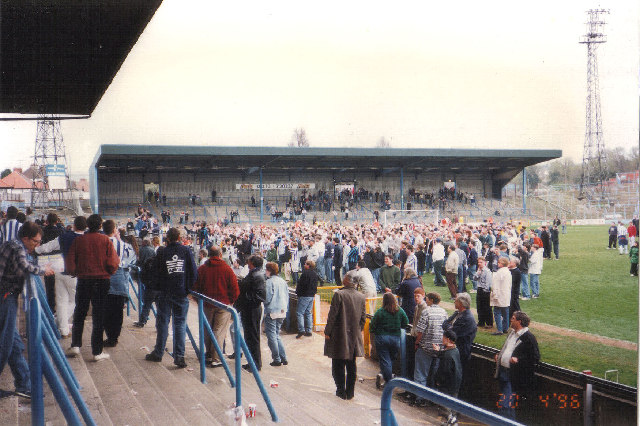
Stats at a Glance
- Team: Brighton & Hove Albion F.C.
- Location: Old Shoreham Road, Hove, East Sussex, England
- Opened: 1902 (first Brighton match)
- Final Match: 26 April 1997
- Demolished: 1997
- Record Attendance: 36,747 vs Fulham, 27 December 1958
- Final Capacity: 18,203
- Olympics Host: 1948 London Summer Olympics (football)
A Ground Built on Terraces and Tradition
The Goldstone Ground took shape gradually over the first half of the twentieth century. Early wooden stands gave way to more permanent structures, with the main West Stand largely completed in 1958 and floodlights installed in 1961. The North Stand terrace, erected in 1984, became the beating heart of Brighton’s most vocal supporters. Together, the stands gave the ground an intimate, characterful atmosphere that larger, purpose-built arenas often lacked. At its record capacity of 36,747 — set during a Third Division South match against Fulham on 27 December 1958 — the noise and intensity were described by those present as extraordinary. Brighton’s top-flight years from 1979 to 1983, including an FA Cup Final appearance in 1983, brought the biggest crowds of the modern era and cemented the ground’s status as a beloved institution.
Controversy, Closure, and What Came After
The Goldstone Ground’s end came amid bitter controversy. The club’s then-directors sold the freehold of the ground in 1995, triggering years of fan protests, pitch invasions, and boardroom upheaval. Brighton were forced to play their final season at the ground with the clock ticking, and on 26 April 1997 they defeated Doncaster Rovers 1–0 in the last match ever played there — a bittersweet farewell. The stadium was demolished shortly afterwards and the site redeveloped as the Goldstone Retail Park, anchored today by a Lidl supermarket. Brighton spent four years ground-sharing at Priestfield Stadium in Gillingham and then more than a decade at the modest Withdean Stadium before finally opening the American Express Stadium at Falmer in 2011. The Goldstone Ground is remembered not only for the football it hosted but as a rallying symbol for fan power in English football.
Explore more: Historic Stadiums Hub.
Goldstone Ground FAQs
When was Goldstone Ground demolished?
The Goldstone Ground was demolished in 1997, shortly after Brighton & Hove Albion played their final match there on 26 April 1997.
What stands on the Goldstone Ground site today?
The site was redeveloped into the Goldstone Retail Park, a shopping area that includes a Lidl supermarket, located on Old Shoreham Road in Hove.
Did David Beckham really make his professional debut at Goldstone Ground?
Yes. David Beckham came on as a substitute for Manchester United against Brighton in a League Cup match at the Goldstone Ground on 23 September 1992, making it the site of his first senior professional appearance.
Get More from Goldstone Ground
Log the coasters, stadiums, and venues you’ve experienced, rate Goldstone Ground, and see what your friends thought. Get the ThrillZing app.
Photo: Steve Daniels / CC BY-SA 2.0, via Wikimedia Commons.