
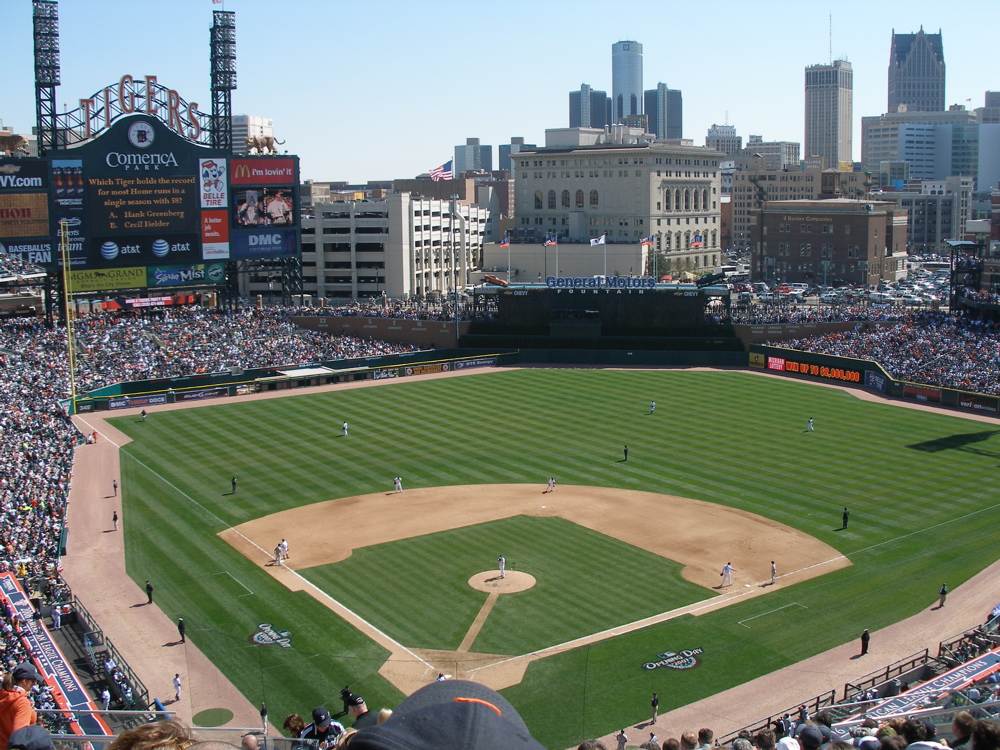
Comerica Park opened on April 11, 2000, at 2100 Woodward Avenue in downtown Detroit, Michigan, replacing the long-beloved Tiger Stadium as the home of the Detroit Tigers. Designed by Populous (then known as HOK Sport) alongside SHG Inc. and Rockwell Group, the ballpark was built in the retro-classic style that defined a wave of new MLB venues in the late 1990s and early 2000s, blending modern amenities with a nostalgic brick-and-steel aesthetic. Construction cost approximately $300 million.
Beyond baseball, Comerica Park became a civic landmark that anchored Detroit’s downtown revitalization, opening the same era as neighboring Ford Field. The stadium holds 41,083 fans and is instantly recognizable for the 15-foot tiger sculpture guarding its main entrance and eight additional heroic-sized tiger statues ringing the exterior. Inside, a Ferris wheel with baseball-shaped gondolas, a vintage carousel, and a center-field fountain give the park an entertainment personality that sets it apart from most MLB venues.
Stats at a Glance
- Team: Detroit Tigers (MLB)
- Location: 2100 Woodward Avenue, Detroit, Michigan
- Opened: April 11, 2000
- Capacity: 41,083
- Construction Cost: $300 million (approx. $561 million in 2025 dollars)
- Surface: Kentucky Bluegrass
- Architect: Populous / SHG Inc. / Rockwell Group
- Record Attendance: 45,280 (July 26, 2008 vs. Chicago White Sox)
A Pitcher-Friendly Gem in Downtown Detroit
In contrast to Tiger Stadium, which was historically regarded as one of baseball’s most hitter-friendly parks, Comerica Park was designed with spacious outfield dimensions that heavily favor pitchers. Center field stretches 412 feet from home plate, and the park’s asymmetrical layout creates challenging angles for batters. Those dimensions contributed to two no-hitters thrown at the park — one in 2007 and another in 2023 — underscoring its reputation as a place where pitching can dominate.
The park has also hosted some of baseball’s biggest stages. It was the site of the 2005 MLB All-Star Game and welcomed World Series games during both the Tigers’ 2006 and 2012 pennant-winning seasons, cementing its status as one of the American League’s premier venues.
More Than a Ballpark
Comerica Park offers attractions that make it a destination even for casual fans. The outfield Ferris wheel — a feature unique among MLB parks — gives riders elevated views of the field, while a historic carousel near the main concourse adds to the family-friendly atmosphere. Statues of Tigers legends including Ty Cobb, Hank Greenberg, Al Kaline, and other Hall of Famers line the concourse, turning a stroll through the park into a walk through Detroit baseball history.
The stadium underwent a significant scoreboard and video board upgrade in 2024, bringing state-of-the-art display technology to the left-field wall. Naming rights have been held by Comerica Bank since December 1998 under a deal extended through 2034, though a bank acquisition announced in late 2025 is expected to trigger a rebrand before the 2027 season.
Explore more: Stadiums hub.
For upper-deck seats. Watch line play at the stadium, or the far side of the park from the top of a lift hill.
Sherpa-lined and windproof, with a waterproof back for wet bleachers. Folds into its own pouch.
For late-season football, outdoor hockey and October park nights. Shake, pocket, and stay warm for hours.


Comerica Park FAQs
When did Comerica Park open?
Comerica Park opened on April 11, 2000, with the Detroit Tigers defeating the Seattle Mariners 5–2 before a crowd of 39,168 in the stadium’s inaugural game.
What is the seating capacity of Comerica Park?
Comerica Park has a seating capacity of 41,083, making it a mid-sized MLB ballpark. The record single-game attendance is 45,280, set on July 26, 2008, against the Chicago White Sox.
What makes Comerica Park unique among MLB stadiums?
Comerica Park is one of the only MLB parks to feature a full Ferris wheel and a carousel inside the stadium. It is also notable for its 15-foot tiger statue at the main entrance, extensive Hall of Fame player statues along the concourse, and a center-field fountain — all set against the backdrop of the downtown Detroit skyline.
Get More from Comerica Park
Log the coasters, stadiums, and venues you’ve experienced, rate Comerica Park, and see what your friends thought. Get the ThrillZing app.
Photo: User MJCdetroit on en.wikipedia / CC BY-SA 3.0, via Wikimedia Commons.