
Citi Field opened on April 13, 2009, in Flushing Meadows–Corona Park, Queens, New York City, replacing the long-serving Shea Stadium next door. Designed by Populous (then known as HOK Sport) at a cost of around $900 million, the ballpark became the permanent home of Major League Baseball’s New York Mets and quickly earned a reputation as one of the most fan-friendly venues in the sport.
The stadium’s design pays deliberate tribute to baseball’s past. Its main entrance, the Jackie Robinson Rotunda, echoes the landmark facade of the long-demolished Ebbets Field and features nine ideals associated with Robinson engraved into the floor. A reborn Home Run Apple rises in center field every time a Met goes deep, and a massive new video scoreboard installed before the 2023 season brought the viewing experience firmly into the modern era.
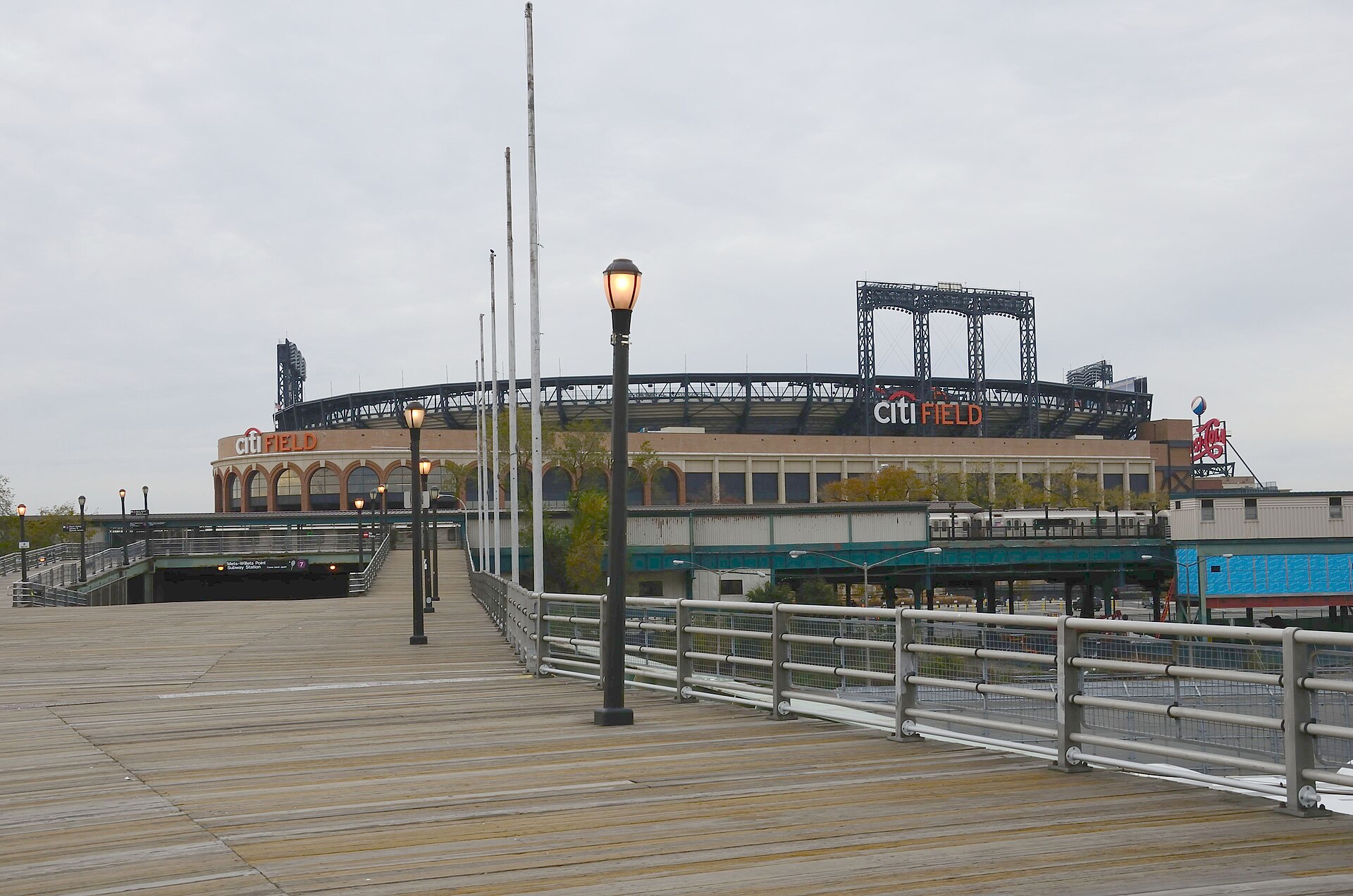
Stats at a Glance
- Team(s): New York Mets (MLB); New York City FC (MLS, part-time)
- Location: Flushing Meadows–Corona Park, Queens, New York City
- Opened: April 13, 2009
- Capacity: 41,922
- Architect: Populous (formerly HOK Sport)
- Surface: Natural grass (Kentucky Bluegrass)
- Naming Rights: Citigroup — $20 million per year, 20-year agreement
A Ballpark Built on Baseball History
From the moment fans pass through the Jackie Robinson Rotunda, Citi Field makes its reverence for the game’s heritage clear. The soaring brick-and-steel entrance was modeled on Ebbets Field, the beloved Brooklyn Dodgers home demolished in 1960, and the nine ideals Robinson stood for — courage, determination, teamwork, persistence, integrity, citizenship, justice, commitment, and excellence — are spelled out on the rotunda floor.
Beyond the entrance, the park rewards exploration. The Pepsi Porch in right field, inspired by Tiger Stadium’s famous overhanging deck, creates one of the most desirable home-run destinations in the majors. An interactive Mets museum just inside the Jackie Robinson Rotunda traces the franchise’s history, while the Taste of the City concourse brings New York’s food culture into every game day.
Landmark Moments at Citi Field
Citi Field’s first decade delivered several unforgettable chapters. On June 1, 2012, Johan Santana threw the first no-hitter in Mets franchise history against the St. Louis Cardinals — a moment that had eluded the club through 50-plus years and thousands of games. The following year the stadium hosted the 2013 MLB All-Star Game, drawing an attendance of 45,186, the highest on record for the venue.
The 2015 postseason brought the Mets back to the World Series for the first time since 2000, with Citi Field hosting Games 3, 4, and 5 against the Kansas City Royals. Though the Mets fell in five games, the three home contests gave the ballpark a place in October lore. Each year the venue also hosts major concerts and events, cementing its role as one of New York City’s premier large-scale gathering places.
Explore more: Explore more stadium guides.
A see-through purse that looks like a purse. Works for most stadium, arena and concert bag policies.
Bleachers for three hours, but with back support. Folds flat and clips to the bench.
For upper-deck seats. Watch line play at the stadium, or the far side of the park from the top of a lift hill.


Citi Field FAQs
When did Citi Field open?
Citi Field opened for its first regular-season game on April 13, 2009, when the New York Mets hosted the San Diego Padres. A college game was played there on March 29, 2009, and an exhibition game against the Boston Red Sox followed on April 3 before the official MLB opener.
What is the seating capacity of Citi Field?
Citi Field has a seating capacity of 41,922, a figure set after the stadium underwent dimension and seating adjustments ahead of the 2012 season. The record single-game attendance at the park is 45,186, set during the 2013 MLB All-Star Game.
What is the Jackie Robinson Rotunda at Citi Field?
The Jackie Robinson Rotunda is the grand main entrance of Citi Field, designed to evoke the historic Ebbets Field facade. The rotunda honors Hall of Famer Jackie Robinson with nine of his core values engraved on the floor, and a large portrait mosaic of Robinson greets visitors as they enter the ballpark.
Get More from Citi Field
Log the coasters, stadiums, and venues you’ve experienced, rate Citi Field, and see what your friends thought. Get the ThrillZing app.
Photo: LostplanetKD73 / CC0, via Wikimedia Commons.