
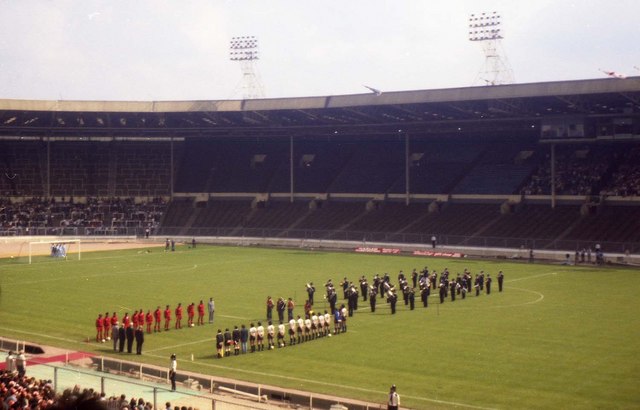
Built in just 300 days by Sir Robert McAlpine and formally opened on 28 April 1923, the original Wembley Stadium — officially named the Empire Stadium — stood as England’s premier sporting arena for eight decades. Designed by architects Sir John William Simpson and Maxwell Ayrton with structural engineering by Sir Owen Williams, the £750,000 ground in Wembley, London was originally conceived as a temporary showpiece for the British Empire Exhibition of 1924. A fateful decision to keep it permanent transformed what might have been rubble into one of sport’s most storied addresses.
The stadium’s iconic Twin Towers — 126-foot ferro-concrete spires whose domes drew on Mughal architectural tradition — defined the Wembley skyline for generations and earned Grade II listed status in 1976. At its greatest the ground held around 127,000 standing spectators, though its inaugural event, the 1923 FA Cup Final, reportedly drew over 200,000. From England’s only World Cup triumph in 1966 to the global spectacle of Live Aid in 1985, the original Wembley hosted history at every turn before its last match in October 2000 and demolition in 2002–2003.
Stats at a Glance
- Location: Wembley, London, England
- Opened: 28 April 1923
- Closed: 7 October 2000
- Demolished: 2002–2003
- Original Capacity: ~127,000 (standing)
- Final Capacity: 82,000 (all-seated, from 1990)
- Record Attendance: 126,047 (1923 FA Cup Final)
- Known For: White Horse Final, 1966 World Cup Final, Live Aid
The White Horse Final and a Chaotic Beginning
The original Wembley announced itself to the world in spectacular, chaotic fashion. On 28 April 1923 the first FA Cup Final held at the ground — Bolton Wanderers versus West Ham United — attracted an estimated crowd of more than 200,000 to a venue built for around 127,000. Spectators flooded the pitch, and mounted police struggled to restore order. It was PC George Scorey, riding a horse named Billy — often misremembered as white though actually grey — whose patient work clearing the field became the day’s defining image.
Bolton Wanderers won 2–0 in a match that proceeded only because of the extraordinary patience of the crowd. The ‘White Horse Final’ entered football folklore instantly, establishing Wembley’s capacity to hold, and shape, the nation’s biggest sporting moments from the very first day of its existence.
From the 1966 World Cup to Live Aid
Over eight decades the original Wembley bore witness to some of the twentieth century’s greatest events. On 30 July 1966, England defeated West Germany 4–2 in the FIFA World Cup Final before 96,924 spectators — the country’s only senior international football triumph to date. The stadium had already served as the centrepiece of the 1948 Summer Olympics and went on to stage five European Cup finals, UEFA Euro 1996 fixtures, and an unbroken run of FA Cup and League Cup deciders.
Beyond sport, Wembley became one of the world’s great concert venues. On 13 July 1985, it formed the UK centrepiece of Live Aid, Bob Geldof’s charity spectacular watched by an estimated 1.9 billion television viewers. Michael Jackson performed there 15 times — more than any other artist. The stadium held its final event in October 2000; demolition began in 2002 and the beloved Twin Towers fell in December of that year, closing the chapter on one of the world’s most recognisable arenas.
Explore more: Historic Stadiums.
Wembley Stadium (1923) FAQs
Why was the 1923 FA Cup Final called the ‘White Horse Final’?
The match attracted an estimated 200,000 people to a venue built for around 127,000, flooding the pitch and threatening to cancel the game. Police officer George Scorey, mounted on a horse named Billy — actually grey, though remembered as white — helped clear spectators back to the touchlines. The image became iconic, and the match has been known as the White Horse Final ever since.
When were the original Wembley Stadium’s Twin Towers demolished?
The Twin Towers were brought down in December 2002 as part of a demolition programme that had begun earlier that year. They had stood 126 feet (38 m) high since 1923 and held Grade II listed status since 1976, making their loss particularly controversial among preservationists. The remainder of the original stadium was cleared by 2003.
What was the largest crowd the original Wembley Stadium ever officially recorded?
The official record attendance was 126,047, set during the 1923 FA Cup Final. However, actual numbers that day were far higher — estimates put the crowd at well over 200,000 — as tens of thousands entered without tickets or streamed past overwhelmed turnstiles before the gates could be closed.
Get More from Wembley Stadium (1923)
log the coasters, stadiums, and venues you’ve experienced, rate Wembley Stadium (1923), and see what your friends thought. Get the ThrillZing app.
Photo: Merv Payne / CC BY-SA 2.0, via Wikimedia Commons.